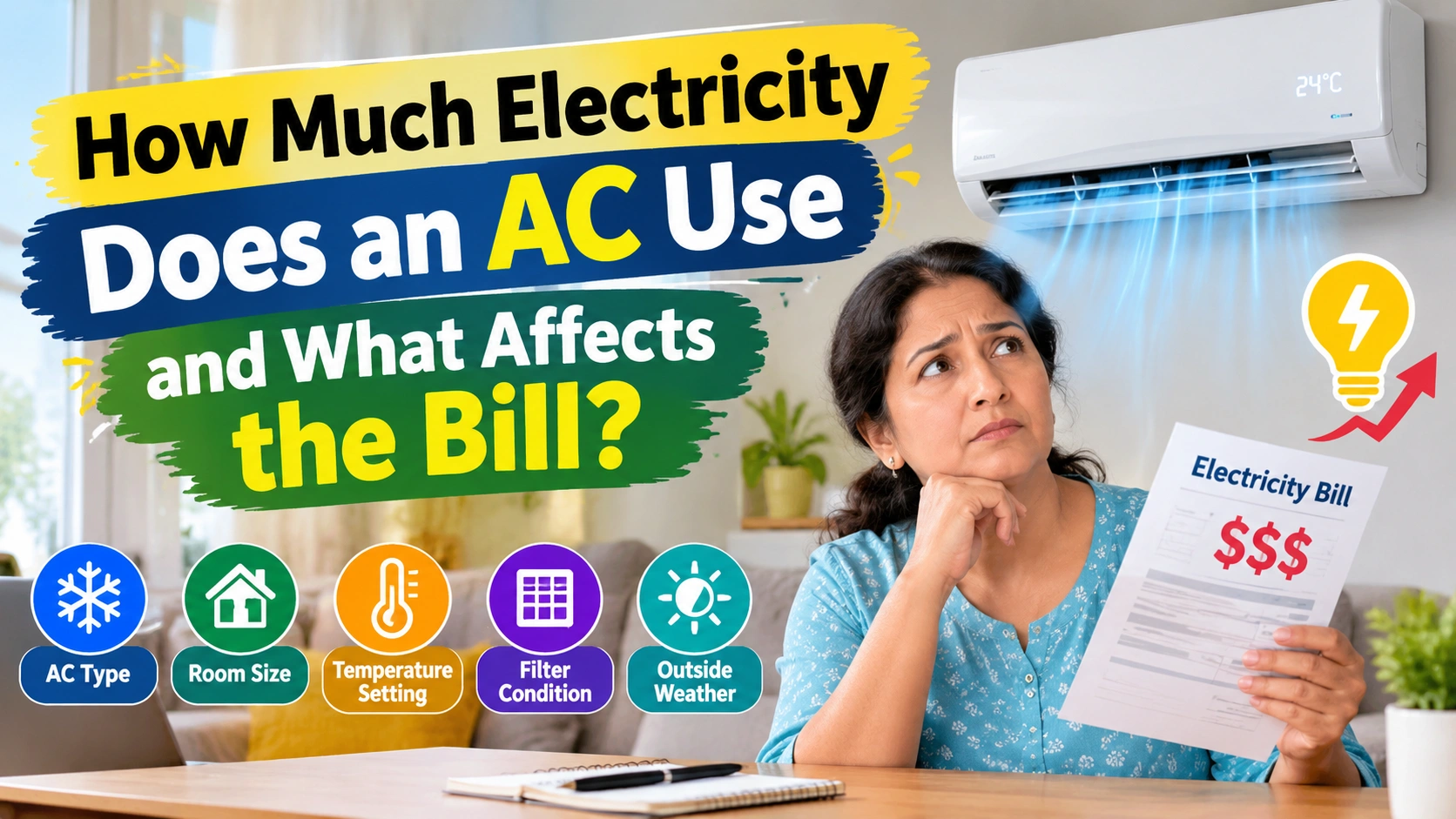
- What Is AC Electricity Consumption?
- How to Calculate AC Electricity Consumption
- Important Factors That Affect AC Electricity Consumption
- 1. AC Size Matters
- 2. Inverter and Non-Inverter ACs
- 3. Your Temperature Setting Makes a Difference
- 4. How Many Hours You Run the AC
- 5. Outside Weather Affects AC Power Use
- 6. Room Size and Insulation
- 7. Dirty Filters Can Increase Energy Use
- 8. AC Maintenance Is Important
- How Much Can an AC Add to Your Electricity Bill?
- How to Reduce AC Electricity Consumption
- Keep Doors and Windows Closed
- Use Curtains During Hot Hours
- Keep the Temperature Reasonable
- Clean the Filters
- Use Sleep or Timer Features
- Avoid Unnecessary Cooling
- Keep the Outdoor Unit Clear
- Service the AC When Needed
- AC Electricity Consumption: Inverter vs Non-Inverter
- Does a Higher Star Rating Mean Lower Electricity Consumption?
- Common Mistakes That Increase AC Electricity Consumption
- A Simple Monthly AC Electricity Check
- Read More
- Frequently Asked Questions
- 1. How much electricity does an AC use in one hour?
- 2. Does setting the AC at 24°C save electricity?
- 3. Does an inverter AC consume less electricity?
- 4. Does a dirty AC filter increase electricity consumption?
- 5. Does room size affect AC electricity consumption?
- 6. How can I reduce my AC electricity bill?
- 7. Is AC the biggest reason for a high electricity bill?
- Conclusion
An air conditioner can make a hot summer day much more comfortable. After coming home from the heat, switching on the AC and sitting in a cool room feels wonderful. But when the electricity bill arrives, that comfort can sometimes come with a surprise.
Many people ask the same question: How much electricity does an AC actually use?
The answer is not the same for every home. AC electricity consumption depends on many things, including the AC capacity, type of AC, room size, temperature setting, outside weather, usage hours, insulation, maintenance and even the condition of the air filter.
I have noticed that people often look only at the AC’s tonnage or star rating when thinking about electricity use. These things are important, but they are not the whole story.
“A small change in daily AC habits can make a noticeable difference to the monthly electricity bill.”
In this article, we will understand AC electricity consumption in simple terms and look at the things that can increase or reduce your bill.
What Is AC Electricity Consumption?
AC electricity consumption means the amount of electrical energy an air conditioner uses while running.
Electricity consumption is usually measured in kilowatt-hours (kWh). In everyday language, we usually call one kWh one unit of electricity.
For example, if an appliance uses 1,000 watts continuously for one hour, it uses about 1 kWh, or one unit.
However, an AC does not always consume the same amount of electricity. Modern inverter ACs can change their compressor speed depending on the cooling requirement. So their power use can go up and down during operation.
This is why the number written on an AC specification label should not be treated as an exact amount of electricity it will use every hour.
How to Calculate AC Electricity Consumption
A simple calculation can help you understand your AC’s electricity use.
Electricity Used = Power in kW × Hours of Use
For example, suppose an AC averages around 1.2 kW while operating and you use it for 8 hours.
1.2 × 8 = 9.6 kWh
So the AC could use around 9.6 units in that period under those conditions.
For 30 days:
9.6 × 30 = 288 units
But remember, this is only an example. Actual AC electricity consumption can be much lower or higher depending on the AC and the conditions in your home.
Your electricity bill also depends on your electricity tariff and other charges.
Important Factors That Affect AC Electricity Consumption
There is no single answer to how much electricity an AC will use. Several factors work together.
| Factor | How It Can Affect Electricity Use | What You Can Do |
|---|---|---|
| AC Capacity | An oversized or unsuitable AC may not operate efficiently | Choose the right capacity for the room |
| Inverter Technology | Can adjust compressor speed according to cooling demand | Consider an efficient inverter model |
| Temperature Setting | Very low settings can increase cooling demand | Use a comfortable moderate setting |
| Usage Hours | More hours generally mean more electricity use | Switch off when cooling is not needed |
| Room Size | A large room can require more cooling | Match AC capacity to room size |
| Outside Temperature | Very hot weather makes cooling harder | Keep windows and doors closed |
| Sunlight | Direct sunlight can heat the room | Use curtains or blinds |
| Air Filter | A dirty filter can reduce airflow | Clean filters regularly |
| Insulation | Poor insulation allows cooled air to escape | Improve sealing and insulation |
| Maintenance | A poorly maintained AC may work harder | Get regular servicing |
| Number of People | More people add heat to the room | Consider room occupancy |
| Appliances | Computers, TVs and lights also produce heat | Turn off unnecessary appliances |
1. AC Size Matters
One of the first things that affects AC electricity consumption is the size or cooling capacity of the AC.
A small AC installed in a large room may have to work very hard to maintain the desired temperature. On the other hand, an AC that is much larger than necessary may not always provide the most efficient operation.
Room size, ceiling height, sunlight, insulation and the number of people using the room should all be considered when choosing an AC.
The right AC capacity is more important than simply buying the biggest AC available.
2. Inverter and Non-Inverter ACs
The type of compressor can also affect electricity consumption.
Traditional non-inverter ACs generally operate the compressor in a simpler on-and-off manner. Inverter ACs can adjust compressor speed depending on the cooling requirement.
When the room reaches the desired temperature, an inverter AC can reduce its compressor speed instead of always operating at full power.
This does not mean every inverter AC will automatically use very little electricity. Efficiency depends on the particular model, usage conditions and installation.
Still, inverter technology can be useful for people who run their AC for several hours regularly.
3. Your Temperature Setting Makes a Difference
Temperature setting is another important part of AC electricity consumption.
Many people immediately set the AC to a very low temperature when they enter a hot room. But this does not necessarily mean the room will cool much faster.
A moderate temperature setting can provide comfortable cooling without demanding unnecessary cooling from the AC.
For everyday use, many households find a comfortable setting around 24°C to 26°C suitable, although the ideal temperature depends on personal comfort and conditions.
Instead of setting the AC extremely low, try finding a temperature that keeps everyone comfortable.
4. How Many Hours You Run the AC
This is one of the easiest factors to understand.
If you use your AC for two hours a day, your electricity consumption will generally be much lower than if you run it for ten hours every day.
For example, using an AC for:
4 hours × 30 days = 120 hours per month
while:
10 hours × 30 days = 300 hours per month
That is a big difference in operating time.
If you do not need cooling in an empty room, switching off the AC can help reduce unnecessary electricity use.
5. Outside Weather Affects AC Power Use
An AC has to remove heat from inside your room and release it outside.
When outdoor temperatures are extremely high, the cooling system may need to work harder.
This is why AC electricity consumption can be noticeably different between a mild summer day and an extremely hot afternoon.
The same AC may therefore consume different amounts of electricity on different days.
6. Room Size and Insulation
A room that holds cool air well is easier to cool than one where cool air constantly escapes.
Open doors, open windows, gaps around doors and poor insulation can allow cooled air to escape.
Similarly, direct sunlight through large windows can make a room much hotter.
Simple things such as closing curtains during strong sunlight and keeping doors and windows closed while the AC is running can help maintain indoor comfort.
7. Dirty Filters Can Increase Energy Use
The air filter inside an AC collects dust and other particles over time.
When the filter becomes dirty, airflow can become restricted. The AC may then have to work harder to provide the same level of cooling.
Cleaning the filter regularly is a simple maintenance habit.
How often the filter needs cleaning depends on usage, indoor dust and the manufacturer’s instructions.
A clean filter can also help maintain better airflow and indoor air quality.
8. AC Maintenance Is Important
Regular maintenance should not be ignored.
An AC has several parts that need to remain clean and in good working condition. Dust on filters, coils or other components can affect performance.
If the AC is not cooling properly, making unusual sounds or taking much longer than usual to cool the room, it may need professional inspection.
Do not wait for the electricity bill to become very high before checking an AC that is not working normally.
Read More: 7 Smart Air Purifier Buying Guide India Tips for Cleaner and Fresher Home Air
How Much Can an AC Add to Your Electricity Bill?
This depends on the AC’s actual power consumption, how long it runs, your electricity tariff and the rest of your home’s electricity usage.
For a simple example, imagine an AC averages 1 kW while operating.
If it runs for 8 hours a day:
1 kW × 8 hours = 8 units per day
For 30 days:
8 × 30 = 240 units per month
If your effective electricity cost were ₹8 per unit, the simple energy cost would be:
240 × ₹8 = ₹1,920
But this is only an example. Real-world AC consumption varies, and electricity tariffs can include different slabs, fixed charges, taxes and other components.
So your final bill will not necessarily equal this simple calculation.
How to Reduce AC Electricity Consumption
You do not always need to stop using your AC to save electricity. Small changes can help.
Keep Doors and Windows Closed
When the AC is running, keep doors and windows properly closed.
Otherwise, cool air can escape and warm air can enter continuously.
Use Curtains During Hot Hours
Sunlight can heat up your room significantly.
Curtains, blinds or suitable window coverings can reduce direct sunlight and help keep the room more comfortable.
Keep the Temperature Reasonable
Avoid setting the AC unnecessarily low.
A comfortable moderate temperature can reduce the cooling load compared with trying to make the room extremely cold.
Clean the Filters
Check the AC filter regularly and clean it according to the manufacturer’s instructions.
This is one of the simplest maintenance habits.
Use Sleep or Timer Features
If your AC has a sleep mode or timer, you can use it when appropriate.
There is no need to keep the AC running all night at the same settings if cooling is no longer required.
Avoid Unnecessary Cooling
If nobody is using a room, there may be little reason to keep the AC running continuously.
Turn it off when you leave for a longer period.
Keep the Outdoor Unit Clear
The outdoor unit needs proper airflow.
Do not block it with objects or cover its ventilation areas. Keep the area around it reasonably clean and unobstructed.
Service the AC When Needed
Regular professional maintenance can help keep the system operating properly.
If you notice unusual cooling performance, water leakage, strange sounds or other problems, get it checked.
AC Electricity Consumption: Inverter vs Non-Inverter
The choice between inverter and non-inverter AC depends on your usage and the specific models you are comparing.
| Feature | Inverter AC | Non-Inverter AC |
|---|---|---|
| Compressor Operation | Variable speed | Mainly fixed-speed operation |
| Cooling Control | Adjusts according to demand | Turns compressor on and off |
| Long Usage | Can be suitable for regular long use | May consume more depending on conditions |
| Initial Cost | Often higher | Often lower |
| Electricity Use | Depends on model and usage | Depends on model and usage |
| Best Comparison Method | Check efficiency and specifications | Check efficiency and specifications |
The most useful thing is not to judge an AC only by whether it is inverter or non-inverter.
Look at the actual efficiency information, capacity, usage pattern and expected operating conditions.
Does a Higher Star Rating Mean Lower Electricity Consumption?
Energy ratings can be useful when comparing AC models.
A more efficient AC can potentially provide the required cooling with less electricity under comparable conditions.
However, the actual electricity bill still depends on how long you use the AC, the temperature setting, weather, room conditions and other factors.
So, when buying an AC, consider both the purchase price and expected running cost.
Common Mistakes That Increase AC Electricity Consumption
Some everyday habits can increase electricity use without us noticing.
Setting the AC extremely low is one common mistake.
Another is leaving doors or windows open while the AC is running.
A dirty filter can also reduce airflow.
Using an AC in a room with strong direct sunlight and poor insulation can increase cooling demand.
Finally, buying an AC that is not suitable for the room can create problems with both comfort and energy use.
A Simple Monthly AC Electricity Check
If you want to understand your own AC electricity consumption, keep a small record.
Write down:
- AC running hours per day
- AC model and rated power
- Temperature setting
- Approximate room size
- Monthly electricity meter reading
- Electricity units used
- Outdoor weather conditions
After a few weeks, you can compare your usage.
This can help you understand your household’s actual pattern instead of relying only on general estimates.
“Your own electricity meter is often the best way to understand your home’s real energy use.”
Read More
For more useful home and electricity-saving information, you can also read:
- How Much Electricity Does a Refrigerator Use at Home?
- Room Heater vs Oil-Filled Radiator: Which Suits Indian Winters?
- Summer Bedroom Setup for Better Airflow and Less Heat Build-Up
- How to Reduce Electricity Consumption at Home
- Energy-Saving Tips for Indian Homes
Frequently Asked Questions
1. How much electricity does an AC use in one hour?
It depends on the AC’s power consumption, capacity, efficiency and operating conditions. An AC may use different amounts of electricity during different parts of its operation, especially an inverter model.
2. Does setting the AC at 24°C save electricity?
A moderate setting such as 24°C can be more practical than setting the AC extremely low. Actual savings depend on the AC, room conditions, outdoor temperature and usage time.
3. Does an inverter AC consume less electricity?
An inverter AC can adjust compressor speed according to cooling demand and may use less electricity under suitable conditions. Actual consumption depends on the model and how it is used.
4. Does a dirty AC filter increase electricity consumption?
A dirty filter can restrict airflow and reduce cooling performance. This can make the AC work harder, so regular filter cleaning is an important maintenance step.
5. Does room size affect AC electricity consumption?
Yes. The room size and conditions affect the amount of cooling required. An AC that is not properly matched to the room may have difficulty maintaining comfortable temperatures efficiently.
6. How can I reduce my AC electricity bill?
You can reduce unnecessary electricity use by using a reasonable temperature setting, keeping doors and windows closed, cleaning filters, using curtains against strong sunlight, maintaining the AC and switching it off when cooling is not needed.
7. Is AC the biggest reason for a high electricity bill?
It can be a major contributor in homes where the AC is used for many hours, especially during hot weather. However, the total bill also includes electricity used by refrigerators, fans, water heaters, washing machines, lighting, computers and other appliances.
Conclusion
Understanding AC electricity consumption can help you make better decisions about your cooling habits and your electricity bill.
An AC does not have one fixed electricity cost for every home. Its consumption depends on the AC model, efficiency, room size, temperature setting, usage hours, outdoor weather, insulation, maintenance and several other factors.
The good news is that many of these factors are within our control.
Simple habits such as keeping filters clean, closing doors and windows, using curtains, choosing a comfortable temperature and avoiding unnecessary cooling can make a difference over time.
If you are planning to buy a new AC, do not look only at the purchase price. Check its efficiency information, cooling capacity and expected running cost as well.
Most importantly, remember that comfort and energy saving can go together.
The goal is not to stop using your AC. The goal is to use it wisely.
Want a professional website designed for your business or blog?
Visit eDigitalized for website design and development services.
Need help or support?
Visit our Contact Us page and get in touch with us.
Want to become a blogger and start your own blog?
Visit WP Bazaar for blogging resources, tools, and helpful guides.

How this guide was prepared
This guide is prepared for everyday readers using practical research, usability checks and editorial review. Product-specific claims should be verified against manufacturer instructions before purchase.
- Reviewed: September 22, 2026
- Next review target: March 22, 2027
- Read our Editorial Policy · Request a correction
How did you like this article?
Your feedback helps us make our stories more useful.

Shweta Pandey
My name is Shweta Pandey, I work as a content writer and I love to write articles. With 4 years of blogging experience I am always ready to inspire others and share knowledge to make them a successful blogger.
Related Articles
 Bills & Utilities
12 Simple Summer Electricity Bill Tips For AC, Fans and Refrigerator
Summer is a lovely season in many ways, but there is one thing I do not enjoy seeing in summer — the…
 Bills & Utilities
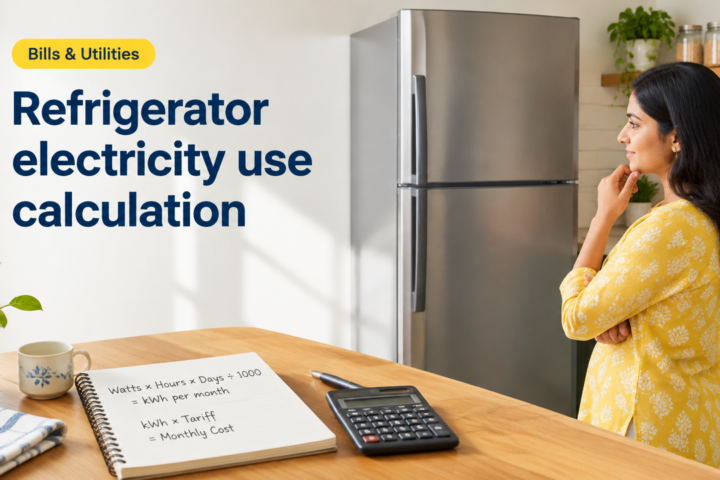
Refrigerator Electricity Use Calculation: How to Estimate Monthly Power Cost in India
Step-by-step guide to calculate how much electricity your fridge uses each month (watts × hours × days ÷ 1000), a worked example…
Join the Discussion
Join the conversation and share a useful tip or experience.