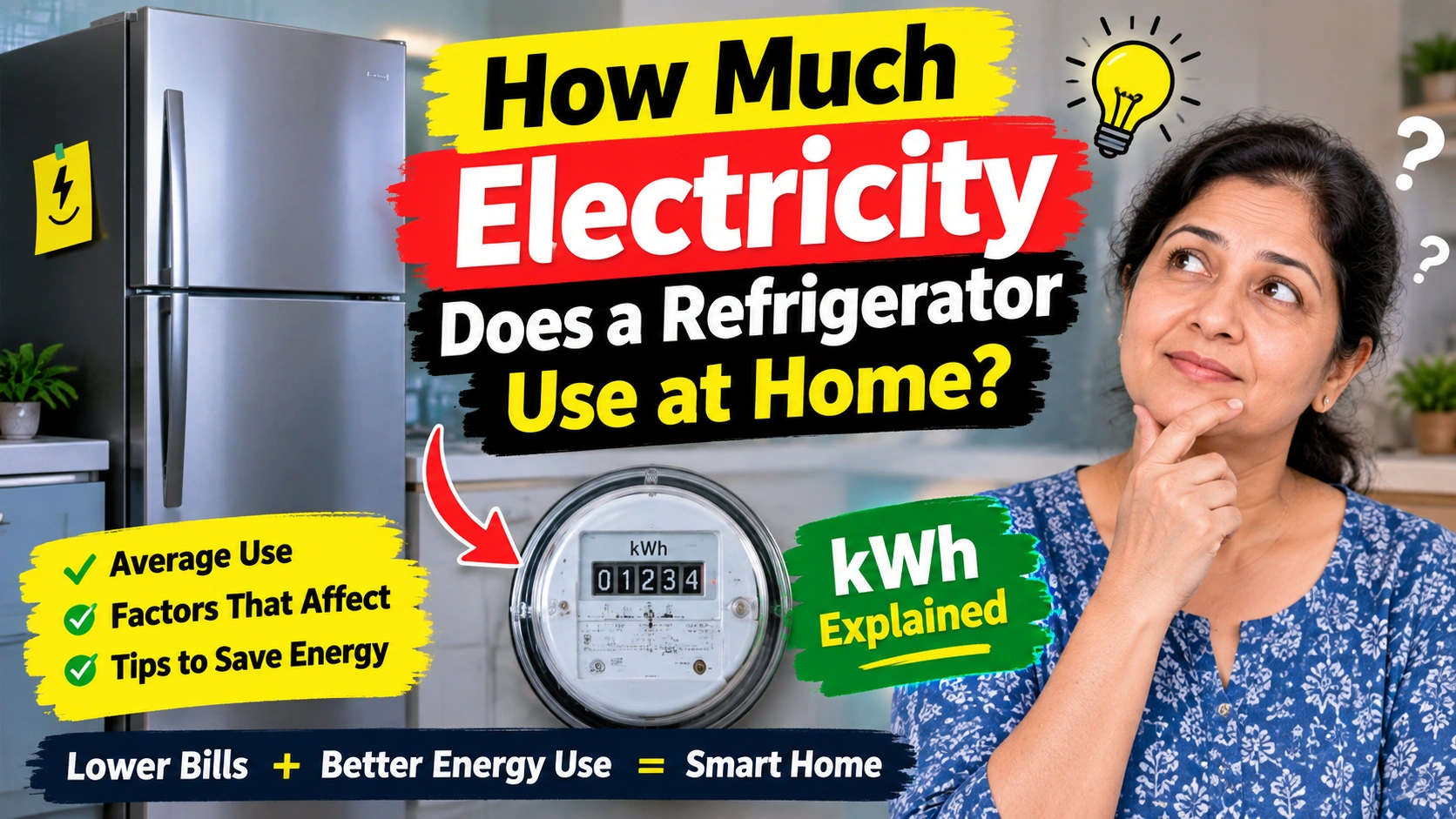
- How Much Electricity Does a Refrigerator Use?
- What Does kWh Mean?
- Refrigerator Electricity Consumption: A Simple Example
- How to Calculate Refrigerator Electricity Consumption
- Simple Calculation Table
- Does a Refrigerator Use Electricity 24 Hours a Day?
- Why Does Refrigerator Electricity Consumption Change?
- 1. Refrigerator Size
- 2. Age of the Refrigerator
- 3. Room Temperature
- 4. Door Opening
- 5. Hot Food
- 6. Temperature Setting
- 7. Door Seal Condition
- Does an Old Refrigerator Use More Electricity?
- How Can I Check My Refrigerator's Electricity Use?
- Simple Ways to Reduce Refrigerator Electricity Consumption
- Keep the Door Closed
- Do Not Overfill It
- Do Not Leave It Nearly Empty
- Clean the Door Gasket
- Keep Space Around the Refrigerator
- Keep It Away From Heat
- Let Food Cool Before Storage
- Check the Temperature
- Keep the Refrigerator Clean
- Refrigerator Electricity Consumption in Summer vs Winter
- Does an Energy-Efficient Refrigerator Really Save Electricity?
- Important Refrigerator Electricity Information
- Refrigerator Wattage vs Actual Electricity Consumption
- Should You Switch Off Your Refrigerator at Night?
- What About Inverter Refrigerators?
- A Simple Monthly Electricity Check
- Common Mistakes That Increase Refrigerator Electricity Consumption
- Frequently Asked Questions
- 1. How much electricity does a refrigerator use per month?
- 2. Does a refrigerator run all day?
- 3. Does opening the refrigerator door increase electricity use?
- 4. Does refrigerator electricity consumption increase in summer?
- 5. How can I reduce refrigerator electricity consumption?
- 6. Is an inverter refrigerator more energy efficient?
- 7. How can I know exactly how much electricity my refrigerator uses?
- Conclusion
A refrigerator is one of those home appliances that we usually keep running without thinking much about it. It works day and night, during summer and winter, whether we are at home or away for a few days. But have you ever wondered, how much electricity does a refrigerator use at home?
I started thinking about this when I noticed that my electricity bill was slowly going up. We usually blame the fans, air conditioner, geyser, washing machine, or lights. But the refrigerator is also running almost 24 hours a day.
The good thing is that a refrigerator normally does not use its full rated power all the time. The compressor switches on and off according to the cooling requirement. Still, because the refrigerator works throughout the day, its electricity use can add up over a month.
In this article, I will explain refrigerator electricity consumption in simple words. We will look at how much electricity a refrigerator may use, how to calculate the cost, what affects electricity use, and what simple things we can do to save power.
As I always say, “Small changes at home can make a big difference to the monthly electricity bill.”
How Much Electricity Does a Refrigerator Use?
The electricity used by a refrigerator depends on its size, age, technology, temperature setting, room temperature, usage, and energy efficiency.
A modern household refrigerator may commonly use somewhere around 200 to 800 kWh of electricity in a year, depending on the model and how it is used. Some efficient smaller refrigerators may use less, while large refrigerators, older models, or refrigerators working in very hot conditions may use more.
This means a refrigerator might use roughly 17 to 67 kWh per month as a simple yearly-average range.
However, these are general figures. Your actual refrigerator electricity consumption can be different.
The best way to know the electricity use of your particular refrigerator is to check its energy label, manual, manufacturer’s specifications, or measure it with a suitable electricity meter.
What Does kWh Mean?
When we talk about electricity bills, we normally see kWh, which means kilowatt-hour.
One kWh is commonly called one unit of electricity on an electricity bill.
For example, if an appliance uses 1,000 watts for one hour, it uses 1 kWh.
A refrigerator is different because its compressor does not usually run continuously. It switches on when cooling is needed and switches off after reaching the required temperature.
So, looking only at the watt number written on the refrigerator does not always tell us the actual monthly electricity consumption.
Refrigerator Electricity Consumption: A Simple Example
Let us take a simple example.
Suppose a refrigerator has an average electricity use of 1 kWh per day.
In 30 days:
1 kWh × 30 days = 30 kWh
So the refrigerator would use about 30 units of electricity per month.
If your electricity rate were ₹8 per unit, the approximate electricity cost would be:
30 × ₹8 = ₹240 per month
This is only an example. Electricity rates vary by location, electricity provider, tariff category, and usage slab.
If the refrigerator uses 1.5 kWh per day:
1.5 × 30 = 45 kWh per month
At ₹8 per unit:
45 × ₹8 = ₹360 per month
This shows why knowing the actual refrigerator electricity consumption can be useful.
How to Calculate Refrigerator Electricity Consumption
If you know the average daily electricity use, the calculation is quite simple.
Monthly electricity use = Average daily electricity use × Number of days
For example:
0.8 kWh × 30 days = 24 kWh per month
For yearly use:
Daily electricity use × 365 days = Yearly electricity consumption
So:
0.8 × 365 = 292 kWh per year
You can then multiply the yearly or monthly consumption by your electricity cost per unit.
Simple Calculation Table
| Information | Example |
|---|---|
| Average daily use | 0.8 kWh |
| Days in month | 30 |
| Monthly consumption | 24 kWh |
| Electricity price | ₹8/unit |
| Approx. monthly cost | ₹192 |
| Approx. yearly consumption | 292 kWh |
| Approx. yearly cost | ₹2,336 |
These numbers are only for understanding the calculation. Your actual refrigerator electricity consumption may be higher or lower.
Does a Refrigerator Use Electricity 24 Hours a Day?
Yes, the refrigerator remains connected to electricity and is available to operate 24 hours a day.
But this does not mean that the compressor runs continuously for 24 hours.
The compressor normally turns on when the refrigerator needs cooling and turns off after the temperature reaches the desired level.
This is why a refrigerator rated at a certain wattage does not simply use that many watts every minute of every day.
The compressor may run more often when the kitchen is hot, when the door is opened repeatedly, or when warm food is placed inside.
Read More: Diwali Cleaning Checklist: 7-Day Room-by-Room Plan for a Happy, Beautiful & Stress-Free Home
Why Does Refrigerator Electricity Consumption Change?
There are several reasons why two refrigerators of similar size can use different amounts of electricity.
1. Refrigerator Size
A larger refrigerator usually has more space to cool.
A large double-door or multi-door refrigerator can therefore have different electricity needs compared with a small single-door model.
However, size is not the only thing that matters. Modern energy-efficient refrigerators can sometimes use electricity very effectively.
2. Age of the Refrigerator
Older refrigerators can consume more electricity, especially if they have an old compressor, damaged door seals, poor insulation, or other problems.
This does not mean every old refrigerator is inefficient. The actual condition of the appliance matters.
3. Room Temperature
This is particularly important during hot Indian summers.
When the kitchen becomes very hot, the refrigerator may need to work harder to maintain the temperature inside.
That can increase refrigerator electricity consumption.
4. Door Opening
Opening the refrigerator door again and again allows cold air to escape.
The refrigerator then needs to cool the inside again.
Opening the door occasionally is normal, of course. But leaving the door open for a long time or frequently checking the refrigerator can increase energy use.
5. Hot Food
Putting very hot food directly inside the refrigerator can increase the cooling load.
It is generally better to allow freshly cooked food to cool appropriately before storing it, while also following safe food-storage practices.
6. Temperature Setting
Keeping the refrigerator much colder than necessary can increase electricity consumption.
It is better to follow the manufacturer’s recommended temperature settings rather than making the refrigerator unnecessarily cold.
7. Door Seal Condition
The rubber gasket around the refrigerator door helps keep cold air inside.
If the gasket is loose, cracked, dirty, or damaged, cold air can escape.
The compressor may then need to run more frequently.
Does an Old Refrigerator Use More Electricity?
It can.
An older refrigerator may have less efficient technology than a newer energy-efficient model. It may also have worn-out parts or damaged seals.
If you have an old refrigerator and notice that it runs almost continuously, makes unusual sounds, does not cool properly, or causes other problems, it may be worth having it checked by a qualified technician.
But I would not recommend replacing a refrigerator only because it is old. First, consider its electricity use, condition, repair needs, and the cost of a replacement.
Sometimes a simple repair or replacement of a worn door gasket can solve an energy problem.
How Can I Check My Refrigerator’s Electricity Use?
There are several ways to estimate refrigerator electricity consumption.
The first is to check the manufacturer’s energy information. Some refrigerators provide an estimated annual electricity consumption figure.
Another option is to use an appropriate electricity monitoring device that can measure the energy used by the appliance over several days.
This can give you a much better idea of actual consumption because refrigerators cycle on and off.
A short measurement of a few minutes may not tell you much. Measuring over several days can provide a more useful average.
Simple Ways to Reduce Refrigerator Electricity Consumption
You do not need to do anything complicated to save electricity.
Keep the Door Closed
Try to decide what you need before opening the refrigerator.
“The less time the door stays open, the less cold air escapes.”
Do Not Overfill It
A refrigerator needs proper airflow to cool food evenly.
Do not pack everything tightly into every corner.
Do Not Leave It Nearly Empty
At the same time, a refrigerator that is almost empty may not operate in the same way as one that has a reasonable amount of stored food.
The main point is to keep the refrigerator reasonably organized rather than constantly overloading or leaving it completely empty.
Clean the Door Gasket
Wipe the rubber door seal regularly.
If you notice that it is damaged or does not close properly, consider getting it checked.
Keep Space Around the Refrigerator
Do not push the refrigerator tightly against the wall if the manufacturer recommends leaving space around it.
Good airflow around the appliance helps heat escape from the cooling system.
Keep It Away From Heat
If possible, keep the refrigerator away from direct sunlight, a cooking stove, or another strong heat source.
A cooler surrounding area can help the refrigerator work more comfortably.
Let Food Cool Before Storage
Do not put steaming-hot food directly into the refrigerator.
Allow it to cool appropriately before storing it.
Check the Temperature
Do not keep the refrigerator colder than necessary.
Use the manufacturer’s recommended settings.
Keep the Refrigerator Clean
Dust and dirt around accessible ventilation or condenser areas can affect performance on some refrigerator designs.
Follow the cleaning instructions in your refrigerator manual.
Refrigerator Electricity Consumption in Summer vs Winter
Electricity consumption can change with the season.
During hot weather, especially in parts of India where temperatures can become very high, a refrigerator may need to work harder.
During cooler weather, the cooling system may not need to operate as frequently.
This is one reason why you may notice a difference in refrigerator electricity consumption between summer and winter.
Of course, the difference depends on your refrigerator, indoor temperature, settings, and how often the door is opened.
Does an Energy-Efficient Refrigerator Really Save Electricity?
Yes, an energy-efficient refrigerator can use less electricity than a less efficient model of similar size and features.
When buying a new refrigerator, do not look only at the purchase price.
Look at the energy information and expected electricity consumption as well.
A refrigerator is an appliance that can stay in your home for many years. Even a small difference in yearly electricity use can add up over its lifetime.
At the same time, the most efficient model is not automatically the right choice for every family. Consider the size, storage requirements, features, purchase price, and expected electricity consumption together.
Important Refrigerator Electricity Information
| Topic | What to Remember |
|---|---|
| Electricity unit | 1 kWh is commonly counted as 1 unit |
| Daily use | Depends on model and conditions |
| Monthly use | Can vary widely between refrigerators |
| Main power user | The compressor and related cooling system |
| Summer use | Can increase in hot conditions |
| Door opening | Frequent or long opening can increase cooling work |
| Door gasket | A damaged seal can waste energy |
| Temperature | Avoid unnecessarily cold settings |
| Refrigerator size | Larger models may require more electricity |
| Age | Older or poorly maintained units may consume more |
| Best way to check | Measure over several days or check manufacturer data |
| Energy saving | Good placement, proper temperature, and maintenance help |
Refrigerator Wattage vs Actual Electricity Consumption
This is something that confuses many people.
Suppose you see a refrigerator with a particular watt rating.
You might think:
Wattage × 24 hours × 30 days = monthly consumption
But this can overestimate actual consumption because the compressor normally does not run continuously.
For example, if a compressor draws 150 watts while operating, that does not mean it necessarily draws 150 watts for all 24 hours.
The compressor cycles depending on the cooling requirement.
That is why average energy consumption over time is more useful than simply looking at the maximum running wattage.
Should You Switch Off Your Refrigerator at Night?
Normally, a household refrigerator is designed to operate continuously.
Switching it off every night is not a good general method for saving electricity because the food needs to remain at a safe temperature.
A refrigerator is different from appliances such as lights or fans that can simply be switched off when not needed.
If you are going away for an extended period, follow the manufacturer’s instructions for handling the refrigerator rather than simply unplugging it without planning.
What About Inverter Refrigerators?
Inverter refrigerators use variable-speed compressor technology.
Instead of simply running at one fixed speed and switching completely off, an inverter compressor can adjust its operation according to the cooling requirement.
This can help improve efficiency and reduce unnecessary power use, although the actual electricity consumption depends on the specific refrigerator and conditions.
When comparing models, look at the manufacturer’s stated energy consumption rather than assuming that every inverter refrigerator will use the same amount of electricity.
A Simple Monthly Electricity Check
If you are curious about your own refrigerator, try this simple method.
First, check the annual electricity consumption information for your refrigerator if it is available.
Then divide it by 12 to get a rough monthly average.
For example:
300 kWh per year ÷ 12 = 25 kWh per month
If your electricity rate is ₹8 per unit:
25 × ₹8 = ₹200 per month
This is an easy way to understand the possible contribution of the refrigerator to your electricity bill.
Remember that the actual bill impact can change depending on your tariff and your home’s total electricity consumption.
Common Mistakes That Increase Refrigerator Electricity Consumption
Sometimes we increase energy use without realizing it.
One common mistake is keeping the refrigerator door open while deciding what to cook.
Another is placing the refrigerator right next to a hot stove.
Some people also ignore a loose door gasket for months.
Another mistake is setting the refrigerator extremely cold because they think colder always means better.
Overloading the refrigerator can also make it harder for cold air to move properly.
Small habits may not look important individually, but together they can affect refrigerator electricity consumption.
Frequently Asked Questions
1. How much electricity does a refrigerator use per month?
It depends on the refrigerator’s size, efficiency, age, temperature, room conditions, and usage. A household refrigerator may use roughly 17–67 kWh per month in some cases, but actual consumption can be outside this range.
2. Does a refrigerator run all day?
The refrigerator stays connected all day, but its compressor normally cycles on and off. It does not usually operate at its full running power continuously for 24 hours.
3. Does opening the refrigerator door increase electricity use?
Yes, frequent or prolonged door opening allows cold air to escape. The refrigerator then needs to remove the additional heat and restore the desired temperature.
4. Does refrigerator electricity consumption increase in summer?
It can. Higher surrounding temperatures can make the refrigerator work harder to maintain its internal temperature.
5. How can I reduce refrigerator electricity consumption?
Keep the door closed as much as possible, maintain the door gasket, use suitable temperature settings, keep good airflow around the appliance, avoid placing it near strong heat, and keep it clean according to the manufacturer’s instructions.
6. Is an inverter refrigerator more energy efficient?
An inverter compressor can adjust its operation according to cooling demand and may improve efficiency. However, actual electricity consumption depends on the particular model and how it is used.
7. How can I know exactly how much electricity my refrigerator uses?
Check the manufacturer’s energy information or use a suitable electricity monitoring device over several days. A longer measurement gives a more useful picture than checking power for only a few minutes.
Conclusion
A refrigerator may look like a small part of our electricity bill, but it is one of the few household appliances that remains connected and ready to operate throughout the day.
Understanding refrigerator electricity consumption can help us make better choices.
The exact electricity use depends on many things, including refrigerator size, age, efficiency, room temperature, door opening, temperature settings, and maintenance.
The good news is that many energy-saving habits are very simple.
Keep the door closed when possible. Do not place the refrigerator beside a hot appliance. Check the door gasket. Keep the recommended temperature. Make sure there is enough airflow around the refrigerator. And when buying a new model, look at its expected energy consumption instead of checking only its price.
I have learned that saving electricity is not always about making huge changes. Sometimes it is simply about using the appliances we already have a little more carefully.
“A small saving every day can become a meaningful saving over a whole year.”
Want a professional website designed for your business or blog?
Visit eDigitalized for website design and development services.
Need help or support?
Visit our Contact Us page and get in touch with us.
Want to become a blogger and start your own blog?
Visit WP Bazaar for blogging resources, tools, and helpful guides.

How this guide was prepared
This guide is prepared for everyday readers using practical research, usability checks and editorial review. Product-specific claims should be verified against manufacturer instructions before purchase.
- Reviewed: September 19, 2026
- Next review target: March 19, 2027
- Read our Editorial Policy · Request a correction
How did you like this article?
Your feedback helps us make our stories more useful.

Shweta Pandey
My name is Shweta Pandey, I work as a content writer and I love to write articles. With 4 years of blogging experience I am always ready to inspire others and share knowledge to make them a successful blogger.
Related Articles
 Cleaning
The Ultimate Daily Home Cleaning Checklist for a Spotless, Tidy Home
A daily home cleaning checklist does not always require hours of scrubbing, organizing, and washing. In most cases, the secret to maintaining…
 Home & Living
Home Ventilation Checklist for Changing Indian Seasons
A step-by-step home ventilation checklist for India to improve airflow, control humidity and maintain indoor comfort across summer, monsoon and winter—plus a…
Join the Discussion
Join the conversation and share a useful tip or experience.