- Quick Action — Practical Summary
- Who this guide is for
- How to calculate refrigerator electricity use (the method)
- Method A — Use the appliance nameplate (watts) and runtime
- Method B — Use the BEE label annual energy consumption
- Method C — Measure directly with an energy meter
- Worked mini-example (step-by-step)
- Factors that increase your refrigerator’s monthly power cost
- Action checklist — Practical steps to lower fridge power use (printable)
- When to measure vs when to replace
- Using an energy meter: quick guide
- Common mistakes
- Next step
- Conclusion
- Frequently Asked Questions
- 7 Powerful & Worry-Free Facts: How Much Electricity Does a Refrigerator Use at Home?
- Use this plan in your own home
Updated/Reviewed: 15 October 2026
Short answer: Use the simple formula watts × hours per day × days ÷ 1000 to get kWh per month, then multiply by your electricity tariff (INR per kWh). For a more accurate number, read the fridge’s BEE annual energy consumption or measure with a plug-in energy meter.
Quick Action — Practical Summary
- First step: Find either the fridge’s input power (watts), the nameplate current (amps), or the BEE label annual kWh. If unsure, use a plug-in energy meter.
- Time estimate: 5–20 minutes to read the label or your meter; 1–2 hours if you measure duty cycle across a day.
- Tools/materials: appliance nameplate, electricity bill (to check tariff), plug-in energy meter (optional), pen and paper or calculator.
- Decision rule: If you want an accurate monthly cost, use either the BEE annual kWh (divide by 12) or measure with an energy meter. Use watts×hours only as an estimate when you know actual running hours.
Who this guide is for
This is for Indian households who want to: estimate how much their refrigerator is adding to the monthly electricity bill, compare models before buying, or lower running costs. It explains the maths, offers a worked example with a sample tariff, lists factors that raise costs, and gives a printable checklist of practical steps.
How to calculate refrigerator electricity use (the method)
There are three common ways to estimate monthly fridge energy use. Pick the one that fits the information you have.
Method A — Use the appliance nameplate (watts) and runtime
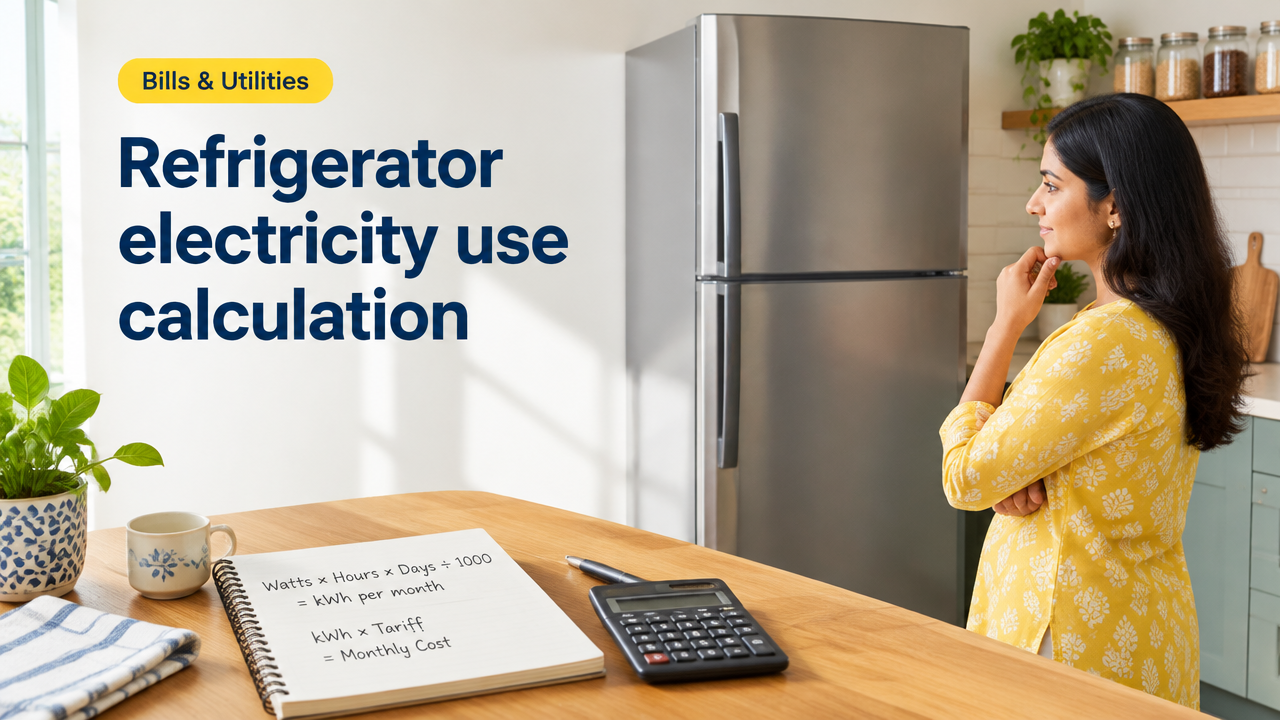
Formula: watts × hours per day × days in month ÷ 1000 = kWh per month.
Then: kWh × your tariff (INR per kWh) = monthly cost.
If you only have current (amps) and supply voltage, convert to watts: watts = volts × amps. Example: 230V × 0.8A ≈ 184W (approx input power).
Method B — Use the BEE label annual energy consumption
Many new fridges show an estimated annual consumption (kWh/year) on the Bureau of Energy Efficiency (BEE) label. Divide that by 12 for a monthly estimate, then multiply by your tariff.
Method C — Measure directly with an energy meter
Use a plug-in energy meter (available online/in stores) between the fridge plug and socket for a few days to a week. The meter shows kWh used — multiply or average for monthly estimate. This is the most accurate practical method for a specific unit and home environment.
Worked mini-example (step-by-step)
Example A (using watts and runtime) — assumptions clearly shown:
- Fridge input power listed or measured: 120 W (this may be the compressor running power, not the start/watt spike)
- Average actual running time (compressor on) per day: 8 hours (this is an estimate; real runtime depends on ambient temperature and usage)
- Days in month: 30
- Electricity tariff used for example: ₹8 per kWh (use your bill to get your exact tariff)
Calculation: 120 × 8 × 30 ÷ 1000 = 28.8 kWh per month.
Monthly cost: 28.8 kWh × ₹8 = ₹230.40 per month (example).
Example B (using annual BEE label):
- BEE annual energy consumption on the label: 360 kWh/year
Monthly estimate: 360 ÷ 12 = 30 kWh/month.
Monthly cost at ₹8/kWh: 30 × 8 = ₹240 per month (example).
Note: These examples use assumed runtime or BEE numbers and an example tariff. Your real cost will vary. For best accuracy, measure with a plug-in energy meter or use the appliance’s recorded kWh on the BEE label.
Factors that increase your refrigerator’s monthly power cost
- High ambient temperature: In hot kitchens or summers the compressor runs more, raising consumption.
- Old or inefficient compressor: Older fridges or ones with low star ratings use more energy for the same cooling.
- Damaged door gasket: Poor seals let cold air escape and force the compressor to run longer.
- Blocked condenser coils: Dust and lint on coils reduce heat exchange and increase runtime.
- Frequent door openings: Opening the door often or for long periods drives up running time.
- Wrong thermostat settings: Very cold settings make the compressor work harder—set to recommended temperatures.
- Overstuffing or empty operation: Overpacked fridges restrict airflow and make the compressor work; an almost empty fridge also cycles inefficiently.
- Location near heat sources: Placing the fridge close to ovens or in direct sun increases load.
- Voltage stabiliser or inverter losses: In areas with voltage fluctuations, stabilisers or backup inverters add some energy loss; poor-quality devices waste more.
- Frequent power cuts and restart cycles: Repeated starts can produce temporary higher draw and stress on the compressor.
Action checklist — Practical steps to lower fridge power use (printable)
- Check the BEE label for annual kWh and divide by 12 to estimate monthly use.
- Use a plug-in energy meter for 3–7 days to measure real kWh; multiply for a month.
- Keep condenser coils clean—vacuum or brush twice a year (follow manufacturer guidance).
- Check door gaskets for cracks; replace or repair if cold air leaks are found.
- Set fridge temperature: fridge section ~3–5°C, freezer ~–18°C (refer to your manual).
- Allow hot food to cool before placing inside; avoid blocking vents with large containers.
- Position the fridge with adequate clearance from walls and away from ovens or sunlight.
- Limit door openings; plan what you need before opening the door.
- Defrost manual-defrost freezers as needed; ice buildup increases energy use.
- If using a stabiliser or inverter, choose good-quality devices sized for your appliance and get an electrician’s advice.
When to measure vs when to replace
Measure first if you suspect unexpectedly high use: plug-in meters are inexpensive and show whether the unit is unusually costly. Replace or repair only if measurements and checks (gasket, coils, thermostat) confirm inefficiency. If the fridge is old and repairs are frequent, compare the total cost of continued operation + repairs vs buying a newer high-star model — account for purchase price, trade-in, and expected energy savings.
Using an energy meter: quick guide
- Plug the meter between the wall socket and fridge power plug.
- Run it for at least 3 full days including day and night; a full week is better for seasonal accuracy.
- Record the kWh shown and divide/scale to a 30-day month if required.
- Note start-up spikes—instantaneous wattage may be higher during compressor start but meters show cumulative kWh which matters for billing.
Common mistakes
- Assuming the fridge runs 24 hours at the rated wattage—compressors cycle, so actual runtime is lower.
- Using the compressor’s start-current or peak wattage for continuous power calculations.
- Not checking your own tariff—different states and consumer categories have different rates and slabs.
- Over-relying on manufacturer claims without measuring in your home’s temperature and usage conditions.
- Neglecting simple maintenance like cleaning coils or checking gaskets, which can add avoidable cost.
Next step
If you want a fast, accurate reading: buy or borrow a plug-in energy meter and measure for a week. If you prefer to lower costs immediately, run through the printable checklist above, especially cleaning coils and checking the door seal.
Related guides that may help: 7 Smart Weekly Fridge Check Routine Tips, Pre Monsoon Home Checklist, and Annual Household Expense Sinking Funds.
Conclusion
Estimating your refrigerator’s monthly electricity cost is straightforward: find watts or annual kWh, calculate kWh per month, and multiply by your tariff. For the most accurate household number, measure with a plug-in energy meter and follow basic maintenance steps. Small fixes—clean coils, good seals, sensible temperature settings and careful placement—often lead to clear monthly savings.
Frequently Asked Questions
Next guide in this cluster: 7 Smart Weekly Fridge Check Routine Tips Before Grocery Shopping That Save Money and Reduce Waste
Use this plan in your own home
Treat the guide as a practical starting point and adjust it for your rooms, materials, appliances, climate, family size and daily routine.
How this guide was prepared
This guide is prepared for everyday readers using practical research, usability checks and editorial review. Product-specific claims should be verified against manufacturer instructions before purchase.
- Reviewed: October 15, 2026
- Next review target: April 15, 2027
- Read our Editorial Policy · Request a correction
How did you like this article?
Your feedback helps us make our stories more useful.

Ashish Pandey
My name is Ashish Pandey, I work as a content writer and I love to write articles. With 4 years of blogging experience I am always ready to inspire others and share knowledge to make them a successful blogger.
Related Articles
 Bills & Utilities
Easy Ways to Reduce Electricity Use at Home
Everyday habits and simple checks that can help households use electricity more intentionally.
 Home & Living
AC Electricity Consumption: How Much Electricity Does an AC Use and What Affects the Bill? 7 Powerful Ways to Reduce AC Electricity Consumption and Save Money
An air conditioner can make a hot summer day much more comfortable. After coming home from the heat, switching on the AC…
Join the Discussion
Join the conversation and share a useful tip or experience.