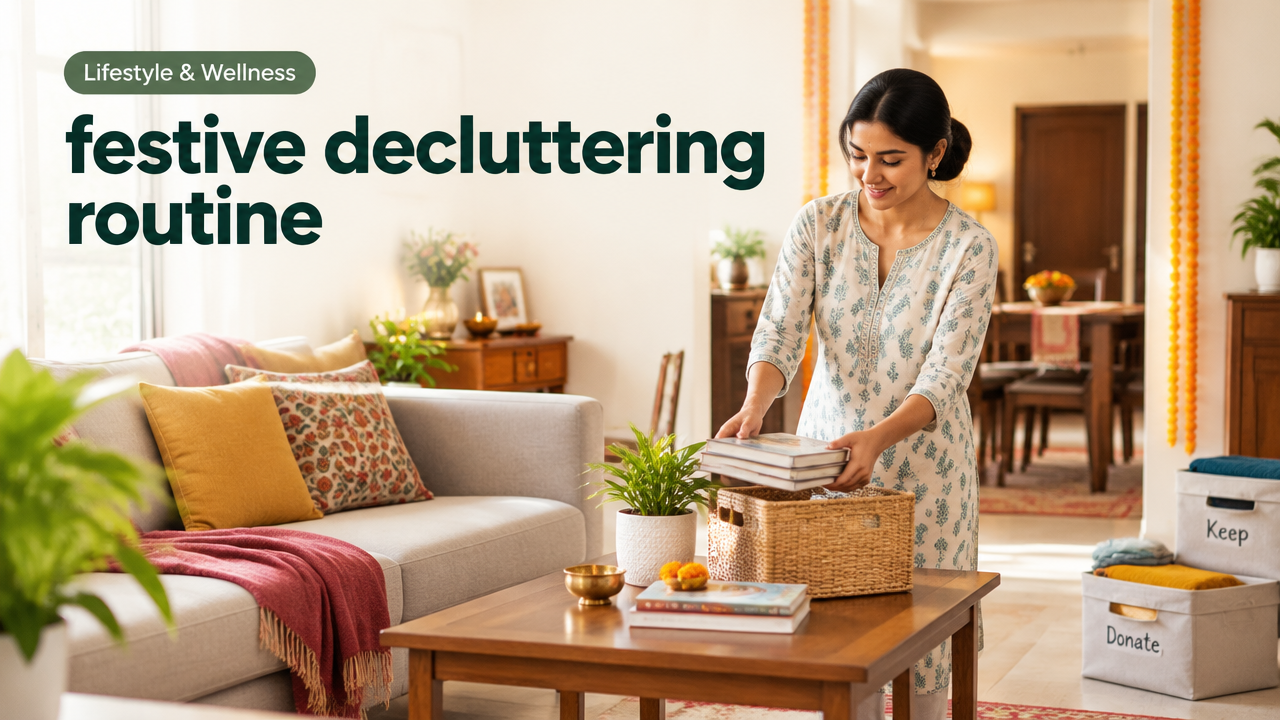
- Why a short routine works better than “clean everything”
- Festive Decluttering Checklist (Printable)
- Step-by-step routine: 2-hour guest-ready plan
- Worked mini-example: 30-minute wardrobe pre-visit sort
- Practical tips that save time and mental load
- Common mistakes to avoid
- How to involve family or helpers quickly
- Where to store items during a short visit
- Links to related household routines
- Next step
- Frequently Asked Questions
- Conclusion
- 15 Powerful Festive Decluttering Tips to Create a Peaceful Home Before the Festival
- Use this plan in your own home
Updated/Reviewed: 15 October 2026
Festive Decluttering Routine for a Calmer Home Before Guests Arrive
Short answer: Follow a focused, room-priority plan that clears high-impact surfaces (entry, living area, dining, kitchen counters and guest bathroom) in short timed blocks, then handle storage and laundry. This gives a calmer home without a full deep clean.
Step: Clear the entry and living-area horizontal surfaces (shoes, mail, toys, visible clutter).
Time: 20–40 minutes for a 1BHK/2BHK family home; scale up by 10–15 minutes per extra room.
Decision rule: If an item hasn’t been used in the last 30 days and has no upcoming festival use, move it to ‘donate/recycle’ or temporary box for review after guests leave.
Materials/Tools: 2 boxes (Keep, Toss/Donate), trash bin, wet wipes or microfibre cloth, small basket for chargers/keys, laundry bag.
Who this guide is for: Indian households preparing for guests during festivals or family visits who want a calm, guest-ready home without an all-day deep clean. It works for small apartments and larger homes by scaling timed tasks.
Why a short routine works better than “clean everything”
Guests notice surfaces and pathways more than every shelf or drawer. A focused decluttering routine reduces visual noise quickly — clearing entryways, seating areas and dining spaces creates the sense of order that guests appreciate. Reserve deep cleaning for stubborn spots or appliances used during the visit.
Festive Decluttering Checklist (Printable)
- Collect shoes, umbrellas and bags from the entry and place in the designated rack or box.
- Clear living room surfaces: coffee table, TV unit, window sills — put away items that don’t belong.
- Tidy seating: fold throws, stack cushions neatly and remove extra pillows.
- Clear dining table and buff surface; set up a temporary serving station if needed.
- Clear kitchen counters except a small work area; put away non-essential appliances.
- Load dirty dishes into dishwasher or fill sink with hot soapy water; dry and store clean dishes.
- Quick clean guest bathroom: clear surfaces, replace hand towel, top up soap and toilet paper.
- Gather loose cables/chargers into a basket at the family drop zone.
- Gather visible laundry and start a quick wash load; fold dry items right away.
- Create a donate/recycle bag and a small ‘temporary storage’ box for items you’ll sort after guests leave.
- Sweep or vacuum main guest path and seating area; quick mop if floors look dull.
- Check lighting: replace a burnt bulb and set soft warm lights; remove distracting blinking lights.
- Final 5-minute walkthrough: look at entrances and view from main seating; remove anything that still looks cluttered.
Step-by-step routine: 2-hour guest-ready plan
This plan is split into focused 15–30 minute blocks. Adjust times to match your home size and available help.
- 0–20 min: Entry and living area — remove shoes and bags, clear flat surfaces, stash toys in a basket, fold throws. Use one box for things to return and one box for donate.
- 20–40 min: Dining and kitchen counters — clear the dining table, wipe surfaces, put away small appliances. Clear kitchen counters and load dishes.
- 40–60 min: Guest bathroom — clear and wipe surfaces, replace towels, top-up supplies, quick mop if needed.
- 60–90 min: Quick laundry run — start a wash of towels/guest linens. Dry and fold immediately to avoid pile-up.
- 90–110 min: Floors and final touch-ups — sweep/vacuum main rooms, spot-mop, straighten cushions and check lighting.
- 110–120+ min: Final staging — set out a small snack station, fresh flowers or a simple bowl of fruit, keep the donate box by the door for later drop-off.
Worked mini-example: 30-minute wardrobe pre-visit sort
Goal: Free up space in the guest bedroom or spare cupboard for luggage and fresh linens in 30 minutes.
- Set a 30-minute timer.
- Action 0–10 min: Pull out top 15 visible items on the rod or shelf and place on the bed.
- Action 10–20 min: Use this decision rule for each item — if not worn this season and no festival use, move to donate; if stained or torn, toss/recycle; if keeper, return neatly.
- Action 20–30 min: Fold and stack keeper items; make a small space for guest linens and luggage. Label the donate bag and set it by the door.
Result: A visible, usable space in 30 minutes with a clear donate bag ready for later drop-off or pick-up.
Practical tips that save time and mental load
- Work outward-in: start where guests will enter and move toward private areas.
- Use baskets and trays to corral small items — a tray on the coffee table makes the space look organised instantly.
- Designate one basket as a family drop zone for keys, chargers and masks. See our Family Drop Zone Organization guide for ideas.
- Keep a small cleaning kit (microfibre cloths, multi-surface spray, broom/vacuum, trash bags) in one place for quick access.
- Label temporary storage boxes with a clear time-to-review (e.g., “Review after 7 days”) to avoid indefinite pile-ups.
- For long-term clutter control, follow a simple rule like the One In One Out method to stop build-up; read our One in One Out Decluttering Rule article.
Common mistakes to avoid
- Trying to deep-clean every room at once — this wastes time and adds stress. Prioritise visible, guest-facing spaces.
- Mixing cleaning chemicals — follow manufacturer labels and never mix bleach with acid or ammonia-based cleaners.
- Hiding clutter in random boxes — use labelled temporary boxes and commit to sorting them within a set time after guests leave.
- Postponing laundry — a quick wash and fold for guest towels and bed linen is faster than dealing with piles later.
- Assuming donation services accept everything — verify with local organisations before assuming they will pick up or accept items.
How to involve family or helpers quickly
Assign small, clear tasks: one person clears the entry, another handles kitchen counters, one starts laundry, and someone else tidies the bathroom. Use a short briefing (5 minutes) and set a visible timer. This reduces overlap and ensures the most important zones get attention.
Where to store items during a short visit
If guests are staying multiple days and you need short-term storage for household items, use these options:
- Guest room bottom shelf for luggage and cleared household bins.
- High shelves or top cupboards for seasonal décor items you won’t need.
- Closet organisers or vacuum bags for bulk bedding — label clearly so you can restore the space after the visit.
Links to related household routines
- Family Drop Zone Organization for Keys, Bags, School Items and Chargers
- One in One Out Decluttering Rule: Practical Guide for Indian Homes
- 15 Essential Guest Ready Home Checklist Tips for a Beautiful and Happy Family Celebration
- Evening Home Reset Routine That Makes Mornings Easier
Next step
Choose one high-impact 30–60 minute block from the plan and do it now — entry + living area or kitchen + dining. After guests leave, schedule a 45-minute follow-up to sort the donate/trash boxes and return items to their permanent homes.
Frequently Asked Questions
Conclusion
A short, focused festive decluttering routine brings visible calm quickly: prioritise entry, living, dining and the guest bathroom, use time blocks and simple decision rules, and prepare a donate bag. After guests leave, use scheduled follow-ups to sort temporary boxes and restore order. For more routines that complement this plan, see our Evening Home Reset Routine and the Guest Ready Home Checklist.
Next guide suggestion: 15 Essential Guest Ready Home Checklist Tips for a Beautiful and Happy Family Celebration
Use this plan in your own home
Treat the guide as a practical starting point and adjust it for your rooms, materials, appliances, climate, family size and daily routine.
How this guide was prepared
This guide is prepared for everyday readers using practical research, usability checks and editorial review. Product-specific claims should be verified against manufacturer instructions before purchase.
- Reviewed: October 15, 2026
- Next review target: April 15, 2027
- Read our Editorial Policy · Request a correction
How did you like this article?
Your feedback helps us make our stories more useful.

Ashish Pandey
My name is Ashish Pandey, I work as a content writer and I love to write articles. With 4 years of blogging experience I am always ready to inspire others and share knowledge to make them a successful blogger.
Related Articles
 Seasonal & Festival
New Year Home Declutter Checklist with Keep-Donate-Recycle System
A practical New Year home declutter checklist using a clear keep-donate-recycle system. Room-by-room steps, time and budget example for Indian homes, common…
 Simple Living
One in One Out Decluttering Rule: Practical Guide for Indian Homes
A clear, practical how-to for using the One In One Out decluttering rule at home — step-by-step system, checklist, a 30-minute wardrobe…
Join the Discussion
Join the conversation and share a useful tip or experience.