- Why Do Indian Homes Need an Air Purifier?
- 1. Start With Your Room Size
- 2. Understand CADR Before Buying
- Why Is CADR Important?
- 3. Look for a Good HEPA Filter
- What Can a HEPA Filter Help With?
- 4. Check for an Activated Carbon Filter
- 5. Do Not Forget the Pre-Filter
- 6. Check Filter Replacement Cost
- 7. Consider Noise Level
- 8. Automatic Mode Can Be Useful
- 9. Think About Electricity Use
- 10. Choose the Right Place for Your Air Purifier
- 11. One Air Purifier for the Whole House?
- Important Air Purifier Buying Checklist
- Common Mistakes People Make
- Should You Buy a Smart Air Purifier?
- Air Purifier Buying Guide India for Bedrooms
- Air Purifier Buying Guide India for Living Rooms
- How to Maintain an Air Purifier
- How Much Should You Spend?
- Quick Buying Formula
- Frequently Asked Questions
- 1. What is the most important thing in an air purifier?
- 2. Is a HEPA filter important for an air purifier?
- 3. What does CADR mean in an air purifier?
- 4. Should I buy an air purifier according to room size?
- 5. How often should an air purifier filter be replaced?
- 6. Is an activated carbon filter useful?
- 7. Can one air purifier clean the whole house?
- Conclusion
Buying an air purifier may look easy when we see so many models in shops and online. But once we start comparing them, there are many things to understand. There are different sizes, filters, prices, features and brands. Some models are made for small bedrooms, while others are designed for large living rooms.
I remember when I first started looking at air purifiers, I was mainly checking the price and appearance. Later, I understood that these are not the only things that matter. Room size, filter type and CADR are much more important when choosing an air purifier.
Indian homes can also have different air-quality problems depending on the location. A home near a busy road may have more dust and outdoor pollution coming inside. A kitchen can have smoke and cooking particles. Bedrooms may need a quieter purifier because nobody wants a noisy machine running at night.
So, before spending money, it is better to understand what you actually need.
As I always say, “The right appliance is not always the most expensive one. It is the one that suits your home.”
This air purifier buying guide India is written in simple language to help you understand the important things before making your choice.
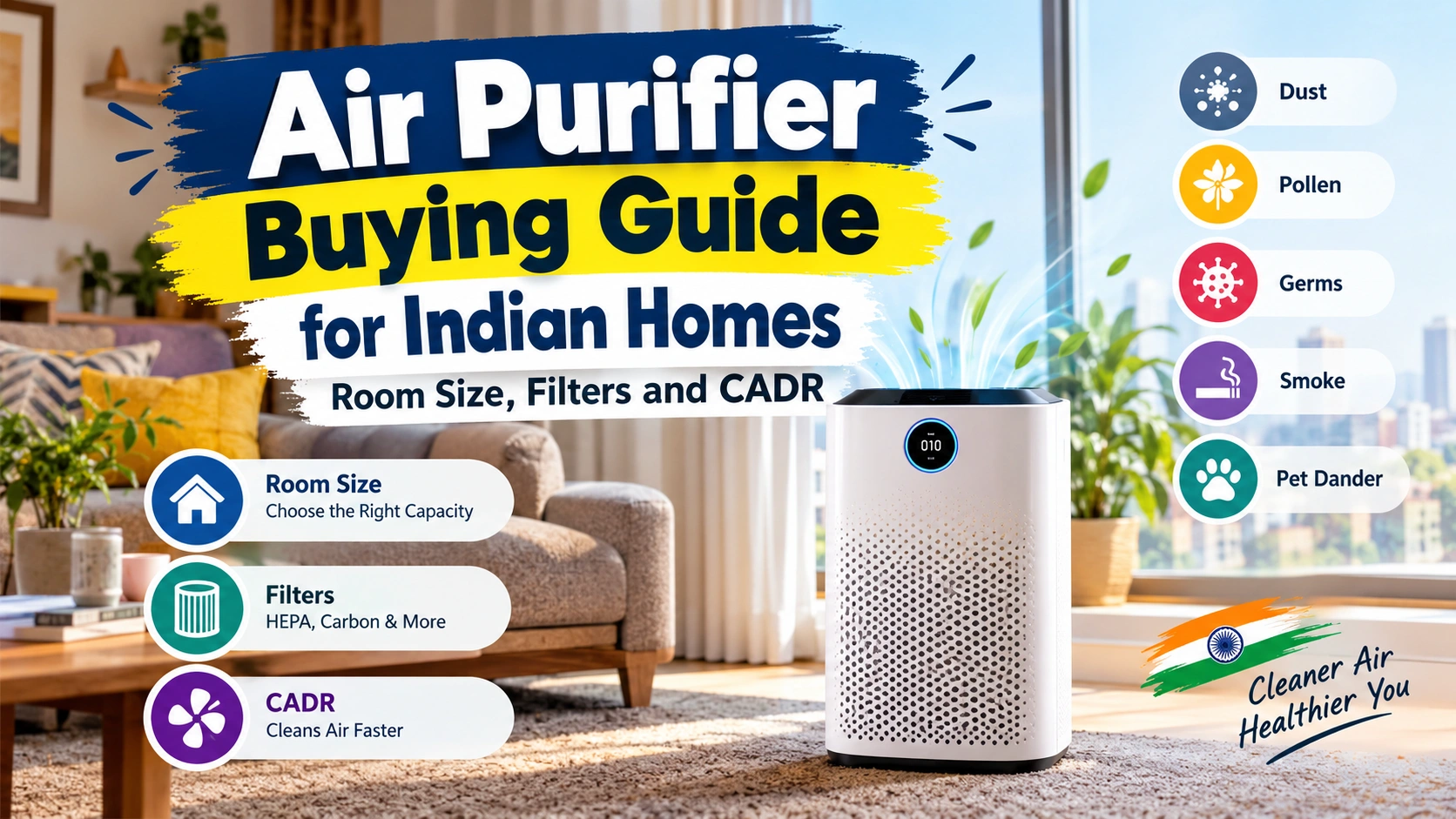
Why Do Indian Homes Need an Air Purifier?
Indoor air can contain dust, fine particles, pollen, smoke, pet-related particles and other unwanted particles. Keeping doors and windows closed does not always mean the indoor air is perfectly clean.
Dust can enter when we open doors and windows. Outdoor pollution can also come inside. Cooking can create smoke and tiny particles. Cleaning the house can temporarily move dust around the room.
An air purifier works by pulling room air through filters and then releasing filtered air back into the room.
However, an air purifier is not a replacement for regular cleaning or ventilation. It is another useful tool that can help improve indoor air quality when used correctly.
This is why choosing the correct purifier is important.
1. Start With Your Room Size
The first thing I would check is the size of the room where you want to use the purifier.
This is one of the most important parts of an air purifier buying guide India because a small purifier may not clean the air effectively in a large room.
For example, imagine buying a compact purifier designed for a small bedroom and putting it in a large living room. The machine may run for hours, but the amount of air it can clean may not be enough for that space.
Measure your room before buying.
You can calculate the approximate floor area like this:
Room length × Room width = Room area
For example:
| Room | Example Size | Approx. Area | What to Consider |
|---|---|---|---|
| Small bedroom | 10 × 10 ft | 100 sq ft | Compact purifier |
| Medium bedroom | 12 × 12 ft | 144 sq ft | Small/medium purifier |
| Large bedroom | 12 × 15 ft | 180 sq ft | Medium-capacity purifier |
| Living room | 15 × 18 ft | 270 sq ft | Higher-capacity purifier |
| Large hall | 18 × 20 ft | 360 sq ft | High-CADR purifier |
These are simple examples, not strict buying limits. Always check the manufacturer’s recommended room area and CADR.
2. Understand CADR Before Buying
CADR stands for Clean Air Delivery Rate.
The easiest way to understand CADR is to think of it as an indication of how quickly a purifier can deliver cleaned air.
A purifier with a higher CADR can generally clean a larger amount of air in a given amount of time.
This is why I would not choose an air purifier just because the box says “suitable for large rooms.” Look for the actual CADR specification.
Different products may show CADR in different units, so check the manufacturer’s specifications carefully.
Why Is CADR Important?
Suppose two air purifiers have similar-looking designs. One has a much lower air-cleaning capacity, while the other has a higher CADR.
If you put both in a large room, the higher-capacity machine may be better suited to the job.
“A purifier’s size and appearance do not tell you how much air it can clean.”
CADR should therefore be one of the main numbers you compare.
3. Look for a Good HEPA Filter
The filter is the heart of an air purifier.
One of the most commonly discussed filters is the HEPA filter. HEPA stands for High Efficiency Particulate Air.
A genuine HEPA filter is designed to capture very small airborne particles. This makes it an important feature when you are buying a purifier mainly for particle pollution.
Some products may use terms such as “HEPA-type” or “HEPA-like.” These terms should not automatically be treated as the same as a certified HEPA filter.
Before buying, check exactly what the manufacturer says about the filter.
What Can a HEPA Filter Help With?
Depending on the purifier and filter design, particle filtration can help reduce things such as:
- Dust
- Fine airborne particles
- Pollen
- Some pet dander
- Other airborne particulate matter
Remember that filters have a limited life. A dirty or clogged filter cannot work the same way as a clean, properly maintained filter.
4. Check for an Activated Carbon Filter
If smells are one of your main concerns, look for a purifier with an activated carbon filter.
Carbon filters are used to help reduce certain odors and gaseous pollutants.
This can be useful in homes where there are cooking smells, smoke or other unwanted odors.
However, not all carbon filters are the same. The amount and quality of carbon can differ between models.
So instead of simply seeing the words “carbon filter” on the box, check the product specifications.
If odor control is important to you, this should be one of your buying points.
5. Do Not Forget the Pre-Filter
A pre-filter is another useful part of many air purifiers.
It can catch larger particles such as hair and larger dust particles before the air reaches the main filter.
This can help protect the more expensive main filter.
A washable or cleanable pre-filter can also be convenient because you can maintain it regularly instead of replacing it as frequently as a main filter.
For an Indian home, where dust can be a regular problem, I think checking the pre-filter is worth the few extra minutes.
6. Check Filter Replacement Cost
This is something many people forget when buying an air purifier.
We often look at the purchase price and think, “This one is cheaper.”
But an air purifier is not a one-time expense.
The filters eventually need cleaning, replacement or both, depending on the design.
Before buying, check:
- Main filter replacement price
- Expected replacement interval
- Pre-filter maintenance
- Carbon filter replacement
- Availability of genuine replacement filters
- Whether filters are easily available in India
A purifier that costs less initially may become expensive if its replacement filters are difficult to find or costly.
“Always check the running cost, not only the buying price.”
7. Consider Noise Level
If you plan to use an air purifier in your bedroom, noise matters.
A purifier may have excellent cleaning performance, but if it makes too much noise at night, you may not want to run it while sleeping.
Look at the manufacturer’s noise specifications if they are available.
Many purifiers have different fan modes, such as:
- Sleep mode
- Low mode
- Medium mode
- High or turbo mode
- Automatic mode
A sleep mode can be particularly useful for bedrooms.
However, remember that lower fan speeds may also mean lower airflow. The quietest setting is not necessarily the fastest cleaning setting.
8. Automatic Mode Can Be Useful
Some air purifiers have sensors that monitor particles in the air and automatically change the fan speed.
This can be convenient.
For example, if the air becomes more polluted, the purifier may increase fan speed. When the air becomes cleaner, it may slow down.
If you do not want to manually adjust the fan every time, automatic mode can be helpful.
Some models also have an air-quality display.
I like this feature because it gives you a quick idea of what the purifier is detecting.
But do not buy a purifier only because it has a fancy display. The actual filtration system and airflow capacity are more important.
9. Think About Electricity Use
An air purifier uses electricity whenever it operates.
If you plan to run it for many hours every day, electricity consumption becomes worth considering.
Check the product’s power consumption before buying.
A purifier that runs continuously in a bedroom may have different energy needs from a larger purifier running in a living room.
You can also use different fan modes depending on the situation. For example, a higher fan speed may be useful when you want faster cleaning, while a lower setting may be enough for maintaining air quality afterward.
10. Choose the Right Place for Your Air Purifier
Buying the right purifier is only half the job. Where you place it also matters.
Keep the purifier where it has enough space around the air intake and outlet.
Avoid pushing it tightly against furniture.
Do not cover the air outlet.
Try to place it in an area where air can move around the room.
If you have a purifier for your bedroom, keeping it close to where the air circulates can make more sense than hiding it behind a cupboard.
Also remember to keep the machine away from places where it can get wet.
11. One Air Purifier for the Whole House?
This is a common question.
If your home has several rooms, one purifier cannot automatically clean all rooms equally well.
Air does not instantly move from one closed bedroom into another room just because the purifier is running.
If the doors are closed, the purifier mainly works on the air in that particular space.
For this reason, you should think about where you spend the most time.
For example, you may decide to use one purifier in the bedroom at night and move it to the living room during the day.
Alternatively, larger homes may benefit from multiple units.
There is no single answer for every home.
Important Air Purifier Buying Checklist
| Feature | Why It Matters | What to Check |
|---|---|---|
| Room size | Determines required cleaning capacity | Manufacturer’s recommended room area |
| CADR | Shows clean-air delivery capacity | Higher capacity for larger rooms |
| HEPA filter | Helps capture airborne particles | Exact filter specification |
| Carbon filter | Helps with certain odors and gases | Carbon type and amount |
| Pre-filter | Captures larger particles | Washable/cleanable design |
| Filter cost | Affects long-term expense | Replacement price and availability |
| Noise | Important for bedrooms | Noise rating and sleep mode |
| Auto mode | Adjusts fan automatically | Sensor and automatic fan control |
| Power consumption | Affects electricity use | Wattage and operating modes |
| Air-quality sensor | Shows detected air conditions | Display and sensor features |
| Warranty | Provides product support | Warranty period and service |
| Spare filters | Needed for long-term use | Availability in India |
Common Mistakes People Make
One mistake is choosing a purifier only because it has a beautiful design.
Another is buying the cheapest model without checking CADR.
Some people also forget about filter replacement costs.
Another common mistake is buying a small purifier for a very large room.
Some buyers also assume that an air purifier removes every type of indoor pollution. That is not correct. Different filters are designed for different types of pollutants.
“Do not buy features. Buy the features your home actually needs.”
Should You Buy a Smart Air Purifier?
Smart features can be convenient, but they are not essential for everyone.
A smart purifier may allow you to:
- Control the purifier through an app
- Check air-quality information
- Change fan modes
- Schedule operation
- Receive filter replacement reminders
These features can be useful if you enjoy controlling appliances from your phone.
But if your main goal is simply to clean the air, you do not necessarily need a Wi-Fi connection.
I would first compare CADR, filters, room coverage, noise and filter cost. Smart features can come after that.
Air Purifier Buying Guide India for Bedrooms
For a bedroom, I would pay extra attention to three things: correct room capacity, noise and filter availability.
You want enough airflow to clean the room properly, but you also want the purifier to be comfortable to use while sleeping.
A sleep mode is useful, but check whether the purifier still provides reasonable airflow at that setting.
Also, check how often the filters need attention.
If you are going to use the purifier every night, maintenance should be simple.
Air Purifier Buying Guide India for Living Rooms
Living rooms are often bigger than bedrooms, so CADR becomes even more important.
Measure the room and compare the manufacturer’s recommended coverage.
If your living room has an open connection to the dining area or another large space, consider the total area that the purifier may need to handle.
Do not blindly trust a room-size number without checking how the manufacturer defines it.
A larger space usually requires a purifier with stronger airflow.
How to Maintain an Air Purifier
Even a good air purifier needs basic care.
Clean the exterior regularly.
If the purifier has a washable pre-filter, clean it according to the manufacturer’s instructions.
Do not wash a filter unless the manufacturer specifically says it is washable.
Replace filters according to the manufacturer’s recommendation or filter-life indicator.
Keep the air intake and outlet free from dust.
Also avoid blocking the purifier with curtains, furniture or other objects.
Good maintenance can help the purifier continue working properly.
How Much Should You Spend?
There is no single perfect price for everyone.
Instead of deciding your budget first and then buying anything that fits it, I would compare the total value.
Ask yourself:
“What am I getting for the money, and what will it cost me later?”
A good comparison includes:
- Purchase price
- CADR
- Filter quality
- Room coverage
- Filter replacement cost
- Electricity use
- Warranty
- Service availability
- Noise level
Sometimes paying a little more initially can make sense if the machine has better airflow and easily available replacement filters.
But expensive does not automatically mean better for your particular room.
Quick Buying Formula
When I compare air purifiers, I like to keep things simple.
Step 1: Measure your room.
Step 2: Check the recommended room coverage.
Step 3: Compare CADR.
Step 4: Check the HEPA filter specification.
Step 5: Check whether there is an activated carbon filter if you need odor control.
Step 6: Check replacement filter prices.
Step 7: Check noise levels.
Step 8: Check electricity consumption.
Step 9: Check warranty and service.
Step 10: Choose the model that fits your actual needs.
This simple process can save you from buying a machine that looks good but does not suit your room.
Frequently Asked Questions
1. What is the most important thing in an air purifier?
Room size and CADR are two of the most important things to check. After that, look at the filter system, especially the particle filter, carbon filter if needed, noise and replacement cost.
2. Is a HEPA filter important for an air purifier?
A HEPA filter can be very useful for capturing airborne particles. However, check the exact filter specification instead of relying only on the word “HEPA” in advertising.
3. What does CADR mean in an air purifier?
CADR means Clean Air Delivery Rate. It indicates the rate at which an air purifier can deliver filtered air. A higher CADR generally means greater air-cleaning capacity.
4. Should I buy an air purifier according to room size?
Yes. Room size is one of the first things you should consider. A purifier designed for a small room may not be suitable for a much larger living room.
5. How often should an air purifier filter be replaced?
It depends on the model, filter type, usage and air conditions. Always follow the manufacturer’s recommendation and check the filter indicator if your purifier has one.
6. Is an activated carbon filter useful?
Yes, activated carbon can help reduce certain odors and gaseous pollutants. It is especially worth considering if smoke or cooking smells are a concern.
7. Can one air purifier clean the whole house?
Usually, one purifier works best within the space it is designed to handle. If rooms are separated by walls and closed doors, one purifier will not clean every room equally.
Conclusion
Buying an air purifier does not have to be confusing. Once you understand the basic points, the decision becomes much easier.
Start with your room size. Then look at CADR, because airflow capacity matters. Check the HEPA filter and consider an activated carbon filter if odors are a concern.
Do not forget the less exciting details such as filter replacement cost, noise, electricity use and service availability. These things become important after you have been using the purifier for several months.
The best air purifier for your home is not necessarily the biggest, most expensive or most advanced model.
It is the one that has the right cleaning capacity, suitable filters, manageable running cost and features that fit your daily life.
As I would tell any friend shopping for one, “Take a little time before buying. Check the numbers, not just the looks.”
That is the simple idea behind this air purifier buying guide India. If you understand room size, filters and CADR, you are already much better prepared to choose an air purifier for your home.
Want a professional website designed for your business or blog?
Visit eDigitalized for website design and development services.
Need help or support?
Visit our Contact Us page and get in touch with us.
Want to become a blogger and start your own blog?
Visit WP Bazaar for blogging resources, tools, and helpful guides.

How this guide was prepared
This guide is prepared for everyday readers using practical research, usability checks and editorial review. Product-specific claims should be verified against manufacturer instructions before purchase.
- Reviewed: September 21, 2026
- Next review target: March 21, 2027
- Read our Editorial Policy · Request a correction
How did you like this article?
Your feedback helps us make our stories more useful.

Shweta Pandey
My name is Shweta Pandey, I work as a content writer and I love to write articles. With 4 years of blogging experience I am always ready to inspire others and share knowledge to make them a successful blogger.
Related Articles
 Cleaning
The Ultimate Daily Home Cleaning Checklist for a Spotless, Tidy Home
A daily home cleaning checklist does not always require hours of scrubbing, organizing, and washing. In most cases, the secret to maintaining…
 Home & Living
Home Ventilation Checklist for Changing Indian Seasons
A step-by-step home ventilation checklist for India to improve airflow, control humidity and maintain indoor comfort across summer, monsoon and winter—plus a…
Join the Discussion
Join the conversation and share a useful tip or experience.