- Who this guide is for
- Why a small refill stock and labels matter
- Choose the right containers: quick comparison
- Step-by-step setup (practical checklist)
- Label system and refill rules (keep it simple)
- Daily use routine (one-minute recipe)
- Worked mini-example: 30-minute spice drawer sort (for a family kitchen)
- Placement & humidity tips for Indian kitchens
- Maintenance, cleaning and safety
- Common mistakes
- Costs and buying considerations (ownership basics)
- Where this fits in your home systems
- Next step
- Conclusion
- Frequently Asked Questions
- 12 Brilliant Indian Spice Storage Ideas for a Neat and Happy Masala Setup
- Use this plan in your own home
Updated/Reviewed 14 October 2026
Indian spice storage system for daily use: refill stock and labels
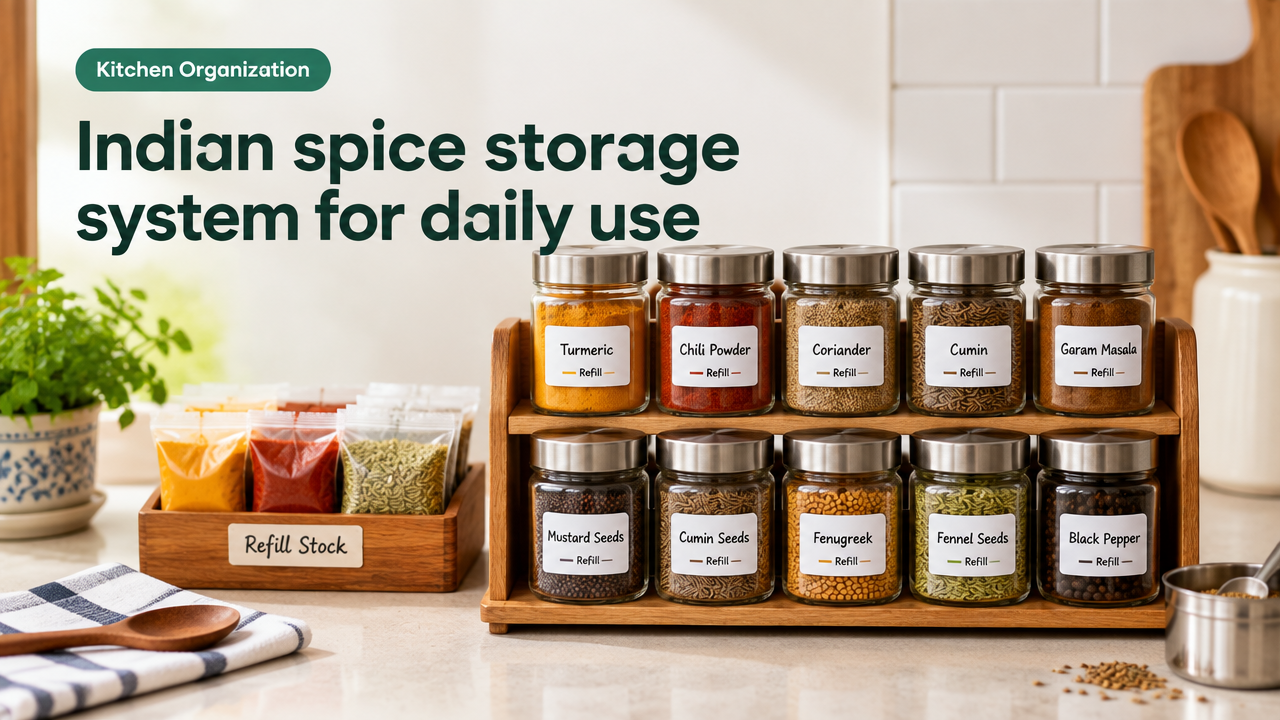
Short answer: For everyday Indian cooking, keep frequently used whole and ground spices in airtight, kitchen-zone jars or tins, label each jar with spice name and ‘refill’ level, store a small refill stock (one-to-two weeks or one small packet) nearby, and use a simple reorder rule (when a jar hits the refill line, move the spare in and add to your shopping list).
- First step: Do a 30-minute spice sort — group, discard damaged packs, and place daily-use spices in clear jars with labels.
- Time estimate: 30–90 minutes for full setup depending on number of spices.
- Simple decision rule: Keep daily-use spices within reach of your main cooking zone; keep heat- and light-sensitive spices away from the stove and direct sun.
- Materials/tools: Airtight jars (glass/steel), funnel, permanent marker/printed labels, masking tape, small scoop or measuring spoons, tray for jars, optional desiccant (food-grade) and a small spare-stock box.
Who this guide is for
This is for Indian households who cook every day and want a practical, low-maintenance spice system: small kitchens, apartment counters, modular kitchens, and anyone who wants quicker access, less waste and an easier refill habit. It helps families who buy spices in supermarket pouches or bulk and need a dependable kitchen routine.
Why a small refill stock and labels matter
Having a small refill stock and clear labels reduces last-minute rushes, prevents open packets left on counters, and speeds up cooking. Labels make it easy for helpers or family members to find and replace spices correctly. A simple refill rule prevents both over-buying and running out.
Choose the right containers: quick comparison
| Type | Best for | Notes |
|---|---|---|
| Small glass jars (clear) | Daily-use spices, visual stock check | Use airtight lids; keep away from direct sun; easy to label |
| Stainless steel tins | Humid kitchens, whole spices | Opaque (protects from light); durable; check lid seal |
| Stackable plastic containers (food-grade) | Drawer/cabinet organisation | Lightweight; choose BPA-free; avoid near high heat |
| Masala box/aid (multi-compartment) | Small kitchens, everyday cooking | Good for 6–8 most-used spices; refill from bulk jars |
Step-by-step setup (practical checklist)
Follow this printable-style checklist to set up a usable system.
- Gather all spices from cupboards, packets, and fridge into one area.
- Group spices: daily-use (eg. turmeric, chilli, coriander, cumin), weekly-use (eg. garam masala), and occasional-use (eg. ajwain, fenugreek).
- Discard damaged or rancid packets and empty torn pouches into compost/recycle as per local rules.
- Choose containers for each group and transfer spices using a funnel; leave room at top for scooping.
- Label jars clearly with spice name and ‘Refill at’ mark (see label system below).
- Create a small refill box or drawer: keep 1–3 unopened packets or a spare jar for each daily spice.
- Place daily-use jars nearest the stove, but not on top of it. Store refill box in a cool, dry cabinet.
- Make a simple shopping note method: a paper list near the spice box, or a list on your phone marked ‘Spice refills’.
Label system and refill rules (keep it simple)
Use these label elements on each jar for clarity:
- Spice name (large, e.g., “Turmeric / Haldi”).
- Date opened — write month/year (useful for rotation).
- Refill line — mark a thin line on the jar indicating the minimum usable level (for example, 1/4 jar).
- Use-by note (optional) — if you want, add ‘Buy if below line’ or replace with manufacturer/package guidance.
Simple refill rule: when a jar reaches the refill line, move the spare from the refill box into the jar and add that spice to your weekly shopping list. For bulk packets, transfer to jar and mark packet with date before storing the packet in cold dry storage.
Daily use routine (one-minute recipe)
Make this short habit part of your cooking flow:
- Before cooking, check the jar level you need. If at or below the refill line, swap in the spare jar or packet.
- After cooking, wipe any spills on jar lids and return jars to their zone.
- Once a week, glance at refill box and add items to market list or online cart.
Worked mini-example: 30-minute spice drawer sort (for a family kitchen)
Goal: Move the most-used spices into labelled jars and create a refill box.
- Set a 30-minute timer. (5 min) Pull spices from cabinets and packets into a tray.
- (5 min) Group items: Daily-use (10 jars), Weekly (6 jars), Occasional (4 packets).
- (10 min) Fill 10 small clear jars with daily spices using a funnel; label each with name + ‘Refill line’.
- (5 min) Put one spare packet or jar for each daily spice into a small cardboard box; label the box ‘Spice refills’.
- (5 min) Place daily jars on a tray near the stove but not on the hob; store refill box in a cool cabinet. Add missing refills to today’s shopping list.
Result: Ten daily spices are reachable in a minute; the refill box keeps a one-step reserve and a clear shopping cue.
Placement & humidity tips for Indian kitchens
Heat, light and humidity reduce the freshness of ground spices faster. Keep in mind:
- Do not keep spices directly above the stove or next to the chimney where steam and heat are strong.
- Choose stainless or opaque tins for very humid kitchens; glass is fine if in a cool, shaded cabinet or drawer.
- Use a drawer tray or tray on the counter so jars are easy to move for cleaning; wipe spills promptly.
Maintenance, cleaning and safety
- Clean jar lids and rims monthly; transfer spices to a clean bowl if you need to wash jars and dry fully before refilling.
- Do not mix cleaning chemicals near spices. Use warm soapy water and dry completely before use.
- If you use small desiccant packs, use only food-grade products and follow the manufacturer’s instructions; verify with the product label.
- Keep large bulk purchases sealed and in cool, dry storage until needed; once opened, portion into jars for daily use.
Common mistakes
- Overfilling jars so there’s no air gap — makes scooping hard and can crumble spices.
- Placing jars too close to stove heat or direct sunlight.
- Using small unlabelled containers that look similar — this is the fastest way to confusion.
- Not keeping a spare or refill rule; you end up buying duplicates or running out mid-cooking.
Costs and buying considerations (ownership basics)
Decide between glass, steel or plastic based on kitchen humidity and visibility needs. Glass jars are inexpensive and show stock at a glance. Stainless options cost more but protect from light and are often better in coastal or humid homes. When buying, consider lids with good seals and a simple return/warranty policy if you buy a set. Factor in a one-time container cost and low ongoing costs for spare packets — ownership cost is mainly initial setup.
Where this fits in your home systems
This spice system complements weekly fridge checks and pantry routines. For related guides see our small kitchen counter organisation ideas and weekly fridge check routine:
- 12 Brilliant Indian Spice Storage Ideas for a Neat and Happy Masala Setup
- 21 Powerful Small Kitchen Counter Organization Ideas for a Happier, More Spacious Kitchen
- 7 Smart Weekly Fridge Check Routine Tips Before Grocery Shopping That Save Money and Reduce Waste
Next step
Do the 30-minute spice drawer sort from the worked example. Once done, set a weekly reminder to check the refill box and add items to your grocery list. If you buy spices in bulk, plan one transfer session per month.
Conclusion
A compact spice system based on reachable jars, a visible refill box, and a simple refill rule will save time, reduce waste and make everyday cooking smoother. Start small—set up daily spices first, add weekly spices next, and keep the system tidy with quick weekly checks.
Frequently Asked Questions
Use this plan in your own home
Treat the guide as a practical starting point and adjust it for your rooms, materials, appliances, climate, family size and daily routine.
How this guide was prepared
This guide is prepared for everyday readers using practical research, usability checks and editorial review. Product-specific claims should be verified against manufacturer instructions before purchase.
- Reviewed: October 14, 2026
- Next review target: April 14, 2027
- Read our Editorial Policy · Request a correction
How did you like this article?
Your feedback helps us make our stories more useful.

Ashish Pandey
My name is Ashish Pandey, I work as a content writer and I love to write articles. With 4 years of blogging experience I am always ready to inspire others and share knowledge to make them a successful blogger.
Related Articles
 Kitchen Solutions
Monsoon Pantry Checklist to Protect Dry Food From Moisture
The rainy season is one of my favorite times of the year. I love the cool weather, the sound of rain, and…
 Kitchen Organization
12 Smart Ways to Organize a Small Kitchen
Simple storage and layout ideas that make a compact kitchen easier to use every day.
Join the Discussion
Join the conversation and share a useful tip or experience.