- Why Indian Spice Storage Needs Special Attention
- 1. Keep Everyday Spices in One Easy-to-Reach Place
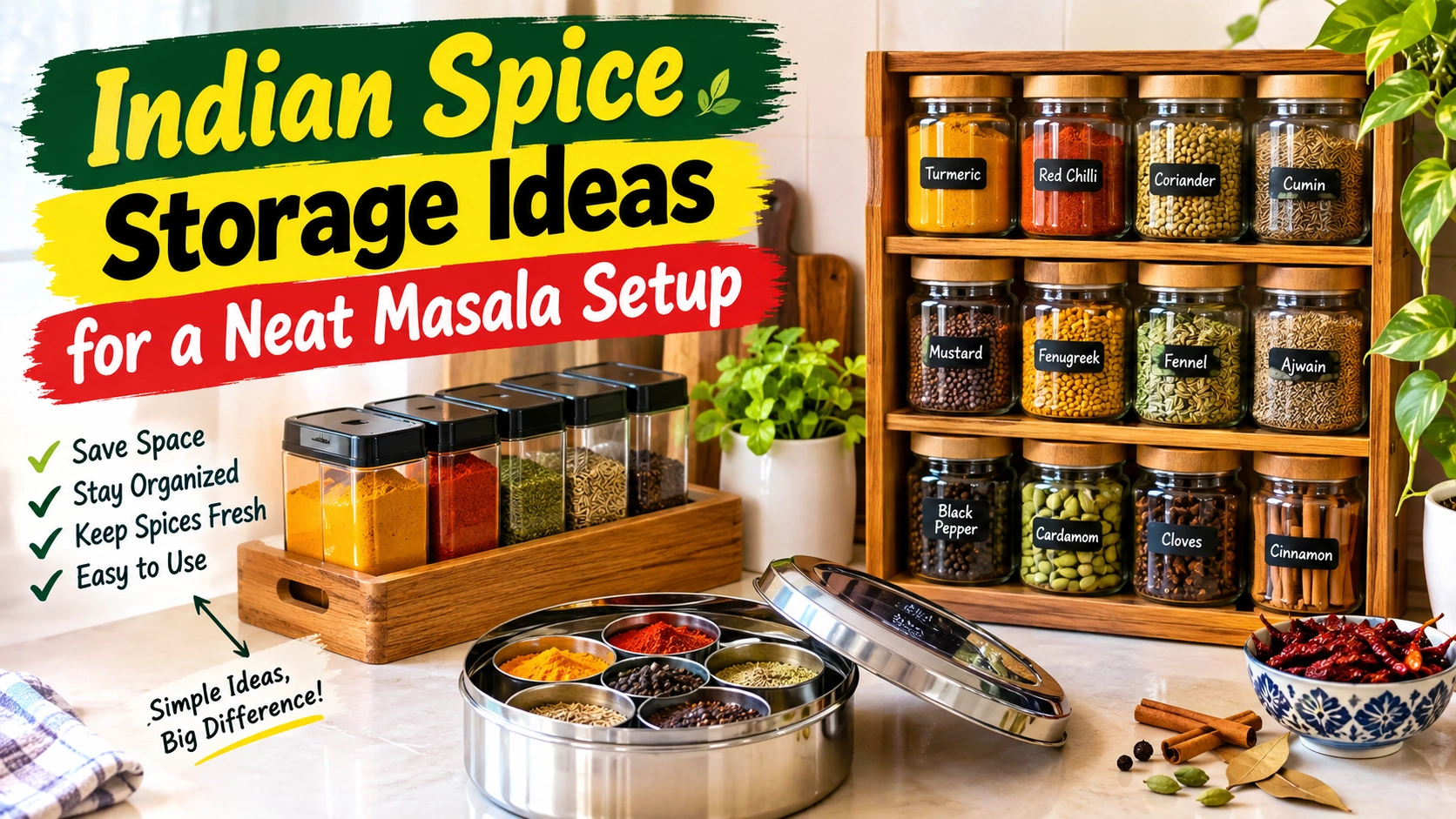
- 2. Use Matching Jars for a Clean Look
- 3. Try a Traditional Masala Dabba
- 4. Use a Small Drawer for Spices
- 5. Use a Wall-Mounted Spice Rack
- 6. Arrange Spices Alphabetically
- 7. Separate Whole Spices and Powdered Spices
- 8. Keep Extra Spice Packets in One Box
- 9. Label Everything Clearly
- 10. Use a Lazy Susan for Deep Cabinets
- 11. Keep Festival and Special Spices Separately
- 12. Make a Small Spice Refill Station
- Simple Indian Spice Storage Ideas for Small Kitchens
- How to Keep Spices Fresh
- My Simple Weekly Spice Cleaning Routine
- Indian Spice Storage Ideas for a Beautiful Kitchen
- Quick Spice Organization Checklist
- Common Spice Storage Mistakes to Avoid
- Frequently Asked Questions
- 1. What is the best way to store Indian spices?
- 2. Is a masala dabba good for spice storage?
- 3. Should spices be stored near the stove?
- 4. Are glass jars good for storing spices?
- 5. How can I organize spices in a small kitchen?
- 6. How often should I clean my spice storage?
- 7. How can I stop my spice cabinet from becoming messy?
- Conclusion
Indian kitchens have one thing that makes them special — spices. Turmeric, red chilli, coriander, cumin, garam masala, mustard seeds, cardamom, cloves, cinnamon and so many more. We use them almost every day, but keeping all these spices neat can sometimes become a real headache.
I have been organizing my kitchen for many years, and I have learned one simple thing: when spices have a proper place, cooking becomes much easier.
Many of us keep spice packets in a drawer, some bottles on the kitchen counter, and a few packets somewhere behind other things. Then, when we need one particular masala, we spend five minutes searching for it.
This is why I love simple Indian spice storage ideas. You do not need an expensive modular kitchen or fancy storage products. With a few containers, labels and a little planning, even a small kitchen can have a clean and useful masala setup.
As I always say, “A neat kitchen does not need to be perfect. It only needs a place for everything.”
Why Indian Spice Storage Needs Special Attention
Indian cooking uses many different spices. Some are powders, while others are whole spices. Some are used daily, while others may be used only during festivals or special meals.
If everything is stored together without a system, the kitchen can quickly look messy.
Spices can also lose their freshness when they are exposed to heat, moisture, sunlight or air for long periods. So good spice storage is not only about making the kitchen look beautiful. It is also about keeping your masalas in good condition.
A good spice storage system should be:
- Easy to use
- Easy to clean
- Easy to refill
- Easy to identify
- Suitable for your kitchen space
- Away from unnecessary heat and moisture
You can choose simple glass jars, stainless steel containers, plastic containers made for food storage, drawer organizers or wall racks depending on your kitchen.
1. Keep Everyday Spices in One Easy-to-Reach Place
One of my favorite Indian spice storage ideas is very simple: keep the spices you use every day together.
For example, you may use turmeric, red chilli powder, coriander powder, cumin and garam masala regularly. These should not be kept at the back of a cupboard.
Put your everyday spices in a small tray or box near your cooking area.
The tray can be taken out when you start cooking and put back after you finish.
This little habit saves time every day.
Instead of opening several cabinets and searching through packets, you can simply pick up the tray and find everything you need.
2. Use Matching Jars for a Clean Look
If you want your kitchen to look neat, matching spice jars can make a big difference.
You do not have to buy expensive jars. Even simple containers of the same size can give your spice shelf a much cleaner appearance.
Choose containers with tight-fitting lids. Transparent jars are especially useful because you can see how much spice is left.
You can use small labels such as:
Turmeric
Red Chilli
Coriander
Cumin
Garam Masala
If your family has children or older members who also help in the kitchen, clear labels make things even easier.
3. Try a Traditional Masala Dabba
The traditional masala dabba is still one of the most practical Indian spice storage ideas.
Most Indian homes already know this round stainless steel container with several small sections inside. It is perfect for everyday cooking.
You can keep commonly used spices inside it, such as:
- Turmeric
- Red chilli powder
- Coriander powder
- Cumin
- Mustard seeds
- Garam masala
- Hing
The best part is that you can keep several spices together without having many bottles standing around your stove.
However, remember to refill it in small amounts rather than filling it with a huge quantity. This helps you use fresh spices regularly.
4. Use a Small Drawer for Spices
If you have a kitchen drawer available, it can become a wonderful spice storage area.
Instead of placing spice bottles randomly, arrange them in rows.
Labels should face upward so you can quickly identify each spice.
For a drawer, short and wide containers often work better than very tall bottles.
You can divide the drawer into sections:
| Spice Group | Examples | Suggested Storage |
|---|---|---|
| Daily powders | Turmeric, chilli, coriander | Front section |
| Whole spices | Cumin, mustard, fennel | Middle section |
| Special spices | Cardamom, cloves, cinnamon | Back section |
| Blended masalas | Garam masala, chaat masala | Separate row |
| Rarely used spices | Special regional spices | Separate box |
This simple arrangement makes a big difference, especially in a small kitchen.
5. Use a Wall-Mounted Spice Rack
When kitchen counter and cabinet space is limited, look upward.
A wall-mounted spice rack can use vertical space that otherwise stays empty.
You can place a small rack on an appropriate kitchen wall and keep your most-used spices there.
But I would avoid placing spices directly above a stove. Constant heat and steam are not ideal for spice storage.
A rack on a cooler wall near your cooking area can be much more practical.
Read More: A Simple Weekly Home Cleaning Routine
6. Arrange Spices Alphabetically
This idea may sound a little unusual, but it works well if you have a large spice collection.
Arrange containers alphabetically:
Cardamom
Cinnamon
Cloves
Coriander
Cumin
Fennel
Garam Masala
Mustard
Red Chilli
Turmeric
You do not have to follow this system for your everyday masala dabba. It is more useful for a larger collection of spices stored in a cabinet.
When everything has a fixed position, you will quickly remember where each spice belongs.
7. Separate Whole Spices and Powdered Spices
Another useful Indian spice storage idea is to keep whole spices and powdered spices in separate sections.
Whole spices include:
- Cumin seeds
- Mustard seeds
- Fennel seeds
- Fenugreek seeds
- Cardamom
- Cloves
- Cinnamon
- Black pepper
Powdered spices include:
- Turmeric
- Red chilli powder
- Coriander powder
- Cumin powder
- Garam masala
- Chaat masala
This separation makes the collection easier to manage.
You can even use different shelves or trays for the two groups.
8. Keep Extra Spice Packets in One Box
I know many Indian homes have this problem.
We buy a new packet of chilli powder even though there is already a half-used packet somewhere in the cupboard.
Then three packets are opened, and nobody remembers which one should be used first.
The solution is simple: create an extra spice box.
Keep unopened packets and refill packets in this box. Whenever a jar becomes empty, refill it from the oldest suitable packet first.
This also makes grocery shopping easier because you can quickly check what you already have.
9. Label Everything Clearly
Labels are one of the easiest ways to make spice storage look organized.
You can use printed labels, handwritten labels or simple sticker labels.
If you have similar-looking spices, labels become even more important.
For example, cumin seeds, fennel seeds and carom seeds may look similar when stored in containers.
A clear label prevents confusion.
You can also write the purchase month or refill date on the back of the container if you want to keep better track of your pantry.
10. Use a Lazy Susan for Deep Cabinets
Deep kitchen cabinets can be difficult because things at the back often disappear from sight.
A rotating tray, also called a lazy Susan, can help.
Put spice jars on the rotating tray and turn it whenever you need something.
This is especially useful for:
- Large spice collections
- Small kitchen cabinets
- Corner shelves
- Tall pantry cabinets
Instead of removing five containers to reach one spice, you simply rotate the tray.
“Good organization is about making everyday work easier.”
That is exactly what this idea does.
11. Keep Festival and Special Spices Separately
Not every spice needs to be kept in your everyday cooking area.
Some spices are used only occasionally.
For example, you may use certain special masalas during Diwali cooking, festive sweets, biryani, pickles or regional dishes.
Keep these in a separate labeled box.
This prevents your everyday spice area from becoming overcrowded.
When you need them, simply take out the special-spice box.
12. Make a Small Spice Refill Station
If you have many spice jars, create a small refill area in your pantry.
Keep your extra packets there along with a small clean spoon or funnel for transferring powdered spices into jars.
Before refilling, make sure the container is clean and completely dry.
Never add fresh spice directly on top of a large amount of very old spice without checking it first.
A little care during refilling can help keep your spice collection cleaner and easier to manage.
Simple Indian Spice Storage Ideas for Small Kitchens
Small kitchens need smarter storage, not necessarily more storage.
If you have limited space, try these simple tricks:
Use vertical space: A narrow rack can hold several spice jars without taking much counter space.
Use the inside of cabinet doors: Depending on the cabinet design, a slim organizer can provide extra storage.
Choose smaller containers: You do not need huge jars for spices that you use only occasionally.
Keep daily spices separate: Your most-used spices should always be the easiest to reach.
Avoid keeping too many containers outside: A clean counter immediately makes a kitchen feel more spacious.
Use trays: Grouping small spice containers on a tray keeps them together and makes cleaning easier.
How to Keep Spices Fresh
Storage is not only about organization. Freshness matters too.
Keep spices away from direct sunlight whenever possible.
Avoid storing spice containers directly beside the stove because heat can affect their quality over time.
Keep containers tightly closed.
Always use a clean, dry spoon when taking powdered spices from a jar. Water or wet spoons can introduce moisture.
For whole spices, airtight containers can help protect them from moisture and unwanted smells.
It is also a good idea to check your spice collection from time to time.
If something has been sitting unused for a very long period, ask yourself whether you really need to keep it.
My Simple Weekly Spice Cleaning Routine
I do not believe kitchen cleaning should become a big weekend project every time.
For spices, a small routine is enough.
Once a week, I wipe the outside of the jars and the spice tray.
Once a month, I check the spice cabinet and remove empty packets.
Every few months, I check older spices and clean the containers properly when they need it.
I also check whether any jar is becoming difficult to close or has become damp.
This takes only a little time, but it keeps the entire setup looking fresh.
Indian Spice Storage Ideas for a Beautiful Kitchen
Your spice storage does not have to look like a supermarket shelf.
You can make it match your kitchen.
For a modern kitchen, clear glass jars with simple black or white labels can look nice.
For a traditional kitchen, stainless steel containers or a classic masala dabba may feel more natural.
For a colorful kitchen, you can use different label styles or small decorative storage boxes.
The important thing is not the appearance alone.
Your spice system should work for you.
A beautiful arrangement that takes five minutes to find one spice is not really useful.
A simple setup where you can find everything in seconds is much better.
Quick Spice Organization Checklist
Before you finish organizing your kitchen, check these points:
| Task | What to Do |
|---|---|
| Check old spices | Remove spices that are no longer useful |
| Clean containers | Make sure jars are clean and dry |
| Add labels | Clearly name each spice |
| Separate groups | Keep powders and whole spices organized |
| Create daily section | Keep frequently used spices together |
| Store extra packets | Use one box for unopened packets |
| Check lids | Make sure containers close properly |
| Avoid heat | Keep spices away from direct stove heat |
| Use trays | Group small jars together |
| Monthly check | Review your spice collection regularly |
Common Spice Storage Mistakes to Avoid
There are a few things I would avoid when setting up your spice area.
First, do not keep every spice on the kitchen counter. It may look convenient at first, but soon the counter becomes crowded.
Second, do not use containers that are difficult to open. A spice jar should make cooking easier, not harder.
Third, avoid very large containers for spices you rarely use. A smaller container is often more practical.
Fourth, do not mix old and new spices without checking what is already inside.
And finally, do not forget to clean the storage area.
Even the best Indian spice storage ideas will not work well if the storage space is difficult to maintain.
Frequently Asked Questions
1. What is the best way to store Indian spices?
The best method depends on how much you cook and how much space you have. Airtight containers, clear labels and a separate area for frequently used spices can make everyday cooking easier.
2. Is a masala dabba good for spice storage?
Yes. A masala dabba is very useful for commonly used Indian spices. It keeps several spices together and makes them easy to reach while cooking.
3. Should spices be stored near the stove?
It is better to avoid placing spices directly beside or above the stove because heat and steam can affect their storage conditions. Keep them nearby but in a cooler, dry place.
4. Are glass jars good for storing spices?
Glass jars can be a good option, especially when they have tight-fitting lids. Clear jars also make it easy to see what is inside and how much is left.
5. How can I organize spices in a small kitchen?
Use vertical racks, drawer organizers, small trays and compact containers. Keep everyday spices together and store less-used spices separately.
6. How often should I clean my spice storage?
A quick wipe once a week and a more complete check once a month is a simple routine. You can clean individual containers whenever they become dusty or need refilling.
7. How can I stop my spice cabinet from becoming messy?
Give every spice a fixed place, use labels, keep extra packets in one box and avoid storing too many loose packets together. A small regular check can prevent the cabinet from becoming messy again.
Conclusion
A well-organized spice area can make a surprisingly big difference in an Indian kitchen. We use spices almost every day, so keeping them easy to find and simple to refill can save both time and effort.
You do not need expensive organizers to start. A few clean containers, clear labels, one tray and a little planning can be enough.
Try one or two of these Indian spice storage ideas first. Once you see how much easier cooking becomes, you can slowly improve the rest of your spice collection.
For me, the best kitchen is not the one that looks perfect all the time. It is the one where everything has a comfortable place and everyday work feels easy.
And when the masalas are neat, labelled and ready to use, even a busy cooking day feels a little more peaceful.
Want a professional website designed for your business or blog?
Visit eDigitalized for website design and development services.
Need help or support?
Visit our Contact Us page and get in touch with us.
Want to become a blogger and start your own blog?
Visit WP Bazaar for blogging resources, tools, and helpful guides.

How this guide was prepared
This guide is prepared for everyday readers using practical research, usability checks and editorial review. Product-specific claims should be verified against manufacturer instructions before purchase.
- Reviewed: September 19, 2026
- Next review target: March 19, 2027
- Read our Editorial Policy · Request a correction
How did you like this article?
Your feedback helps us make our stories more useful.

Shweta Pandey
My name is Shweta Pandey, I work as a content writer and I love to write articles. With 4 years of blogging experience I am always ready to inspire others and share knowledge to make them a successful blogger.
Related Articles
 Cleaning
The Ultimate Daily Home Cleaning Checklist for a Spotless, Tidy Home
A daily home cleaning checklist does not always require hours of scrubbing, organizing, and washing. In most cases, the secret to maintaining…
 Home & Living
Home Ventilation Checklist for Changing Indian Seasons
A step-by-step home ventilation checklist for India to improve airflow, control humidity and maintain indoor comfort across summer, monsoon and winter—plus a…
Join the Discussion
Join the conversation and share a useful tip or experience.