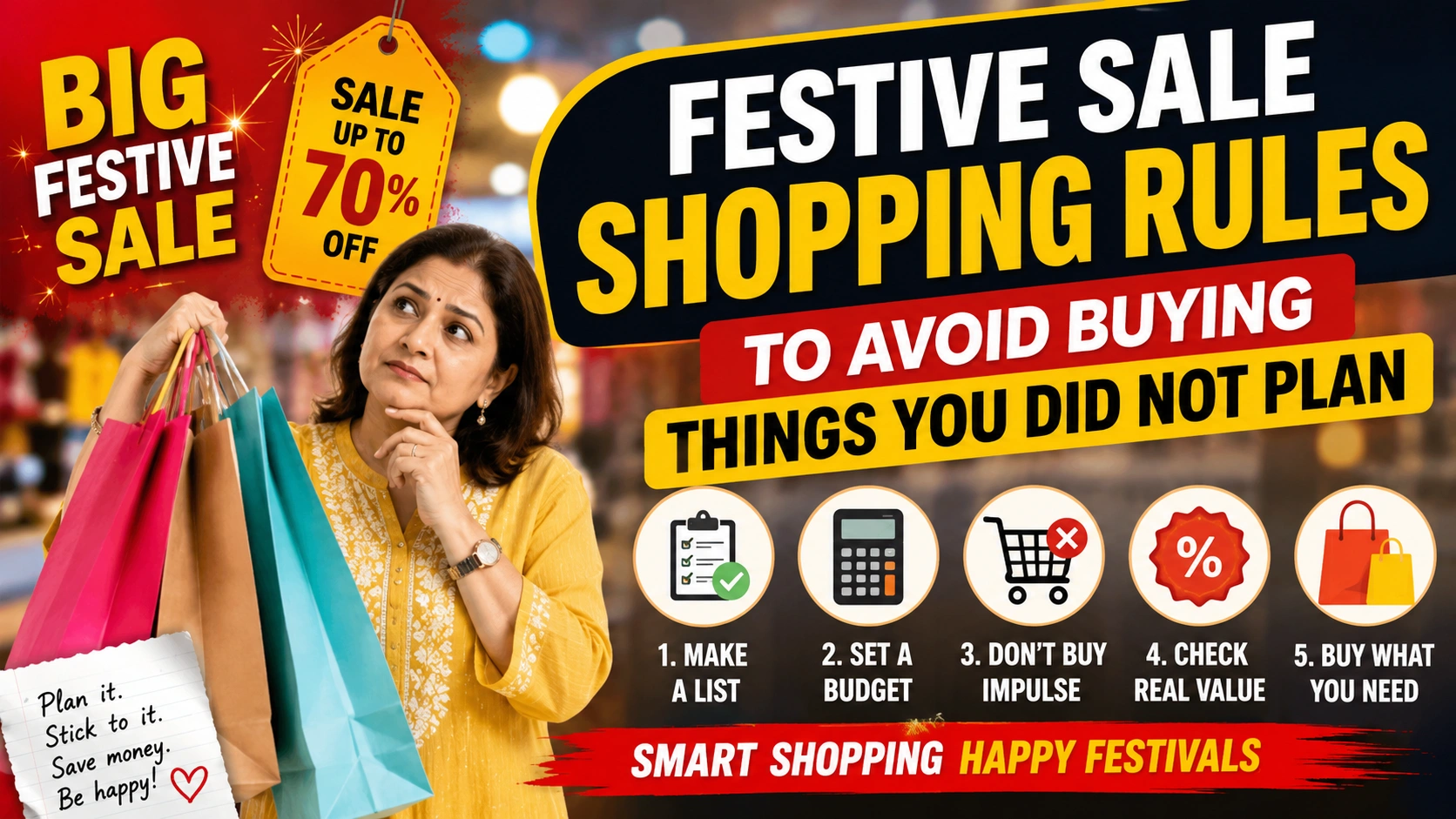
- Why Festive Sales Make Us Buy More
- 1. Make Your Shopping List Before the Sale
- 2. Set a Festive Shopping Budget
- 3. Separate Needs From Wants
- 4. Do Not Shop Just Because the Discount Looks Big
- 5. Use the 24-Hour Rule for Unplanned Purchases
- 6. Do Not Let “Limited Time” Scare You
- 7. Check Your Home Before Buying Home Items
- 8. Do Not Buy Something Just Because It Is Free
- 9. Compare Prices Before Buying
- 10. Be Careful With Cashback and Card Offers
- 11. Keep a Running Total While Shopping
- 12. Avoid Shopping When You Are Bored or Upset
- 13. Do Not Buy Clothes for Every Festival
- 14. Think About Where the Item Will Go
- 15. Do Not Feel Bad About Leaving a Sale Empty-Handed
- A Simple Festive Sale Shopping Checklist
- My Simple Festive Sale Shopping Rules
- How to Make Festive Shopping More Enjoyable
- What to Do After the Sale
- Frequently Asked Questions
- 1. What are the best festive sale shopping rules?
- 2. How can I stop impulse buying during festive sales?
- 3. Is a big discount always a good deal?
- 4. Should I buy extra items to get cashback?
- 5. How can I shop for festivals without overspending?
- 6. What should I do if I see a limited-time festive offer?
- 7. Can I enjoy festive sales without buying many things?
- Conclusion
Festive season is one of my favorite times of the year. The house feels happy, family members are excited, and every shop seems to have colorful decorations and attractive offers. From clothes and kitchen items to home décor, electronics, gifts, and sweets, there is something everywhere.
But there is one small problem with festive sales. They can make us buy things we never planned to buy.
I have done this myself many times. I may open a shopping app just to buy a curtain or a small gift. Then I see a beautiful bag on sale. After that, I notice a kitchen box with a “special price.” Before I know it, my cart has five or six extra things.
Later, I look at the bill and think, “Did I really need all this?”
This is why having some simple festive sale shopping rules can make a big difference. A sale should help us save money on things we already need. It should not make us spend more money just because something has a big discount label.
As the saying goes, “A good deal is only a good deal when you actually need it.”
So, before you start your festive shopping, take a little time to make a plan. These simple rules can help you enjoy the sale without filling your home with unnecessary things.
Why Festive Sales Make Us Buy More
Festive sales are designed to create excitement. We see words like “SALE,” “LIMITED TIME,” “LAST CHANCE,” “EXTRA DISCOUNT,” and “BUY NOW.”
Sometimes these offers are useful. But sometimes they make us feel that we must buy immediately.
The problem is that when we feel rushed, we may stop asking the most important question:
“Do I really need this?”
A discount does not automatically mean that we are saving money. If we spend ₹2,000 on something we did not need, we have not saved ₹500 by getting a discount. We have still spent ₹2,000.
Recent personal finance advice also recommends making a budget, preparing a shopping list, comparing prices, and avoiding pressure-based purchases during festive sales.
That is why my first rule is very simple: plan first, shop later.
Read More: Diwali Cleaning Checklist: 7-Day Room-by-Room Plan for a Happy, Beautiful & Stress-Free Home
1. Make Your Shopping List Before the Sale
The first of my festive sale shopping rules is to make a proper shopping list.
Do not open a shopping app and start looking around without knowing what you need. That is when unnecessary things usually enter the cart.
Take a notebook or use your phone and write down everything you actually plan to buy.
For example:
- New festive clothes
- Gifts for family
- Kitchen items that need replacement
- Festival decorations
- Sweets or food items
- Home cleaning products
- Shoes or other necessary items
Once your list is ready, divide it into two sections:
Need Now
and
Can Wait
This simple method helps you understand what deserves your money first.
If a beautiful item is not on either list, think twice before buying it.
2. Set a Festive Shopping Budget
Before shopping, decide how much money you are comfortable spending.
This is one of the most useful festive sale shopping rules because a budget gives you a clear limit.
For example, you may decide:
| Shopping Category | Planned Budget | Important Rule |
|---|---|---|
| Clothes | ₹4,000 | Buy only planned clothes |
| Gifts | ₹3,000 | Set a limit for each person |
| Home items | ₹2,000 | Replace only what is needed |
| Decorations | ₹1,500 | Reuse items from last year |
| Food and sweets | ₹2,500 | Buy according to family needs |
| Emergency/extra | ₹1,000 | Keep this separate |
| Total | ₹14,000 | Do not cross the total |
You can change these numbers according to your own situation.
The important thing is not the exact amount. The important thing is having a limit.
A budget should feel like a helpful boundary, not a punishment.
3. Separate Needs From Wants
This is one rule I personally find very helpful.
Before buying anything, ask yourself:
“Do I need this, or do I simply want this because it is on sale?”
There is nothing wrong with buying something you want. Festivals are also about happiness. But when every small want becomes a purchase, the total spending can become much bigger than expected.
For example, if your old pressure cooker is damaged, buying a new one may be a real need.
But if your kitchen already has five storage boxes and you see another set at 40% off, that may not be necessary.
A sale should not decide what you need.
You should decide what you need, and then use the sale to get it at a better price.
4. Do Not Shop Just Because the Discount Looks Big
A large discount percentage can be very tempting.
We may see:
50% OFF
or
70% OFF
and immediately think we are getting an amazing deal.
But always look at the final price.
A product that was not needed before the sale is still not needed after the sale.
Also, compare the actual price across different sellers when possible. Some offers have conditions, minimum purchase amounts, cashback limits, or other terms that can change the real saving.
So instead of asking:
“Wow, how much discount am I getting?”
Ask:
“What will I actually pay, and was this already on my list?”
That question can save a lot of money.
5. Use the 24-Hour Rule for Unplanned Purchases
Here is one of my favorite festive sale shopping rules.
If you see something that was not on your list, do not buy it immediately.
Wait for 24 hours.
Add it to a separate wishlist if you are shopping online. If you are in a store, take a photo or simply write down the product name.
After one day, ask yourself:
- Do I still want it?
- Do I really need it?
- Do I have space for it?
- Can I afford it?
- Was it already on my shopping list?
- Would I buy it if there was no sale?
If you still think it is useful and it fits your budget, you can consider buying it.
Many impulse purchases look much less exciting after we have had time to think.
6. Do Not Let “Limited Time” Scare You
Festive sales often use countdown timers and messages such as “only a few left” or “offer ends tonight.”
These messages can make us feel nervous.
We start thinking:
“If I don’t buy this now, I will lose the deal.”
But we should not let a timer make our shopping decisions.
Sometimes the product may really be limited. Sometimes another offer may appear later. Either way, buying something unnecessary just because of a countdown is not smart shopping.
A few minutes of thinking can be worth much more than a quick purchase.
7. Check Your Home Before Buying Home Items
This rule is especially useful for festive shopping.
Before buying decorations, containers, kitchen items, bedsheets, cushions, lamps, or other home products, check what you already have.
I have found things in my cupboards that I completely forgot about!
Sometimes we buy another set of plates while an unused set is already sitting in the cabinet.
Sometimes we buy decoration pieces even though last year’s decorations are still perfectly good.
Before shopping, open your cupboards, drawers, storage boxes, and shelves.
You may discover that you already have enough.
8. Do Not Buy Something Just Because It Is Free
“Buy two, get one free” sounds wonderful.
But ask yourself something simple:
“Would I buy two of these if there was no free item?”
If the answer is no, then the offer may not actually be useful for you.
Free gifts can also make us spend more than planned. A free item has no real value if we would never use it.
This does not mean all bundle offers are bad. If you already need the products and the bundle gives you a genuine saving, it can be useful.
Just make sure the offer is helping your plan rather than changing your plan.
9. Compare Prices Before Buying
Never assume the first sale price is the best price.
If you are buying something expensive, spend a few minutes checking the price from other sellers.
Compare:
- Final price
- Delivery charges
- Warranty
- Return policy
- Product size
- Model or version
- Included accessories
- Seller details
Sometimes a cheaper-looking product may have extra charges at checkout.
Other times, a slightly more expensive option may offer better value.
The cheapest price is not always the best deal. The best value is what matters.
10. Be Careful With Cashback and Card Offers
Cashback can be useful, but it can also encourage extra spending.
Suppose you planned to spend ₹3,000, but a special offer says you will get cashback if you spend ₹5,000.
Do not spend an extra ₹2,000 just to receive cashback.
You have to spend money first.
Before using any payment offer, check its conditions. Look for minimum purchase amounts, maximum cashback, expiry dates, and other charges.
The same rule applies to “no-cost EMI” or similar payment plans. Always understand the full cost and repayment terms before using them.
11. Keep a Running Total While Shopping
This is a very simple habit.
As you add something to your cart, write down the amount.
For online shopping, keep checking your cart total.
For offline shopping, use your phone calculator if needed.
Sometimes we think:
“It is only ₹300.”
Then another item is ₹500.
Then another is ₹700.
Suddenly, those small purchases become ₹2,000 or ₹3,000.
Small amounts can become a big bill when we keep adding them.
A running total helps you stay aware.
12. Avoid Shopping When You Are Bored or Upset
Sometimes shopping is not really about shopping.
We may shop because we are bored, stressed, tired, or simply scrolling on our phones.
Festive sale notifications make this even easier because there is always another product to look at.
If you notice that you are opening shopping apps without needing anything, close the app.
Have some tea. Talk to someone. Clean a room. Watch something you enjoy. Go for a walk.
Come back to shopping later when you have a clear reason.
This small break can prevent many unnecessary purchases.
13. Do Not Buy Clothes for Every Festival
Festivals often make us feel that we need a completely new outfit.
But we do not always need one.
Look through your wardrobe first.
You may already have a beautiful kurta, saree, dress, shirt, or suit that can look fresh with a different dupatta, scarf, jewellery, shoes, or hairstyle.
If you do need something new, buy something that you can wear again.
A good festive outfit should not become a one-day outfit.
Choose clothes that are comfortable and useful beyond one celebration.
14. Think About Where the Item Will Go
Before buying anything for your home, ask:
“Where will I keep this?”
This question has saved me from buying many decorative things.
If you do not have a place for something, you may eventually feel that your home is becoming crowded.
Festivals should bring freshness into the home, not piles of unused things.
Choose items that have a purpose or bring genuine happiness.
15. Do Not Feel Bad About Leaving a Sale Empty-Handed
This is perhaps the most important rule.
Sometimes we feel that going to a sale means we must buy something.
No.
You are allowed to look at a sale and buy nothing.
If nothing on sale matches your list, simply leave it.
You have not missed an opportunity.
You have actually saved money.
Remember:
“The money you do not spend on something unnecessary is money you can use for something that truly matters.”
A Simple Festive Sale Shopping Checklist
Before clicking “Buy Now” or taking the product to the billing counter, ask yourself these questions:
| Question | Yes/No |
|---|---|
| Is this item on my shopping list? | ___ |
| Do I really need it? | ___ |
| Does it fit my budget? | ___ |
| Did I compare the price? | ___ |
| Did I check the final price after charges? | ___ |
| Do I have space for it at home? | ___ |
| Will I use it more than once? | ___ |
| Would I buy it without the discount? | ___ |
| Have I waited before making an impulse purchase? | ___ |
| Am I buying it because I need it, not because of FOMO? | ___ |
If most answers are “No,” put the item back.
Your future self will probably thank you.
My Simple Festive Sale Shopping Rules
After years of shopping for festivals, I have learned that we do not need complicated rules.
My personal list is simple:
1. Make a list.
2. Set a budget.
3. Separate needs from wants.
4. Compare prices.
5. Do not rush because of a countdown.
6. Wait before buying unplanned things.
7. Check what you already have at home.
8. Keep track of every purchase.
9. Be careful with cashback and payment offers.
10. Remember that you do not have to buy anything just because there is a sale.
These festive sale shopping rules are simple enough for anyone to follow.
How to Make Festive Shopping More Enjoyable
Smart shopping does not mean removing all the fun from festivals.
In fact, I think planning makes shopping more enjoyable.
When you know your budget, you do not have to worry about every purchase.
When you have a list, you do not have to spend hours scrolling.
When you know what you need, you can focus on finding good quality instead of buying everything that looks attractive.
You can also involve your family.
Ask children what gifts they really want. Talk to your partner about home purchases. Make a gift list for relatives. Decide together how much you want to spend.
Festivals are about spending time with people we love.
The happiest festival is not the one with the biggest shopping bags. It is the one with the best memories.
What to Do After the Sale
Your shopping plan should not end when the sale ends.
After everything arrives, check your purchases.
Make sure the products are correct and in good condition. Keep bills, invoices, and other important purchase information safely.
If you bought something online, check the return or exchange period.
Most importantly, look at your final spending.
Did you stay within your budget?
Did you buy things from your original list?
Did you make any unnecessary purchases?
Do not feel bad if you made a mistake. Simply learn from it.
Every shopping season teaches us something.
Frequently Asked Questions
1. What are the best festive sale shopping rules?
The best festive sale shopping rules are to make a shopping list, set a budget, compare prices, separate needs from wants, avoid rushed purchases, and wait before buying things that were not planned.
2. How can I stop impulse buying during festive sales?
Make a list before shopping and avoid buying immediately when you see an attractive offer. Use a 24-hour waiting rule for unplanned purchases. If you still need the item after waiting and it fits your budget, then consider buying it.
3. Is a big discount always a good deal?
No. A big discount is useful only when the product is something you actually need and the final price is reasonable. Always compare prices and check the final amount before purchasing.
4. Should I buy extra items to get cashback?
Usually, no. If you need to spend more money just to receive cashback, the offer may not save you money. Check the offer conditions and stay within your original budget.
5. How can I shop for festivals without overspending?
Start with a list and divide your budget into categories such as clothes, gifts, food, decorations, and household items. Track your spending as you shop and avoid buying things that were not planned.
6. What should I do if I see a limited-time festive offer?
Do not panic. First ask whether you actually need the product. Check the price, compare it if possible, and see whether it fits your budget. Never buy something unnecessary only because a timer is counting down.
7. Can I enjoy festive sales without buying many things?
Of course. A sale is an opportunity, not an obligation. You can enjoy looking at offers and buy only the things that are useful, planned, and affordable.
Conclusion
Festive sales can be wonderful when we use them wisely. They can help us buy things we already need at a better price. But when we shop without a plan, those attractive discounts can quickly turn into unnecessary spending.
That is why these festive sale shopping rules are worth keeping in mind.
Make your list. Set your budget. Check what you already have. Compare prices. Take your time. Do not let countdown timers or big discount numbers make your decisions for you.
And most importantly, remember that you do not have to buy something just because it is on sale.
A peaceful festival is worth much more than a cupboard full of things you never planned to buy.
Shop with a plan, save where you can, and enjoy the festival with a happy heart.
Want a professional website designed for your business or blog?
Visit eDigitalized for website design and development services.
Need help or support?
Visit our Contact Us page and get in touch with us.
Want to become a blogger and start your own blog?
Visit WP Bazaar for blogging resources, tools, and helpful guides.

How this guide was prepared
This guide is prepared for everyday readers using practical research, usability checks and editorial review. Product-specific claims should be verified against manufacturer instructions before purchase.
- Reviewed: August 31, 2026
- Next review target: March 3, 2027
- Read our Editorial Policy · Request a correction
How did you like this article?
Your feedback helps us make our stories more useful.

Shweta Pandey
My name is Shweta Pandey, I work as a content writer and I love to write articles. With 4 years of blogging experience I am always ready to inspire others and share knowledge to make them a successful blogger.
Related Articles
 Buying Guides
What to Check Before Buying a Mixer Grinder
Important capacity, safety, warranty and everyday-use checks to make before choosing a mixer grinder.
 Home Products
A Smart Shopping Checklist Before You Buy Home Products
A quick checklist for comparing usefulness, size, maintenance, warranty and total value before buying.
Join the Discussion
Join the conversation and share a useful tip or experience.