- What Decides How Much Electricity an Appliance Uses?
- Quick Look: Appliances Use Most Electricity India
- Which Appliances Use Most Electricity India: The Biggest Ones
- Use the AC Wisely
- Do Not Keep the Geyser Running
- Keep the Refrigerator Healthy
- Switch Off Unused Appliances
- Use Full Loads in the Washing Machine
- Use Natural Light
- Choose Energy-Efficient Appliances
- 1. Which home appliance uses the most electricity in India?
- 2. Does a refrigerator use a lot of electricity?
- 3. Does an AC increase the electricity bill a lot?
- 4. Does switching off the geyser save electricity?
- 5. Which appliances should I check first if my electricity bill is high?
- 6. Are energy-efficient appliances worth buying?
- 7. How can I reduce electricity consumption without buying new appliances?
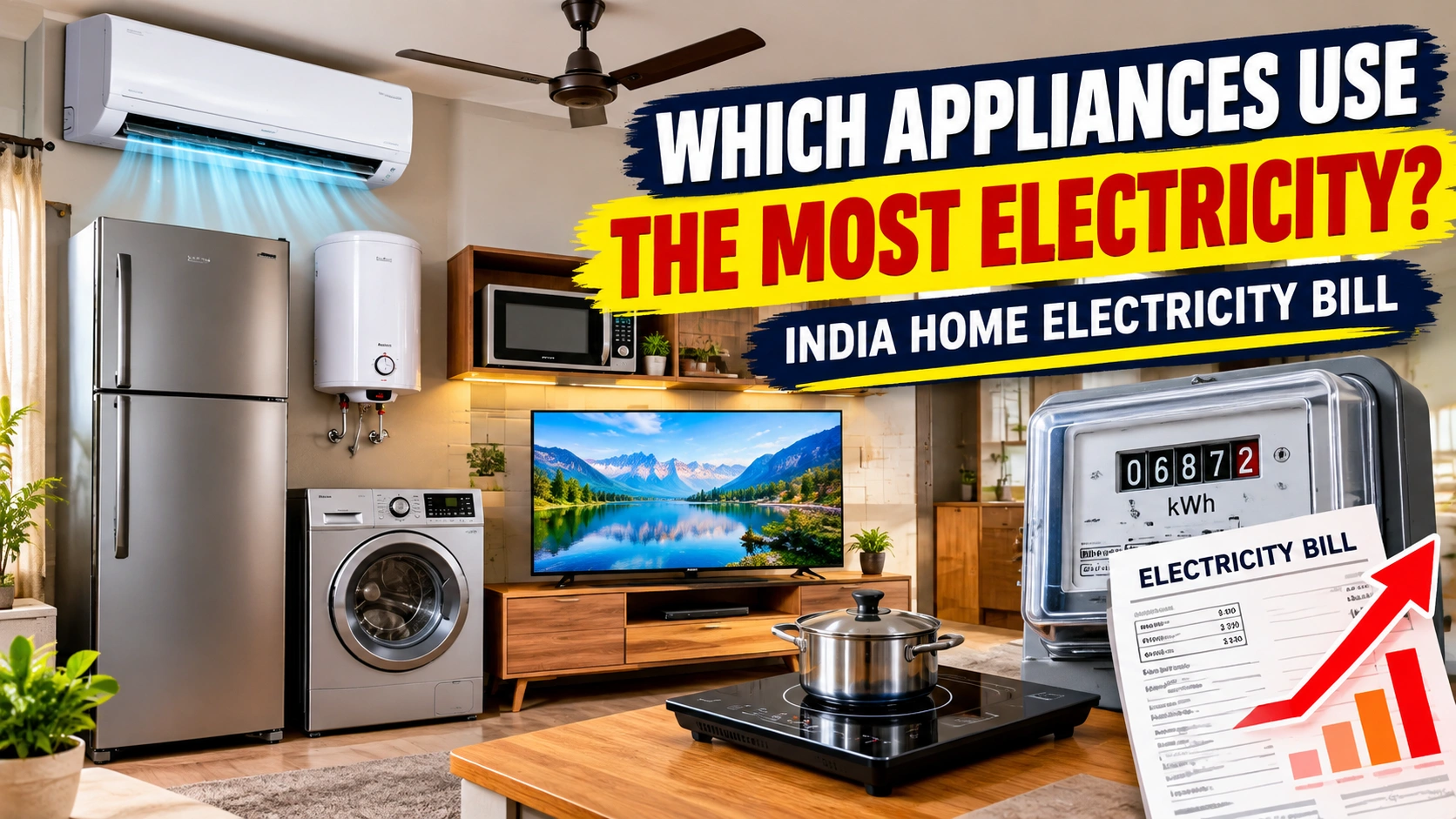
appliances that use most electricity in India: When the electricity bill suddenly becomes higher than usual, the first thing many of us do is wonder, “What is using so much electricity at home?”
We all use many home appliances every day. There is the refrigerator running day and night, the fan running for hours, the television, washing machine, geyser, mixer, microwave, air conditioner and many other things. Each appliance may not look like a big expense on its own, but when we add everything together, the monthly electricity use can become quite high.
I have also noticed that we often blame small appliances for a high bill, while some of the bigger appliances are quietly using much more power.
So, which appliances use most electricity in India?
In most Indian homes, appliances such as air conditioners, electric geysers, room heaters, refrigerators, washing machines, water pumps and electric cooking appliances can have a noticeable effect on electricity use. However, the actual cost depends on the appliance’s power rating, how long it runs, how often it is used and the electricity tariff in your area.
The good news is that we do not always need to stop using these appliances. A few simple habits can help us reduce unnecessary electricity use without making daily life uncomfortable.
What Decides How Much Electricity an Appliance Uses?
Before we look at individual appliances, it is important to understand one simple thing.
An appliance with a high wattage usually uses more electricity when it runs, but running time also matters a lot.
For example, a 2,000-watt appliance used for a short time may consume less electricity than a 100-watt appliance that runs for many hours every day.
The basic idea is:
Electricity used = Power of appliance × Time it is used
Electricity consumption is normally measured in kilowatt-hours (kWh). On your electricity bill, this is commonly shown as units.
For example, if a 1,000-watt appliance runs for one hour, it uses about 1 unit of electricity.
This is why both the power rating and daily usage matter.
Quick Look: Appliances Use Most Electricity India
| Appliance | Typical Power Range | Usual Daily Use | Electricity Impact |
|---|---|---|---|
| Air Conditioner | 1,000–2,500+ W | Several hours | Very High |
| Electric Geyser | 1,500–3,000 W | 15–60 minutes | High |
| Room Heater | 1,000–2,500 W | Several hours | Very High |
| Refrigerator | 100–300 W while running | 24 hours | High over time |
| Water Pump | 500–1,500 W | Short periods | Medium to High |
| Washing Machine | 400–2,000 W | Few hours weekly | Medium |
| Induction Cooktop | 1,200–2,200 W | Daily | Medium to High |
| Microwave Oven | 800–1,500 W | Short periods | Medium |
| Electric Iron | 1,000–2,000 W | Short periods | Medium |
| Television | 50–250 W | Several hours | Low to Medium |
These are general ranges. Actual power use varies by model, settings, size, efficiency and usage.
1. Air Conditioner Can Be One of the Biggest Electricity Users
If you ask me which appliance can make the biggest difference to a summer electricity bill, the air conditioner is near the top of the list.
An AC needs a good amount of electricity to cool a room. If it runs for many hours every day, the monthly electricity consumption can rise quickly.
This is especially true during hot Indian summers when the AC may be running for several hours in the afternoon and at night.
The good thing is that you do not have to stop using your AC. Instead, use it wisely.
Keep doors and windows closed while the AC is running. Clean the filters regularly. Avoid setting the temperature extremely low. Also, make sure direct sunlight is not heating the room unnecessarily.
“Small changes in daily AC use can make a noticeable difference over a whole month.”
2. Electric Geyser Uses a Lot of Power
A geyser is another appliance that can use a surprising amount of electricity.
Most electric geysers have heating elements with fairly high power ratings. The appliance heats water quickly, but that heating requires electricity.
In winter, many families use the geyser more often and for longer periods. This can increase electricity consumption.
One simple habit is to avoid keeping the geyser switched on when you are not using hot water.
If your geyser has a temperature setting, you can also avoid unnecessarily high temperatures.
For families with several people, using hot water carefully can make a bigger difference because the geyser may be used multiple times every day.
3. Room Heater Can Increase Winter Bills
In many parts of India, winters are not extremely cold, but some areas do become quite chilly. Electric room heaters can use a lot of electricity because they are designed to produce heat using electrical power.
A heater may have a high wattage and can run for several hours.
That means a heater used every night for long periods can become one of the appliances that use most electricity in India during the winter season.
If you use one, try to warm the room only when necessary. Keep doors and windows closed while heating the room and switch the heater off when it is no longer needed.
4. Refrigerator Runs All Day
The refrigerator is different from appliances like an iron or mixer.
You may use an iron for 20 minutes, but the refrigerator works throughout the day and night.
It does not necessarily use its full rated power every minute. The compressor switches on and off according to the cooling requirement. Still, because the refrigerator operates continuously, it can contribute significantly to household electricity use.
Keep the refrigerator door closed as much as possible. Do not put very hot food directly inside. Keep enough space around the refrigerator for proper airflow.
Also, check the door seal. If the door does not close properly, the refrigerator may have to work harder to maintain its temperature.
5. Water Pump Can Add to Electricity Use
Many homes use electric water pumps to move water from a tank, underground storage area or other source.
A water pump can have a fairly high power rating, but it usually runs for a shorter period.
The problem comes when the pump is accidentally left running or has to work longer than normal because of a water or plumbing issue.
Check your water storage system regularly. A simple float switch or automatic control can also help prevent unnecessary running.
6. Washing Machine Uses Electricity and Water
A washing machine is very useful, especially for a busy family. But it still uses electricity, particularly during certain washing and heating functions.
The actual electricity use depends on the type of washing machine, washing program, load size and whether hot water is used.
Try to run the washing machine with a proper load instead of washing just a few clothes each time.
Do not overload it either. The aim is to use the machine efficiently.
Using suitable wash programs can also help avoid unnecessary electricity consumption.
7. Induction Cooktop Can Use High Power
Induction cooking has become common in many Indian kitchens. It is quick, clean and convenient.
However, induction cooktops can have a high power rating.
That does not automatically mean they are expensive to use. What matters is how long you use them and at what power level.
For example, using an induction cooktop for a short cooking task may not add a huge amount to the monthly bill. But using it for several hours every day can have a larger effect.
Use the appropriate power setting instead of always using maximum power.
8. Microwave Oven Is Usually Used for Short Periods
A microwave oven can have a fairly high power rating, but most people use it for only a few minutes at a time.
Because of this, its total electricity use may be lower than appliances that operate for many hours.
Still, if you use the microwave several times a day, its consumption can add up.
Try to use the correct setting and avoid running it empty. Also, keep the appliance clean so it works properly.
9. Electric Iron Can Use High Power
An electric iron may be small, but it can have a surprisingly high wattage.
The good news is that most people do not use it continuously for many hours.
If you iron clothes once or twice a week, the total electricity use may be fairly limited compared with an AC or geyser.
One useful habit is to collect clothes and iron them together instead of switching the iron on for one or two items several times during the week.
10. Television and Entertainment Devices
A television normally uses much less power than an AC, geyser or room heater.
But remember that many homes have several entertainment devices.
There may be a TV, set-top box, speakers, gaming system, streaming device and other electronics.
If these devices stay on for many hours every day, their combined electricity use can become noticeable.
Switch off devices when you are finished using them instead of leaving everything running for no reason.
Which Appliances Use Most Electricity India: The Biggest Ones
If I had to make a simple list for an average home, I would pay the most attention to these appliances:
1. Air conditioner
2. Room heater
3. Electric geyser
4. Refrigerator
5. Water pump
6. Induction or other electric cooking appliances
7. Washing machine
8. Electric iron
9. Microwave oven
10. Television and entertainment devices
But this is not a fixed ranking for every home.
For example, one family may use an AC for eight hours every day, while another family may not have an AC at all. One home may use an electric geyser every morning, while another may use solar water heating.
So, your usage pattern matters more than simply looking at the appliance name.
How to Find Which Appliance Is Increasing Your Electricity Bill
If your electricity bill has suddenly increased, do not guess.
Start by looking at your daily habits.
Ask yourself:
- How many hours does the AC run?
- How often is the geyser used?
- Is a room heater being used?
- Does the refrigerator have a problem?
- How often does the washing machine run?
- Is the water pump running longer than usual?
- Are lights or fans being left on?
- Are several electronic devices always plugged in?
You can also check the power rating label on your appliances.
Many appliances have a label showing their wattage or power consumption.
For example, an appliance marked 1,500 W uses more power while operating than one marked 500 W, assuming both are running under comparable conditions.
Read More: 7 Essential Diwali Kitchen Cleaning Checklist for a Happy Home
Simple Ways to Reduce Electricity Use at Home
Reducing your bill does not mean living without modern appliances.
It is mostly about avoiding waste.
Use the AC Wisely
Set a comfortable temperature instead of making the room extremely cold.
Clean filters regularly and keep the room properly closed.
Do Not Keep the Geyser Running
Switch it on when needed and switch it off after use.
Avoid heating water unnecessarily.
Keep the Refrigerator Healthy
Do not keep the door open for a long time.
Check the door seal and keep the refrigerator in a suitable location with enough airflow.
Switch Off Unused Appliances
A TV, computer, speaker or charger does not need to remain active when nobody is using it.
Make it a habit to switch things off after use.
Use Full Loads in the Washing Machine
Instead of running several small loads, plan your washing when possible.
This can save both electricity and water.
Use Natural Light
During the daytime, open curtains and use sunlight instead of switching on every light in the house.
Choose Energy-Efficient Appliances
When buying a new appliance, do not look only at the purchase price.
Check its energy efficiency and expected electricity use too.
A slightly more efficient appliance can be helpful over many years of use.
A Simple Monthly Electricity Check
I find that keeping a small note of appliance use can be surprisingly helpful.
You do not need a complicated spreadsheet.
Just write down the appliances that run for long hours and check how often you use them.
| What to Check | Why It Matters |
|---|---|
| AC usage | Can have a major effect during summer |
| Geyser usage | Heating water needs significant power |
| Heater usage | Can increase winter consumption |
| Refrigerator condition | Runs throughout the day |
| Pump usage | High power but usually short running time |
| Washing machine | Depends on cycles and frequency |
| Cooking appliances | Depends on daily cooking time |
| TV and electronics | Long hours can add up |
| Lights and fans | Multiple units running for long periods matter |
| Appliance condition | Faults can sometimes increase energy use |
This small check can help you understand your own home’s electricity habits.
Does Switching Off Appliances Really Save Electricity?
Yes, switching off appliances when they are not needed is a good habit.
However, the amount saved depends on the appliance.
Switching off a high-power appliance that would otherwise run for hours can make a much bigger difference than switching off a small electronic device for a few minutes.
This is why I always suggest starting with the appliances that have high power ratings or long operating hours.
Should You Replace Old Appliances?
Sometimes, yes.
An old appliance may not work as efficiently as a newer model. But you should not replace a perfectly working appliance only because a newer model exists.
If an appliance is very old, frequently needs repair, performs poorly or uses a lot of electricity, then comparing newer energy-efficient models may make sense.
When buying, look at the energy label and compare the expected electricity use of different models.
Remember, the cheapest appliance to buy is not always the cheapest appliance to own.
What About Fans and Lights?
Fans and lights are used for many hours in Indian homes, so they should not be ignored.
A single fan may not use as much electricity as an AC, but several fans running all day can add up.
LED lights generally use much less electricity than older types of bulbs.
So, if you still have old, inefficient bulbs at home, changing them to efficient LED lighting can be a simple improvement.
The Biggest Lesson About Electricity Bills
The biggest lesson is that high electricity consumption usually comes from a combination of power and time.
A high-power appliance used for a short time may be manageable.
A medium-power appliance used for many hours can also become important.
And a low-power appliance used continuously can still contribute to the bill.
So instead of asking only, “Which appliance uses the most electricity?”, it is better to ask:
“Which appliances in my home are using the most electricity every day?”
That answer will be different for every family.
FAQ for This Article
1. Which home appliance uses the most electricity in India?
Air conditioners, room heaters and electric geysers can be among the biggest electricity users because they often have high power ratings. Their actual consumption depends on how long and how often they are used.
2. Does a refrigerator use a lot of electricity?
A refrigerator can contribute significantly because it operates throughout the day. It does not normally run at full power continuously, but its long operating time makes its electricity use important.
3. Does an AC increase the electricity bill a lot?
It can. An AC may use a considerable amount of electricity, especially when it runs for many hours every day during hot weather.
4. Does switching off the geyser save electricity?
Yes. Switching off the geyser after heating the required water can help avoid unnecessary electricity use.
5. Which appliances should I check first if my electricity bill is high?
Start with appliances that have high power ratings or run for long periods. Check the AC, geyser, room heater, refrigerator, water pump and electric cooking appliances first.
6. Are energy-efficient appliances worth buying?
They can be, especially for appliances that you use regularly for many years. Compare energy ratings and expected electricity use before buying.
7. How can I reduce electricity consumption without buying new appliances?
Start with simple habits. Switch off unused appliances, reduce unnecessary AC and geyser use, use LED lights, avoid running washing machines with very small loads and make sure appliances are maintained properly.
Conclusion
Understanding which appliances use most electricity in India can help us make better choices at home.
The biggest electricity users are often the appliances that either have a high power rating or operate for many hours. Air conditioners, geysers, room heaters, refrigerators and water pumps deserve special attention.
But there is no single appliance that is responsible for every family’s high bill.
Your daily routine matters.
If your AC runs for several hours every day, it may be your biggest electricity user. If you do not use an AC but use an electric geyser often, the geyser may have a bigger impact. In another home, a refrigerator, pump or electric cooking appliance may be more important.
The best way to lower an electricity bill is not to stop using appliances. It is to stop wasting electricity.
Start with the appliances you use the most. Check their power ratings, reduce unnecessary running time and keep them properly maintained.
A few small changes every day can make a meaningful difference over the whole month.
As I always like to say, “Saving electricity starts with noticing where it is being used.”
Want a professional website designed for your business or blog?
Visit eDigitalized for website design and development services.
Need help or support?
Visit our Contact Us page and get in touch with us.
Want to become a blogger and start your own blog?
Visit WP Bazaar for blogging resources, tools, and helpful guides.

How this guide was prepared
This guide is prepared for everyday readers using practical research, usability checks and editorial review. Product-specific claims should be verified against manufacturer instructions before purchase.
- Reviewed: September 8, 2026
- Next review target: March 8, 2027
- Read our Editorial Policy · Request a correction
How did you like this article?
Your feedback helps us make our stories more useful.

Shweta Pandey
My name is Shweta Pandey, I work as a content writer and I love to write articles. With 4 years of blogging experience I am always ready to inspire others and share knowledge to make them a successful blogger.
Related Articles
 Home & Living
Room by Room House Cleaning: How to Clean Without Feeling Overwhelmed In 7 Steps
There was a time when I thought cleaning the whole house had to be done in one big day. I would wake…
 Cleaning
The Ultimate Daily Home Cleaning Checklist for a Spotless, Tidy Home
A daily home cleaning checklist does not always require hours of scrubbing, organizing, and washing. In most cases, the secret to maintaining…
Join the Discussion
Join the conversation and share a useful tip or experience.