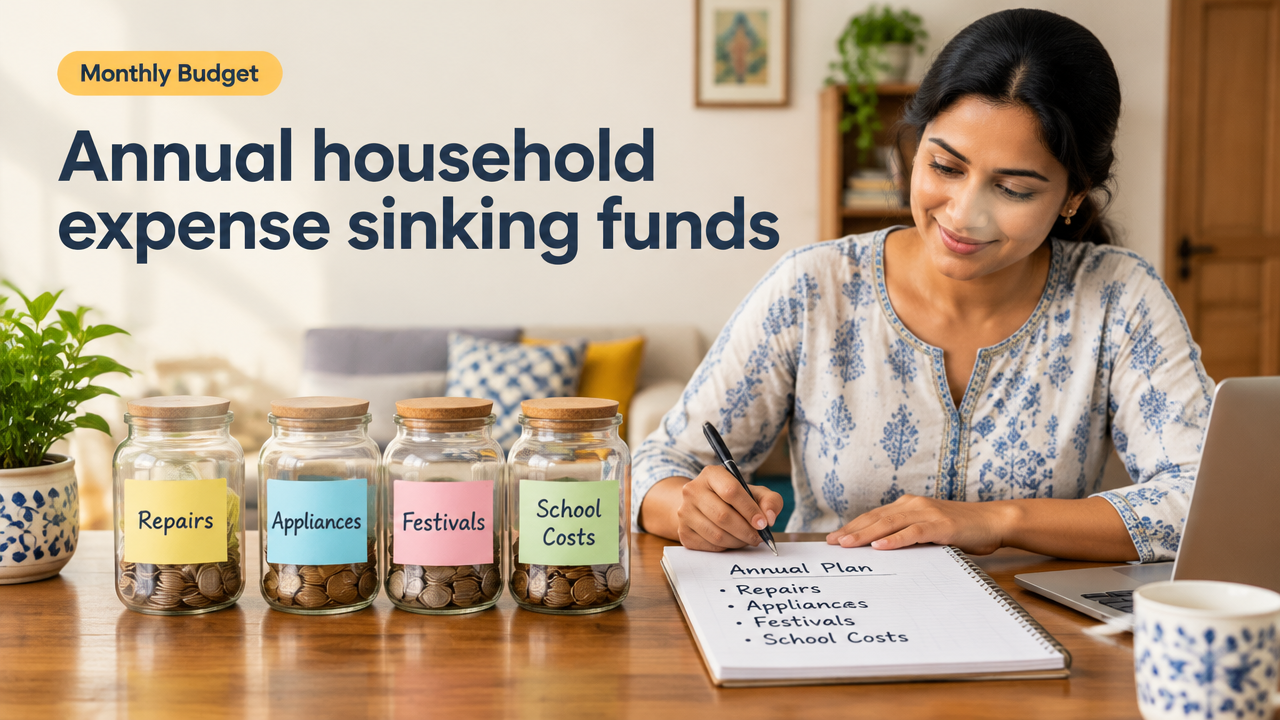
- Who this guide is for
- Why use sinking funds instead of one big emergency pot?
- Step-by-step: set up annual household sinking funds
- Practical table: common sinking funds and how to set targets
- Worked mini-example: family planning for four common costs
- Where to keep sinking funds — practical Indian options
- Printable-style checklist: set up your sinking funds
- How to prioritise when cash is tight
- Common mistakes to avoid
- Quick tips to stretch sinking funds
- Next step
- Helpful internal resources
- Conclusion
- Frequently Asked Questions
- 9 Ways to Save Time on Everyday Household Chores
- Use this plan in your own home
Short answer: Yes. Create separate annual sinking funds (small, dedicated savings) for predictable yearly or multi‑year household costs such as repairs, appliance replacement, festivals and school fees. Estimate an annual target for each fund, divide by months to save, automate monthly transfers and park the money in safe, liquid instruments timed to your payment dates. This prevents borrowing and protects emergency savings.
Updated/Reviewed: 13 October 2026
- First step: List the 4–6 predictable annual household costs and estimate each annual amount using past receipts.
- Time estimate: 60–90 minutes for initial setup (list, targets, and automation); 10–15 minutes monthly to monitor.
- Decision rule: If an expense recurs yearly or every few years and costs > INR 3,000, create a separate sinking fund; if < INR 3,000, include it in a general maintenance fund.
- Tools & materials: Spreadsheet or budgeting app, bank savings account(s) or recurring deposit (RD), auto‑transfer/standing instruction facility, simple labelled envelope or app tags for visibility.
Who this guide is for
This guide is for Indian households who want to plan and save for predictable annual or multi‑year costs — salaried families, freelancers with fluctuating income, retirees managing fixed budgets, and anyone who prefers predictable monthly saving instead of last‑minute borrowing or dipping into emergency funds.
Why use sinking funds instead of one big emergency pot?
Sinking funds are purpose-specific savings set aside regularly for known costs (Diwali, AC servicing, school fees, appliance replacement). They protect your emergency fund (meant for unexpected crises) and make monthly cashflow predictable. Key benefits:
- Reduces reliance on credit cards or high‑interest loans during peak spending months.
- Smaller, planned monthly contributions are easier to budget than large annual spikes.
- Helps prioritise and cut low‑impact spending if cash is tight.
Step-by-step: set up annual household sinking funds
- List predictable annual costs: Include festivals, appliance replacement or major repairs, school fees/uniforms, vehicle insurance & service, home maintenance (painting/plumbing), and seasonal purchases (winter bedding).
- Estimate realistic annual targets: Use receipts, bank statements, vendor quotes and a small buffer (5–15%) for inflation or price fluctuations.
- Decide months to save: If the payment is in a fixed month (e.g., school fees in April), count months until that date; otherwise use 12 months for yearly items.
- Calculate monthly contribution: Monthly = Annual target ÷ months to save. Record each amount in your budget spreadsheet or app.
- Choose where to park funds: Use separate labelled savings accounts, RDs set to mature before the expense, or a single account with clear sub‑tracking in a spreadsheet/app.
- Automate and review: Set standing instructions/auto‑transfers right after payday. Review quarterly and before payment months to adjust targets.
Practical table: common sinking funds and how to set targets
| Category | Example annual target (INR) | Monthly saving (INR) | Suggested vehicle |
|---|---|---|---|
| Festival spending (gifts, groceries) | 30,000 | 2,500 | Saving account / RD |
| Appliance replacement / major repairs | 24,000 | 2,000 | Separate account / RD |
| Annual school fees / uniforms | 36,000 | 3,000 | RD or FD maturing before fees |
| Home maintenance (painting, plumbing) | 12,000 | 1,000 | Savings account |
| Vehicle insurance & service | 8,400 | 700 | Savings account |
Worked mini-example: family planning for four common costs
Example household chooses targets based on past spending and vendor quotes. Calculation steps and reasoning are shown so you can replicate.
| Expense | Annual target (INR) | Months to save | Monthly contribution (INR) |
|---|---|---|---|
| Diwali & festival shopping | 24,000 | 12 | 2,000 |
| Washing machine replacement cushion | 18,000 | 36 | 500 |
| School admission & uniforms | 30,000 | 12 | 2,500 |
| Annual home maintenance | 12,000 | 12 | 1,000 |
| Total | 84,000 | – | 6,000 per month |
How this helps: by saving INR 6,000 per month into labelled sinking funds (or tracking sub‑balances in one account), the household avoids borrowing or using emergency savings when these costs arrive. If monthly capacity is lower, they could stretch the washing machine target to 48 months (INR 375/month) to reduce the monthly load.
Where to keep sinking funds — practical Indian options
- Separate savings accounts: Good for visibility and liquidity; many banks allow multiple accounts or zero‑balance savings options.
- Recurring Deposits (RDs): Useful when you have a fixed monthly contribution and a target date; RDs earn better interest than a basic savings account and can be timed to mature before the expense.
- Fixed Deposits (FDs): Use only when the FD term matches the payment date because early withdrawal may incur penalties.
- Digital wallets / cash envelopes: Best for very short-term festival budgets; maintain safety and documentation if using cash.
- Budgeting apps or spreadsheets: Use category tags or labelled columns to track sub‑balances if you prefer one bank account but need clarity.
Printable-style checklist: set up your sinking funds
- Identify 6–8 predictable annual or multi‑year household costs.
- Collect last 2 years’ receipts or bank statements for each cost.
- Set a conservative annual target for each (include 5–15% buffer if needed).
- Decide how many months you will save and compute monthly contributions.
- Choose parking (savings account, RD, FD) for each fund and label it clearly.
- Set up automatic monthly transfers or standing instructions immediately after salary credit.
- Add calendar reminders to review targets quarterly and before payment months.
- Keep receipts and compare actual expense vs target to improve next year’s estimates.
How to prioritise when cash is tight
Use this decision rule when you cannot fund every category:
- Maintain an emergency fund (3–6 months of essentials) first.
- Prioritise mandatory annual costs (school fees, insurance renewals) over discretionary ones (large festival splurges, nonessential upgrades).
- Stretch the timeline for costly items (save for replacements over 24–36 months instead of 12).
- Temporarily reduce festival budgets and plan lower‑cost celebrations if needed.
Common mistakes to avoid
- Underestimating costs — start with conservative targets and add a small buffer (5–15%).
- Parking short-term sinking funds in volatile investments where value can drop before you need the money.
- Mixing emergency and sinking funds without clear tagging — this increases the chance of misuse.
- Relying on manual transfers alone — set automation to avoid missed savings.
- Not revising targets annually — price changes, school upgrades and appliance lifespans change needs.
Quick tips to stretch sinking funds
- Buy nonperishable festival items on seasonal sales; stagger purchases across months.
- Negotiate service and repair quotes and ask for bundle discounts from trusted local vendors.
- Consider extended warranties or service plans only after checking total ownership cost and repair coverage.
- Consolidate many tiny sinking funds into a single maintenance account if multiple accounts add overhead; track sub‑balances digitally.
Next step
If you have never set sinking funds before: spend 60–90 minutes this weekend to list predictable annual costs, set conservative targets and automate transfers. Use a simple spreadsheet and create calendar reminders for quarterly reviews.
Helpful internal resources
- Guide to which home appliances raise electricity bills — useful when estimating running costs for appliances you may replace.
- Diwali prep timeline: what to do 30, 15, 7 and 1 day before — helps plan festival sinking funds and spending schedule.
- Year-end home admin checklist — use this to gather receipts and finalise annual targets.
- New Year declutter checklist — declutter before festival purchases to reduce spending and storage needs.
Conclusion
Sinking funds transform unpredictable annual payments into manageable monthly actions. With one focused setup session and automated transfers, most Indian households can protect emergency savings, avoid debt and approach festivals, school fees and repairs with predictable cashflow. Start small, automate, review quarterly and adjust targets based on actual spending.
Frequently Asked Questions
Next guide suggestion: read our Year-End Home Admin Checklist to gather receipts and set accurate annual targets.
Use this plan in your own home
Treat the guide as a practical starting point and adjust it for your rooms, materials, appliances, climate, family size and daily routine.
How this guide was prepared
This guide is prepared for everyday readers using practical research, usability checks and editorial review. Product-specific claims should be verified against manufacturer instructions before purchase.
- Reviewed: October 15, 2026
- Next review target: April 15, 2027
- Read our Editorial Policy · Request a correction
How did you like this article?
Your feedback helps us make our stories more useful.

Ashish Pandey
My name is Ashish Pandey, I work as a content writer and I love to write articles. With 4 years of blogging experience I am always ready to inspire others and share knowledge to make them a successful blogger.
Related Articles
 Monthly Budget
How to Plan a Practical Monthly Grocery Budget
A simple method to plan grocery spending, reduce waste and keep household costs easier to track.
Join the Discussion
Join the conversation and share a useful tip or experience.