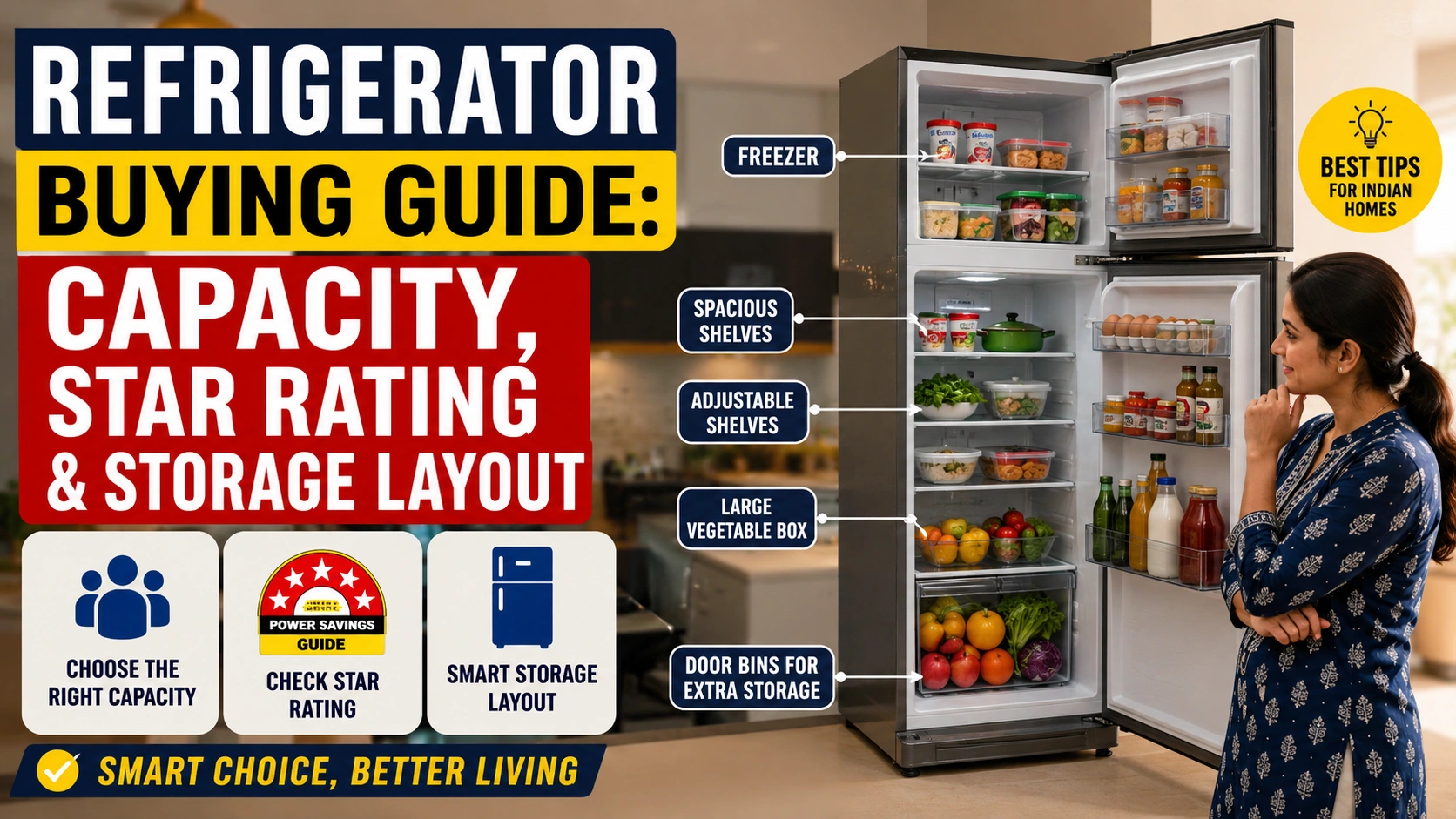
- What Should You Check Before Buying a Refrigerator?
- Refrigerator Capacity: How Many Litres Do You Need?
- Think About Your Shopping Habit
- Single Door Refrigerator
- Double Door Refrigerator
- Side-by-Side Refrigerator
- French Door Refrigerator
- Understanding Star Rating
- Is a 5-Star Refrigerator Always the Best Choice?
- Check the BEE Label Properly
- Storage Layout Is More Important Than You Think
- Adjustable Shelves
- Vegetable and Fruit Drawer
- Door Storage
- Freezer Size
- Make Sure Your Containers Will Fit
- Refrigerator Width, Height and Depth
- Leave Enough Space Around the Refrigerator
- Direct Cool or Frost Free?
- Look at the Compressor and Cooling System
- Important Features Worth Considering
- Smart Refrigerators: Do You Really Need One?
- Warranty and Service Matter
- Price Is Not the Only Cost
- Refrigerator Buying Guide India: A Simple Comparison
- Mistakes to Avoid When Buying a Refrigerator
- Buying the Biggest Refrigerator
- Looking Only at Star Rating
- Forgetting Kitchen Measurements
- Ignoring Shelf Design
- Buying Too Many Features
- Forgetting Door Opening Space
- Not Checking Service
- My Simple Refrigerator Shopping Checklist
- Frequently Asked Questions
- 1. What capacity refrigerator is good for a family of four?
- 2. Is a 5-star refrigerator better than a 3-star refrigerator?
- 3. What is more important: capacity or star rating?
- 4. Is a double-door refrigerator good for an Indian family?
- 5. How much freezer space do I need?
- 6. Should I buy a smart refrigerator?
- 7. What should I check before buying a refrigerator online?
- Final Thoughts
- Important Links and Information
- Blog SEO Details
- What Should You Check Before Buying a Refrigerator?
- Refrigerator Capacity: How Many Litres Do You Need?
- Think About Your Shopping Habit
- Single Door Refrigerator
- Double Door Refrigerator
- Side-by-Side Refrigerator
- French Door Refrigerator
- Understanding Star Rating
- Is a 5-Star Refrigerator Always the Best Choice?
- Check the BEE Label Properly
- Storage Layout Is More Important Than You Think
- Adjustable Shelves
- Vegetable and Fruit Drawer
- Door Storage
- Freezer Size
- Make Sure Your Containers Will Fit
- Refrigerator Width, Height and Depth
- Leave Enough Space Around the Refrigerator
- Direct Cool or Frost Free?
- Look at the Compressor and Cooling System
- Important Features Worth Considering
- Smart Refrigerators: Do You Really Need One?
- Warranty and Service Matter
- Price Is Not the Only Cost
- Refrigerator Buying Guide India: A Simple Comparison
- Mistakes to Avoid When Buying a Refrigerator
- Buying the Biggest Refrigerator
- Looking Only at Star Rating
- Forgetting Kitchen Measurements
- Ignoring Shelf Design
- Buying Too Many Features
- Forgetting Door Opening Space
- Not Checking Service
- My Simple Refrigerator Shopping Checklist
- Frequently Asked Questions
- 1. What capacity refrigerator is good for a family of four?
- 2. Is a 5-star refrigerator better than a 3-star refrigerator?
- 3. What is more important: capacity or star rating?
- 4. Is a double-door refrigerator good for an Indian family?
- 5. How much freezer space do I need?
- 6. Should I buy a smart refrigerator?
- 7. What should I check before buying a refrigerator online?
- Final Thoughts
Buying a refrigerator is not something we do every year. It is one of those home appliances that we buy and then expect to use for many years. That is why I always feel it is better to spend a little time understanding what we actually need before choosing one.
When I was younger, I used to think a refrigerator was simply about keeping food cold. But after managing a home for many years, I have learned that the right refrigerator can make daily kitchen work much easier. The size, shelves, vegetable box, freezer space, door storage, electricity use and even the way we open the doors can make a big difference.
There are so many models in the market today that it can become confusing. One refrigerator may look beautiful, another may have more features, and another may have a higher star rating. Then there is the question of capacity. Do you need 200 litres? 300 litres? 500 litres? And what about double-door, side-by-side or French-door models?
This refrigerator buying guide India is written in simple words to help you understand these things before spending your money.
As the Bureau of Energy Efficiency (BEE) explains, star labels are designed to help consumers compare energy performance and understand the possible energy-saving and cost-saving benefits of appliances. A higher star rating means better energy efficiency within the relevant category.
“A good refrigerator is not always the biggest one. It is the one that fits your family, your kitchen and your daily habits.”
What Should You Check Before Buying a Refrigerator?
Before looking at colours and fancy features, I suggest checking these basic things:
1. Capacity
2. Refrigerator type
3. BEE star rating
4. Annual electricity consumption
5. Storage layout
6. Freezer size
7. Vegetable and fruit storage
8. Door shelves
9. Kitchen space
10. Warranty and after-sales service
These points are more important than simply choosing the model that looks attractive in a showroom.
Refrigerator Capacity: How Many Litres Do You Need?
Capacity is one of the first things people should think about.
A refrigerator that is too small can become difficult to manage. Food gets pushed together, containers do not fit properly, and you may forget what is sitting at the back.
On the other hand, buying a very large refrigerator when you do not need one can take up valuable kitchen space and cost more.
Here is a simple guide:
| Family Size | Approximate Capacity | Suitable For |
|---|---|---|
| 1–2 people | 150–250 litres | Small household and basic daily storage |
| 2–3 people | 200–300 litres | Regular home cooking and moderate storage |
| 3–4 people | 250–400 litres | Family meals, vegetables, fruits and containers |
| 4–5 people | 300–450 litres | Larger grocery shopping and more food storage |
| 5+ people | 400 litres and above | Large family and frequent bulk storage |
These are only general ranges. Your actual requirement depends on how often you shop, how much food you store and how much freezer space you need.
For example, a family of four that buys fresh vegetables every two or three days may not need the same refrigerator as a family of four that shops once a week.
Read More: 12 Simple Summer Electricity Bill Tips For AC, Fans and Refrigerator
Think About Your Shopping Habit
This is a small point, but it can save you from buying the wrong size.
If you buy vegetables, fruits, milk and other fresh items frequently, you may need more fresh-food space.
If you buy frozen food regularly or prepare food in larger quantities, freezer space becomes more important.
So don’t decide capacity only by the number of people in the family.
Single Door Refrigerator
A single-door refrigerator is often a simple choice for a small family or a person living alone.
It usually has one main door and a smaller freezer section inside.
The advantages are:
- Usually simple to use
- Takes less space
- Good for smaller kitchens
- Often suitable for smaller households
- Easy to organize
But the freezer section may be limited compared with larger double-door models.
If you do not store much frozen food, this may not be a problem.
Double Door Refrigerator
Double-door refrigerators are popular with families because the freezer and refrigerator sections are separated.
This gives you more organized storage.
You can usually keep fresh vegetables, fruits, milk, cooked food and other daily items in the main refrigerator section while frozen foods remain in the freezer.
For many Indian families, a double-door model can be a good middle option between a small single-door refrigerator and a very large premium refrigerator.
Side-by-Side Refrigerator
Side-by-side refrigerators are wide and usually provide a large amount of storage.
They can be useful for larger families or people who want plenty of organized space.
However, before buying one, measure your kitchen carefully. A refrigerator may fit inside the kitchen area but still make it difficult to open the doors properly.
Also remember that the wide design does not automatically mean every shelf will be suitable for your containers. Check the actual internal layout.
French Door Refrigerator
French-door refrigerators usually offer a spacious fresh-food section with freezer storage arranged separately.
They can look beautiful and provide flexible storage, but they are often larger and more expensive.
If you are considering one, check your kitchen measurements, door opening space and actual storage needs before buying.
Understanding Star Rating
This is one part of refrigerator shopping that should not be ignored.
In India, the Bureau of Energy Efficiency (BEE) uses a star-rating system to show energy efficiency. The scale goes from 1 star to 5 stars, with 5 stars representing the higher efficiency level in the rating system.
A refrigerator works throughout the year, so electricity consumption matters.
It is tempting to look only at the purchase price, but I think it is better to think about the refrigerator as a long-term household expense.
Is a 5-Star Refrigerator Always the Best Choice?
Not necessarily.
A higher star rating can mean better energy efficiency, but you should compare the actual annual energy consumption shown on the label, along with capacity and price.
A refrigerator with more capacity may naturally use more electricity than a smaller model, even when both have a good rating.
The BEE refrigerator standards use annual energy consumption as an important part of the rating process.
So don’t simply say, “This one has five stars, so I will buy it.”
Instead ask:
How many litres is it?
How much electricity does it use annually?
How much more does it cost than the other model?
That gives you a better picture.
Check the BEE Label Properly
When you are standing in a shop, don’t just look at the number of stars.
Look at the complete label.
The BEE label can include information such as annual energy consumption, brand and model details, technical information, label validity and other details.
BEE also provides tools for consumers to check and compare labelled appliances.
This is useful because two refrigerators can look almost identical while having different energy-use figures.
Storage Layout Is More Important Than You Think
Now comes the part I personally care about a lot: storage layout.
A refrigerator can have a large capacity but still feel small if the shelves and drawers are badly designed.
Before buying, open the refrigerator door and look inside.
Ask yourself:
- Can my regular containers fit?
- Is there enough space between shelves?
- Can I adjust the shelves?
- Is the vegetable box large enough?
- Can I keep tall bottles?
- Are the door bins strong?
- Is the freezer easy to organize?
- Can I easily see food at the back?
A good layout can make a medium-size refrigerator feel much more useful.
Adjustable Shelves
Adjustable shelves are very helpful.
Sometimes we need to keep a tall bottle, a large cooking pot or a big container. If every shelf is fixed, we may have to struggle to make things fit.
With adjustable shelves, you can change the layout according to your needs.
This is one feature I would definitely check before buying.
Vegetable and Fruit Drawer
For Indian kitchens, a good vegetable drawer can be very useful.
We often store potatoes, carrots, tomatoes, leafy vegetables, fruits and other fresh items.
Look for a drawer that is:
Wide, easy to pull out and easy to clean.
Also check whether the drawer can hold the amount of vegetables your family normally buys.
Don’t judge it only by looking at the outside of the refrigerator. Open it and see the actual size.
Door Storage
Door bins are useful for bottles, sauces, jars, milk containers and smaller items.
But too many door bins do not always mean better storage.
Check their depth and strength.
A very narrow bin may look nice but may not hold the bottles you use at home.
“The best storage space is the space you can actually use every day.”
Freezer Size
Think carefully about your freezer habits.
If you regularly keep frozen peas, ice cream, frozen vegetables, meat or other frozen foods, you may want a larger freezer.
If you mostly use the freezer for ice and occasional frozen food, you may not need a huge freezer.
This is one reason why two families with the same number of members can need completely different refrigerators.
Make Sure Your Containers Will Fit
This sounds simple, but it is one of the most common things people forget.
Before buying a refrigerator, think about the containers you already use.
Do you keep stainless-steel cooking pots in the refrigerator?
Do you use large glass containers?
Do you store water bottles?
Do you keep large milk packets or tall bottles?
If yes, check the shelf height carefully.
A refrigerator should fit your kitchen habits, not force you to change everything.
Refrigerator Width, Height and Depth
Never buy a refrigerator based only on its litre capacity.
Measure the place where you plan to keep it.
Check:
Width
Height
Depth
Door opening space
Wall clearance
Path from the main door to the kitchen
That last point is often forgotten.
A refrigerator may fit perfectly in the kitchen but may not pass easily through a narrow doorway or staircase.
If you are replacing an old refrigerator, measure the old space first.
Leave Enough Space Around the Refrigerator
A refrigerator needs proper ventilation according to the manufacturer’s installation requirements.
Do not push it tightly into a corner without checking the instructions.
Also make sure the doors can open fully.
This is especially important for large double-door and side-by-side refrigerators.
Direct Cool or Frost Free?
This is another common question.
Direct Cool refrigerators are generally simpler and may suit people who do not need a large freezer or advanced cooling arrangement.
Frost Free refrigerators automatically manage frost buildup and are commonly available in larger family sizes.
The best choice depends on your family size, budget, storage needs and how you use the freezer.
Look at the Compressor and Cooling System
You may see different compressor technologies and cooling features while shopping.
Instead of getting confused by every technical word, focus on practical questions:
- Is cooling suitable for your use?
- Is the model energy efficient?
- What is the annual electricity consumption?
- Is the warranty clear?
- Is service available in your area?
- Does the refrigerator maintain an even temperature according to the manufacturer’s specifications?
You do not need to become an engineer to buy a refrigerator.
You just need to understand the information that affects your daily use.
Important Features Worth Considering
Modern refrigerators can have many extra features.
Some can be genuinely useful, while others may simply look impressive.
Here are some features you may come across:
Convertible freezer: Can offer flexibility in using freezer space depending on the model.
Inverter compressor: Designed to adjust operation according to cooling demand in compatible models.
Door alarm: Useful if someone often forgets to close the door properly.
Fast cooling: Helpful when you need to cool items quickly, depending on the model.
Deodorizing features: May help manage unwanted smells.
Digital temperature controls: Can make temperature adjustment easier.
Water or ice dispenser: Convenient for some families, but adds another feature to maintain.
My advice is simple: buy useful features, not just impressive features.
Smart Refrigerators: Do You Really Need One?
Smart refrigerators can have connected features, screens, apps and other technology.
They can be interesting, but ask yourself whether you will actually use those features.
If your main requirement is keeping food fresh, storing vegetables and managing electricity use, you may not need to pay extra for technology that you will rarely use.
For me, simple and useful is usually better.
Warranty and Service Matter
A refrigerator is a long-term appliance, so after-sales service is important.
Before buying, check:
- Product warranty
- Compressor warranty
- What parts are covered
- Service availability in your city
- Installation terms
- Customer support
- Repair conditions
Do not assume that a long compressor warranty means every repair will be free.
Read the warranty conditions.
Price Is Not the Only Cost
Suppose one refrigerator is cheaper and another costs more.
The cheaper one may look like the obvious choice.
But think about the complete cost.
You may have:
Purchase price + electricity cost + maintenance + possible repairs
This does not mean you should always buy the most expensive refrigerator.
It means you should look at the bigger picture.
A reasonably priced refrigerator with suitable capacity, good efficiency and a practical layout can be a better choice than an expensive model full of features you never use.
Refrigerator Buying Guide India: A Simple Comparison
| What to Check | Why It Matters | What to Look For |
|---|---|---|
| Capacity | Decides how much food you can store | Choose according to family and shopping habits |
| Star Rating | Helps compare energy efficiency | Check BEE stars and annual energy consumption |
| Annual Energy Use | Helps understand running cost | Compare kWh/year on the label |
| Refrigerator Type | Affects space and organization | Single door, double door, side-by-side or French door |
| Freezer | Important for frozen food storage | Choose according to your actual freezer use |
| Shelves | Affects daily organization | Adjustable and strong shelves |
| Vegetable Box | Useful for fresh produce | Large, accessible and easy to clean |
| Door Bins | Holds bottles and small items | Check depth and strength |
| Dimensions | Must fit your kitchen | Measure width, height and depth |
| Door Opening | Needed for comfortable use | Check surrounding space |
| Warranty | Gives protection after purchase | Read coverage carefully |
| Service | Important for long-term use | Check availability in your area |
Mistakes to Avoid When Buying a Refrigerator
There are a few mistakes I would personally avoid.
Buying the Biggest Refrigerator
Bigger is not always better.
If you don’t need the space, you may simply be paying more for unused capacity.
Looking Only at Star Rating
Stars are important, but do not ignore annual energy consumption, capacity and price.
Forgetting Kitchen Measurements
This can become a very expensive mistake.
Measure first.
Ignoring Shelf Design
Always open the refrigerator and check it yourself.
Buying Too Many Features
Do not pay extra for features you will never use.
Forgetting Door Opening Space
A refrigerator needs room for its doors to open properly.
Not Checking Service
A good warranty is useful, but accessible service is also important.
My Simple Refrigerator Shopping Checklist
Before making the final payment, I would check these things:
- Family size
- Required capacity
- Kitchen measurements
- Freezer requirement
- BEE star rating
- Annual energy consumption
- Shelf layout
- Vegetable drawer
- Door bins
- Container space
- Warranty
- After-sales service
- Final price
If all these points look good, then you can start thinking about colour and appearance.
Frequently Asked Questions
1. What capacity refrigerator is good for a family of four?
A refrigerator around 250 to 400 litres can be suitable for many families of four, but the exact size depends on shopping habits, cooking style and freezer requirements.
2. Is a 5-star refrigerator better than a 3-star refrigerator?
A 5-star refrigerator is rated as more energy efficient than a lower-star model within the applicable rating category. However, compare the actual annual energy consumption and purchase price before deciding. BEE uses star ratings to help consumers compare energy performance.
3. What is more important: capacity or star rating?
Both are important. First choose a capacity that suits your family. Then compare energy efficiency and annual energy consumption among suitable models.
4. Is a double-door refrigerator good for an Indian family?
Yes, a double-door refrigerator can be a practical choice for many families because it provides separate refrigerator and freezer sections. But your final choice should depend on your space, budget and food-storage habits.
5. How much freezer space do I need?
It depends on how much frozen food you store. If you regularly buy frozen items, use ice frequently or freeze food at home, choose a model with more freezer space.
6. Should I buy a smart refrigerator?
Only if you will actually use its smart features. If your main needs are cooling, food storage, energy efficiency and easy cleaning, a simpler model may be enough.
7. What should I check before buying a refrigerator online?
Check the exact capacity, dimensions, star rating, annual energy consumption, refrigerator type, storage layout, warranty and installation details. Also make sure the refrigerator will fit through your doors and into your kitchen.
Final Thoughts
Choosing a refrigerator does not have to be confusing.
The trick is to stop looking only at the outside appearance and start looking at how the refrigerator will work in your home.
Think about your family. Think about how often you shop. Think about how much food you normally keep. Think about your freezer use. Measure your kitchen. Then compare the BEE star rating and annual energy consumption.
Most importantly, open the refrigerator and look inside.
Check the shelves.
Check the vegetable drawer.
Check the door bins.
Check whether your regular containers will fit.
After all, you are going to open that door almost every day.
A refrigerator should make life easier, not create another daily problem.
As the BEE explains, energy labels are meant to help consumers make informed choices by comparing energy performance and potential energy savings.
So, take your time, compare carefully and choose the refrigerator that matches your real needs.
The smartest refrigerator purchase is not necessarily the biggest or the most expensive one. It is the one that gives you the right space, sensible electricity use and easy storage for your everyday life.
“Buy for the home you have, the family you have and the way you actually live.”
Important Links and Information
| Resource | Why It Is Useful |
|---|---|
| Bureau of Energy Efficiency (BEE) | Official information about India’s Standards and Labelling programme |
| BEE Star Label information | Helps understand appliance energy labels and star ratings |
| BEE appliance comparison tools | Useful for checking and comparing labelled appliances |
| Refrigerator BEE standards | Official information about refrigerator energy-consumption standards |
Blog SEO Details
Title: Refrigerator Buying Guide: Capacity, Star Rating and Storage Layout
Focus Keyword: refrigerator buying guide India
Tags: Refrigerator Buying Guide, Refrigerator Buying Guide India, Best Refrigerator Tips, Refrigerator Capacity, BEE Star Rating, Energy Efficient Refrigerator, Refrigerator Storage, Double Door Refrigerator, Kitchen Appliances
Slug: refrigerator-buying-guide-india-capacity-star-rating-storage-layout
Meta Description: Read this simple refrigerator buying guide India to understand capacity, BEE star rating, electricity use, storage layout, freezer space and important features before buying.
Schema Description: A practical and easy-to-understand guide to buying a refrigerator in India, covering capacity, BEE star ratings, annual energy consumption, refrigerator types, freezer space, storage layout, kitchen measurements, warranty and common buying mistakes.
Buying a refrigerator is not something we do every year. It is one of those home appliances that we buy and then expect to use for many years. That is why I always feel it is better to spend a little time understanding what we actually need before choosing one.
When I was younger, I used to think a refrigerator was simply about keeping food cold. But after managing a home for many years, I have learned that the right refrigerator can make daily kitchen work much easier. The size, shelves, vegetable box, freezer space, door storage, electricity use and even the way we open the doors can make a big difference.
There are so many models in the market today that it can become confusing. One refrigerator may look beautiful, another may have more features, and another may have a higher star rating. Then there is the question of capacity. Do you need 200 litres? 300 litres? 500 litres? And what about double-door, side-by-side or French-door models?
This refrigerator buying guide India is written in simple words to help you understand these things before spending your money.
As the Bureau of Energy Efficiency (BEE) explains, star labels are designed to help consumers compare energy performance and understand the possible energy-saving and cost-saving benefits of appliances. A higher star rating means better energy efficiency within the relevant category.
“A good refrigerator is not always the biggest one. It is the one that fits your family, your kitchen and your daily habits.”
What Should You Check Before Buying a Refrigerator?
Before looking at colours and fancy features, I suggest checking these basic things:
1. Capacity
2. Refrigerator type
3. BEE star rating
4. Annual electricity consumption
5. Storage layout
6. Freezer size
7. Vegetable and fruit storage
8. Door shelves
9. Kitchen space
10. Warranty and after-sales service
These points are more important than simply choosing the model that looks attractive in a showroom.
Refrigerator Capacity: How Many Litres Do You Need?
Capacity is one of the first things people should think about.
A refrigerator that is too small can become difficult to manage. Food gets pushed together, containers do not fit properly, and you may forget what is sitting at the back.
On the other hand, buying a very large refrigerator when you do not need one can take up valuable kitchen space and cost more.
Here is a simple guide:
| Family Size | Approximate Capacity | Suitable For |
|---|---|---|
| 1–2 people | 150–250 litres | Small household and basic daily storage |
| 2–3 people | 200–300 litres | Regular home cooking and moderate storage |
| 3–4 people | 250–400 litres | Family meals, vegetables, fruits and containers |
| 4–5 people | 300–450 litres | Larger grocery shopping and more food storage |
| 5+ people | 400 litres and above | Large family and frequent bulk storage |
These are only general ranges. Your actual requirement depends on how often you shop, how much food you store and how much freezer space you need.
For example, a family of four that buys fresh vegetables every two or three days may not need the same refrigerator as a family of four that shops once a week.
Think About Your Shopping Habit
This is a small point, but it can save you from buying the wrong size.
If you buy vegetables, fruits, milk and other fresh items frequently, you may need more fresh-food space.
If you buy frozen food regularly or prepare food in larger quantities, freezer space becomes more important.
So don’t decide capacity only by the number of people in the family.
Single Door Refrigerator
A single-door refrigerator is often a simple choice for a small family or a person living alone.
It usually has one main door and a smaller freezer section inside.
The advantages are:
- Usually simple to use
- Takes less space
- Good for smaller kitchens
- Often suitable for smaller households
- Easy to organize
But the freezer section may be limited compared with larger double-door models.
If you do not store much frozen food, this may not be a problem.
Double Door Refrigerator
Double-door refrigerators are popular with families because the freezer and refrigerator sections are separated.
This gives you more organized storage.
You can usually keep fresh vegetables, fruits, milk, cooked food and other daily items in the main refrigerator section while frozen foods remain in the freezer.
For many Indian families, a double-door model can be a good middle option between a small single-door refrigerator and a very large premium refrigerator.
Side-by-Side Refrigerator
Side-by-side refrigerators are wide and usually provide a large amount of storage.
They can be useful for larger families or people who want plenty of organized space.
However, before buying one, measure your kitchen carefully. A refrigerator may fit inside the kitchen area but still make it difficult to open the doors properly.
Also remember that the wide design does not automatically mean every shelf will be suitable for your containers. Check the actual internal layout.
French Door Refrigerator
French-door refrigerators usually offer a spacious fresh-food section with freezer storage arranged separately.
They can look beautiful and provide flexible storage, but they are often larger and more expensive.
If you are considering one, check your kitchen measurements, door opening space and actual storage needs before buying.
Understanding Star Rating
This is one part of refrigerator shopping that should not be ignored.
In India, the Bureau of Energy Efficiency (BEE) uses a star-rating system to show energy efficiency. The scale goes from 1 star to 5 stars, with 5 stars representing the higher efficiency level in the rating system.
A refrigerator works throughout the year, so electricity consumption matters.
It is tempting to look only at the purchase price, but I think it is better to think about the refrigerator as a long-term household expense.
Is a 5-Star Refrigerator Always the Best Choice?
Not necessarily.
A higher star rating can mean better energy efficiency, but you should compare the actual annual energy consumption shown on the label, along with capacity and price.
A refrigerator with more capacity may naturally use more electricity than a smaller model, even when both have a good rating.
The BEE refrigerator standards use annual energy consumption as an important part of the rating process.
So don’t simply say, “This one has five stars, so I will buy it.”
Instead ask:
How many litres is it?
How much electricity does it use annually?
How much more does it cost than the other model?
That gives you a better picture.
Check the BEE Label Properly
When you are standing in a shop, don’t just look at the number of stars.
Look at the complete label.
The BEE label can include information such as annual energy consumption, brand and model details, technical information, label validity and other details.
BEE also provides tools for consumers to check and compare labelled appliances.
This is useful because two refrigerators can look almost identical while having different energy-use figures.
Storage Layout Is More Important Than You Think
Now comes the part I personally care about a lot: storage layout.
A refrigerator can have a large capacity but still feel small if the shelves and drawers are badly designed.
Before buying, open the refrigerator door and look inside.
Ask yourself:
- Can my regular containers fit?
- Is there enough space between shelves?
- Can I adjust the shelves?
- Is the vegetable box large enough?
- Can I keep tall bottles?
- Are the door bins strong?
- Is the freezer easy to organize?
- Can I easily see food at the back?
A good layout can make a medium-size refrigerator feel much more useful.
Adjustable Shelves
Adjustable shelves are very helpful.
Sometimes we need to keep a tall bottle, a large cooking pot or a big container. If every shelf is fixed, we may have to struggle to make things fit.
With adjustable shelves, you can change the layout according to your needs.
This is one feature I would definitely check before buying.
Vegetable and Fruit Drawer
For Indian kitchens, a good vegetable drawer can be very useful.
We often store potatoes, carrots, tomatoes, leafy vegetables, fruits and other fresh items.
Look for a drawer that is:
Wide, easy to pull out and easy to clean.
Also check whether the drawer can hold the amount of vegetables your family normally buys.
Don’t judge it only by looking at the outside of the refrigerator. Open it and see the actual size.
Door Storage
Door bins are useful for bottles, sauces, jars, milk containers and smaller items.
But too many door bins do not always mean better storage.
Check their depth and strength.
A very narrow bin may look nice but may not hold the bottles you use at home.
“The best storage space is the space you can actually use every day.”
Freezer Size
Think carefully about your freezer habits.
If you regularly keep frozen peas, ice cream, frozen vegetables, meat or other frozen foods, you may want a larger freezer.
If you mostly use the freezer for ice and occasional frozen food, you may not need a huge freezer.
This is one reason why two families with the same number of members can need completely different refrigerators.
Make Sure Your Containers Will Fit
This sounds simple, but it is one of the most common things people forget.
Before buying a refrigerator, think about the containers you already use.
Do you keep stainless-steel cooking pots in the refrigerator?
Do you use large glass containers?
Do you store water bottles?
Do you keep large milk packets or tall bottles?
If yes, check the shelf height carefully.
A refrigerator should fit your kitchen habits, not force you to change everything.
Refrigerator Width, Height and Depth
Never buy a refrigerator based only on its litre capacity.
Measure the place where you plan to keep it.
Check:
Width
Height
Depth
Door opening space
Wall clearance
Path from the main door to the kitchen
That last point is often forgotten.
A refrigerator may fit perfectly in the kitchen but may not pass easily through a narrow doorway or staircase.
If you are replacing an old refrigerator, measure the old space first.
Leave Enough Space Around the Refrigerator
A refrigerator needs proper ventilation according to the manufacturer’s installation requirements.
Do not push it tightly into a corner without checking the instructions.
Also make sure the doors can open fully.
This is especially important for large double-door and side-by-side refrigerators.
Direct Cool or Frost Free?
This is another common question.
Direct Cool refrigerators are generally simpler and may suit people who do not need a large freezer or advanced cooling arrangement.
Frost Free refrigerators automatically manage frost buildup and are commonly available in larger family sizes.
The best choice depends on your family size, budget, storage needs and how you use the freezer.
Look at the Compressor and Cooling System
You may see different compressor technologies and cooling features while shopping.
Instead of getting confused by every technical word, focus on practical questions:
- Is cooling suitable for your use?
- Is the model energy efficient?
- What is the annual electricity consumption?
- Is the warranty clear?
- Is service available in your area?
- Does the refrigerator maintain an even temperature according to the manufacturer’s specifications?
You do not need to become an engineer to buy a refrigerator.
You just need to understand the information that affects your daily use.
Important Features Worth Considering
Modern refrigerators can have many extra features.
Some can be genuinely useful, while others may simply look impressive.
Here are some features you may come across:
Convertible freezer: Can offer flexibility in using freezer space depending on the model.
Inverter compressor: Designed to adjust operation according to cooling demand in compatible models.
Door alarm: Useful if someone often forgets to close the door properly.
Fast cooling: Helpful when you need to cool items quickly, depending on the model.
Deodorizing features: May help manage unwanted smells.
Digital temperature controls: Can make temperature adjustment easier.
Water or ice dispenser: Convenient for some families, but adds another feature to maintain.
My advice is simple: buy useful features, not just impressive features.
Smart Refrigerators: Do You Really Need One?
Smart refrigerators can have connected features, screens, apps and other technology.
They can be interesting, but ask yourself whether you will actually use those features.
If your main requirement is keeping food fresh, storing vegetables and managing electricity use, you may not need to pay extra for technology that you will rarely use.
For me, simple and useful is usually better.
Warranty and Service Matter
A refrigerator is a long-term appliance, so after-sales service is important.
Before buying, check:
- Product warranty
- Compressor warranty
- What parts are covered
- Service availability in your city
- Installation terms
- Customer support
- Repair conditions
Do not assume that a long compressor warranty means every repair will be free.
Read the warranty conditions.
Price Is Not the Only Cost
Suppose one refrigerator is cheaper and another costs more.
The cheaper one may look like the obvious choice.
But think about the complete cost.
You may have:
Purchase price + electricity cost + maintenance + possible repairs
This does not mean you should always buy the most expensive refrigerator.
It means you should look at the bigger picture.
A reasonably priced refrigerator with suitable capacity, good efficiency and a practical layout can be a better choice than an expensive model full of features you never use.
Refrigerator Buying Guide India: A Simple Comparison
| What to Check | Why It Matters | What to Look For |
|---|---|---|
| Capacity | Decides how much food you can store | Choose according to family and shopping habits |
| Star Rating | Helps compare energy efficiency | Check BEE stars and annual energy consumption |
| Annual Energy Use | Helps understand running cost | Compare kWh/year on the label |
| Refrigerator Type | Affects space and organization | Single door, double door, side-by-side or French door |
| Freezer | Important for frozen food storage | Choose according to your actual freezer use |
| Shelves | Affects daily organization | Adjustable and strong shelves |
| Vegetable Box | Useful for fresh produce | Large, accessible and easy to clean |
| Door Bins | Holds bottles and small items | Check depth and strength |
| Dimensions | Must fit your kitchen | Measure width, height and depth |
| Door Opening | Needed for comfortable use | Check surrounding space |
| Warranty | Gives protection after purchase | Read coverage carefully |
| Service | Important for long-term use | Check availability in your area |
Mistakes to Avoid When Buying a Refrigerator
There are a few mistakes I would personally avoid.
Buying the Biggest Refrigerator
Bigger is not always better.
If you don’t need the space, you may simply be paying more for unused capacity.
Looking Only at Star Rating
Stars are important, but do not ignore annual energy consumption, capacity and price.
Forgetting Kitchen Measurements
This can become a very expensive mistake.
Measure first.
Ignoring Shelf Design
Always open the refrigerator and check it yourself.
Buying Too Many Features
Do not pay extra for features you will never use.
Forgetting Door Opening Space
A refrigerator needs room for its doors to open properly.
Not Checking Service
A good warranty is useful, but accessible service is also important.
My Simple Refrigerator Shopping Checklist
Before making the final payment, I would check these things:
- Family size
- Required capacity
- Kitchen measurements
- Freezer requirement
- BEE star rating
- Annual energy consumption
- Shelf layout
- Vegetable drawer
- Door bins
- Container space
- Warranty
- After-sales service
- Final price
If all these points look good, then you can start thinking about colour and appearance.
Frequently Asked Questions
1. What capacity refrigerator is good for a family of four?
A refrigerator around 250 to 400 litres can be suitable for many families of four, but the exact size depends on shopping habits, cooking style and freezer requirements.
2. Is a 5-star refrigerator better than a 3-star refrigerator?
A 5-star refrigerator is rated as more energy efficient than a lower-star model within the applicable rating category. However, compare the actual annual energy consumption and purchase price before deciding. BEE uses star ratings to help consumers compare energy performance.
3. What is more important: capacity or star rating?
Both are important. First choose a capacity that suits your family. Then compare energy efficiency and annual energy consumption among suitable models.
4. Is a double-door refrigerator good for an Indian family?
Yes, a double-door refrigerator can be a practical choice for many families because it provides separate refrigerator and freezer sections. But your final choice should depend on your space, budget and food-storage habits.
5. How much freezer space do I need?
It depends on how much frozen food you store. If you regularly buy frozen items, use ice frequently or freeze food at home, choose a model with more freezer space.
6. Should I buy a smart refrigerator?
Only if you will actually use its smart features. If your main needs are cooling, food storage, energy efficiency and easy cleaning, a simpler model may be enough.
7. What should I check before buying a refrigerator online?
Check the exact capacity, dimensions, star rating, annual energy consumption, refrigerator type, storage layout, warranty and installation details. Also make sure the refrigerator will fit through your doors and into your kitchen.
Final Thoughts
Choosing a refrigerator does not have to be confusing.
The trick is to stop looking only at the outside appearance and start looking at how the refrigerator will work in your home.
Think about your family. Think about how often you shop. Think about how much food you normally keep. Think about your freezer use. Measure your kitchen. Then compare the BEE star rating and annual energy consumption.
Most importantly, open the refrigerator and look inside.
Check the shelves.
Check the vegetable drawer.
Check the door bins.
Check whether your regular containers will fit.
After all, you are going to open that door almost every day.
A refrigerator should make life easier, not create another daily problem.
As the BEE explains, energy labels are meant to help consumers make informed choices by comparing energy performance and potential energy savings.
So, take your time, compare carefully and choose the refrigerator that matches your real needs.
The smartest refrigerator purchase is not necessarily the biggest or the most expensive one. It is the one that gives you the right space, sensible electricity use and easy storage for your everyday life.
“Buy for the home you have, the family you have and the way you actually live.”
Want a professional website designed for your business or blog?
Visit eDigitalized for website design and development services.
Need help or support?
Visit our Contact Us page and get in touch with us.
Want to become a blogger and start your own blog?
Visit WP Bazaar for blogging resources, tools, and helpful guides.

How this guide was prepared
This guide is prepared for everyday readers using practical research, usability checks and editorial review. Product-specific claims should be verified against manufacturer instructions before purchase.
- Reviewed: August 26, 2026
- Next review target: February 26, 2027
- Read our Editorial Policy · Request a correction
How did you like this article?
Your feedback helps us make our stories more useful.

Shweta Pandey
My name is Shweta Pandey, I work as a content writer and I love to write articles. With 4 years of blogging experience I am always ready to inspire others and share knowledge to make them a successful blogger.
Related Articles
 Home & Living
10 Smart Washing Machine Buying Tips You Should Know Before You Buy
Buying a washing machine is not something most of us do every year. It is usually a decision we make after using…
 Buying Guides
What to Check Before Buying a Mixer Grinder
Important capacity, safety, warranty and everyday-use checks to make before choosing a mixer grinder.
Join the Discussion
Join the conversation and share a useful tip or experience.