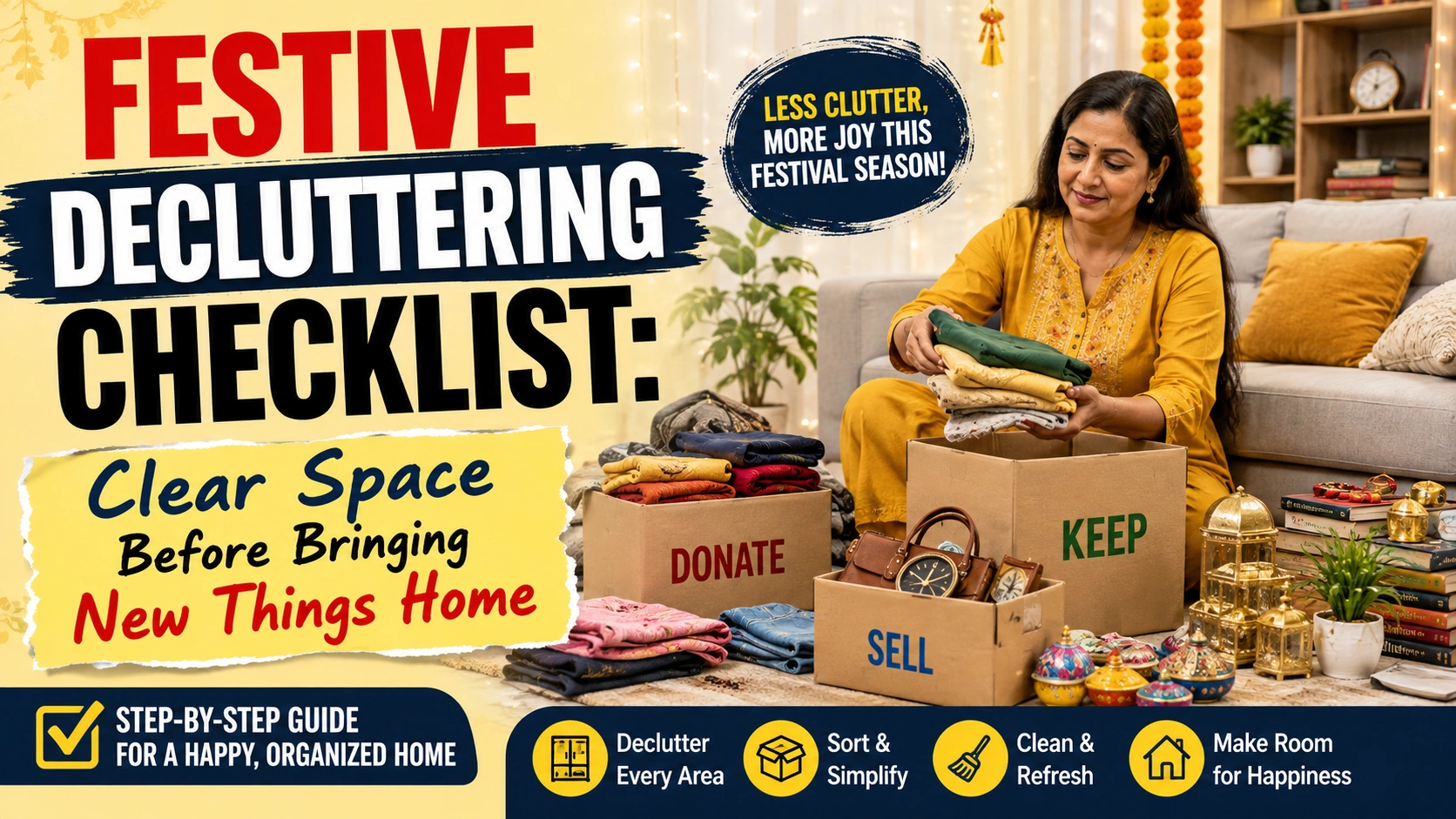
- What Is Festive Decluttering?
- Why Declutter Before Bringing New Things Home?
- Your Festive Decluttering Checklist at a Glance
- Start With One Room at a Time
- 1. Declutter the Wardrobe Before Festival Shopping
- 2. Check the Kitchen Carefully
- 3. Clear the Living Room
- 4. Sort the Decoration Boxes
- 5. Do Not Forget the Bathroom
- 6. Go Through the Storage Area
- 7. Declutter the Kids' Things
- 8. Check Shoes and Bags
- 9. Clean Your Paper and Document Pile
- 10. Look at Your Entryway
- A Simple Rule for Buying New Things
- The 20-Minute Festive Decluttering Routine
- What Not to Declutter
- Make a “Do Not Buy” List
- Give Away Things Before the Festival
- Do Not Try to Make Your Home Perfect
- A 7-Day Festive Decluttering Plan
- My Favorite Festive Decluttering Questions
- Final Festive Decluttering Checklist
- FAQ for Festive Decluttering Checklist
- 1. When should I start using a festive decluttering checklist?
- 2. What should I declutter first before a festival?
- 3. Should I throw away everything I have not used recently?
- 4. How can festive decluttering help with shopping?
- 5. What should I do with clothes and household items I no longer need?
- 6. How can I declutter when I have very little time?
- 7. How do I stop clutter from coming back after the festival?
- Conclusion
Festivals are a beautiful time of the year. The house feels different, the kitchen becomes busy, guests start coming, and we all enjoy buying something new for our home. New clothes, decorations, kitchen items, gifts, storage boxes, sweets, and many other things slowly enter the house.
But there is one small problem.
Before we know it, the house becomes full of things we do not really need.
I have faced this many times myself. A new festival decoration comes home, but there is no proper place to keep it. We buy new clothes, but the cupboard is already packed. We buy new kitchen containers, but old ones are sitting unused in a corner.
This is why I believe a little decluttering before the festive season can make a big difference.
A good festive decluttering checklist does not mean throwing everything away. It simply means looking at what we already have, deciding what we still use, and making some free space for the things that are truly useful.
As I always say, “A clean home does not need to be perfect. It only needs to feel peaceful.”
So, before you bring new things home this festive season, take some time to clear the old clutter. You will be surprised at how much lighter and happier your home can feel.
What Is Festive Decluttering?
Festive decluttering means removing things that are no longer useful, needed, or loved before the festival season begins.
It can include:
- Old clothes
- Broken decorations
- Unused kitchen items
- Extra containers
- Old papers
- Expired products
- Toys nobody uses
- Unused bags
- Damaged furniture
- Duplicate household items
- Old beauty and personal-care products
- Things kept “just in case”
The goal is not to create an empty house.
The goal is to make useful space.
When there is less unnecessary stuff around, cleaning becomes easier, decorating becomes simpler, and finding things takes less time.
Why Declutter Before Bringing New Things Home?
During festivals, we naturally bring more things into the house. We may shop during festive sales, receive gifts from relatives, buy new decorations, or replace old household products.
If we do not clear anything first, the new things simply add to the existing pile.
That is how cupboards become difficult to close and drawers become difficult to open.
I prefer to follow one simple rule:
“Before something new comes in, see if something old can go out.”
This does not mean you have to remove one item for every new item. It simply reminds you to think before buying.
For example, if you are buying new festive clothes, check your cupboard first. Maybe there are clothes you have not worn for years.
If you are buying new serving dishes, look at your kitchen shelf. You may already have more than enough.
This small habit can save space and also save money.
Your Festive Decluttering Checklist at a Glance
Here is a simple table you can use before starting.
| Area | What to Check | What You Can Remove | Final Goal |
|---|---|---|---|
| Wardrobe | Old and unused clothes | Worn, unused or duplicate clothes | More cupboard space |
| Kitchen | Containers and utensils | Broken or duplicate items | Easier cooking |
| Living Room | Decorations and display items | Damaged or unused pieces | Open, clean space |
| Bedroom | Drawers and bedside areas | Papers, old items and clutter | Peaceful room |
| Bathroom | Toiletries | Expired or empty products | Neat shelves |
| Storage Area | Boxes and old items | Things nobody needs | Useful storage space |
| Kids’ Area | Toys and books | Broken or unused items | More playing space |
| Entryway | Shoes and bags | Damaged or unused items | Clean entrance |
| Balcony | Pots and unused items | Broken or unwanted things | Fresh outdoor space |
Start With One Room at a Time
One mistake I used to make was trying to clean the whole house in one day.
It sounds good when we say, “Today I will finish everything.”
But after a few hours, we become tired and lose interest.
Instead, take one room at a time.
Start with the room that feels most crowded. You can spend 30 to 60 minutes there and stop when you feel tired.
The next day, move to another area.
Small progress is still progress.
Keep three bags or boxes nearby:
KEEP – Things you use and need.
DONATE – Things in good condition that someone else may use.
DISCARD – Things that are broken, damaged, empty, or no longer useful.
This simple three-box method makes decisions much easier.
Read More: 7 Powerful Festival Week Routine Tips for a Happy, Stress-Free Home
1. Declutter the Wardrobe Before Festival Shopping
Festival shopping often means new clothes.
Before buying more, open your wardrobe properly.
Do not just look at the clothes hanging in front. Check the shelves, drawers, and bags too.
Ask yourself:
- Have I worn this recently?
- Does it still fit comfortably?
- Is it in good condition?
- Do I really like it?
- Am I keeping it only because I feel guilty throwing it away?
- Do I have something very similar?
If you have clothes that are clean and in good condition but you never wear them, consider giving them to someone who can use them.
Old damaged clothes that cannot be reused should be handled separately according to your local waste or textile-recycling options.
Also check scarves, handbags, shoes, belts, and festive accessories.
You may find several things you completely forgot about.
2. Check the Kitchen Carefully
The kitchen is one place where clutter grows very quickly.
We collect containers, plates, glasses, serving bowls, spoons, gadgets, jars, and many other things.
Before the festive cooking begins, take a good look.
Check for:
- Containers without lids
- Lids without containers
- Cracked storage boxes
- Duplicate utensils
- Old kitchen gadgets
- Unused bottles
- Broken serving items
- Extra mugs
- Old plastic items
- Empty jars you never use
Do not throw away useful things simply because they are old. If something is safe and working well, there is no need to replace it just because a new design is available.
But if you have five similar items and regularly use only two, perhaps the other three can find a new home.
A clean kitchen makes festival cooking much more enjoyable.
3. Clear the Living Room
The living room is usually the first place guests see.
Before putting up new decorations, remove old clutter.
Look at:
- Coffee tables
- Shelves
- TV units
- Side tables
- Display cabinets
- Corners
- Cushions and throws
- Decorative items
Festival decorations look much better when they have some space around them.
You do not need to cover every corner.
Sometimes one beautiful decoration looks better than ten small things placed everywhere.
Remove decorations that are broken, faded, or no longer meaningful to your family.
If something has sentimental value, keep it. Decluttering is not about removing memories.
It is about removing things that no longer serve a purpose.
4. Sort the Decoration Boxes
This is one of my favorite parts of festive decluttering.
Take out your decoration boxes before buying anything new.
You may find old lights, candles, diyas, ribbons, wall hangings, table decorations, and other items.
Check each one.
Ask:
Does it work?
Is it safe to use?
Will I actually use it this year?
Do I have several similar pieces?
If lights or electrical decorations are damaged, do not keep using them. Set aside anything unsafe and dispose of it properly.
Also label your decoration boxes.
For example:
- Diwali decorations
- Lights
- Diyas
- Table decorations
- Gift wrapping
- General festive items
Next year, you will thank yourself.
5. Do Not Forget the Bathroom
Bathrooms are often forgotten during decluttering.
Open the cabinets and check everything.
Remove empty bottles and products that are past their use date or no longer suitable for use.
Organize:
- Shampoo
- Soap
- Toothpaste
- Cleaning products
- Hair-care items
- Towels
- Extra toiletries
Keep everyday items where you can easily reach them.
You do not need ten bottles sitting on the counter.
A clear bathroom feels cleaner even before you start deep cleaning it.
6. Go Through the Storage Area
This can be the hardest part.
Storage spaces often contain things we have not looked at for years.
We keep old boxes because we think they may be useful someday.
We keep broken items because we plan to repair them.
We keep things because someone may need them later.
Sometimes “later” never comes.
Take one box at a time.
Do not empty the entire storage room at once.
Ask yourself:
“If I needed this today, would I know where it was?”
If the answer is no, it may be time to look at that item properly.
Keep useful seasonal items together and label the boxes.
7. Declutter the Kids’ Things
Children grow quickly, so their belongings can pile up.
Before buying new festive clothes, toys, books, or craft items, check what they already have.
Look for:
- Broken toys
- Toys they have outgrown
- Unused school supplies
- Old notebooks
- Clothes that no longer fit
- Books they no longer read
Ask children to help with this process when possible.
Do not simply throw away their belongings without talking to them, especially if an item has emotional value.
You can make it simple by asking them to choose:
Keep – Give – Recycle
This also teaches children that buying something new does not mean keeping everything old.
8. Check Shoes and Bags
Shoes and bags often take more space than we realize.
Take everything out and check each pair.
Remove items that are:
- Damaged beyond practical repair
- Uncomfortable
- Never used
- Outgrown
- Duplicates you do not need
Clean the items you are keeping and arrange them properly.
This will also make getting ready for festival visits much easier.
9. Clean Your Paper and Document Pile
Paper clutter can quietly grow.
Old bills, shopping receipts, instruction papers, packaging slips, newspapers, and unwanted documents can take over drawers.
Spend some time sorting them.
Keep important documents safely.
Recycle papers that are no longer needed, while making sure you do not throw away anything important.
You can create one simple folder for household papers that you may need regularly.
Less paper on the table means less visual clutter in the home.
10. Look at Your Entryway
The entrance sets the feeling of the whole house.
If shoes, bags, parcels, umbrellas, and other items are lying around, the house can feel messy even when the rest is clean.
Before the festival:
- Arrange daily-use shoes
- Remove unused footwear
- Organize bags
- Clear old parcels
- Keep keys in one place
- Clean the entrance area
- Make space for guests’ footwear
You do not need a fancy entrance.
A simple and clean entrance is enough.
A Simple Rule for Buying New Things
After decluttering, you may notice something interesting.
You may not need to buy as much as you planned.
This is one of the biggest benefits of decluttering.
Before buying something, ask these five questions:
- Do I really need it?
- Do I already own something similar?
- Where will I keep it?
- Will I use it regularly?
- Would I still buy it if there was no sale?
That last question is especially useful during festive sales.
A discount does not automatically make something a good purchase.
If you do not need it, you are still spending money.
The 20-Minute Festive Decluttering Routine
If you do not have much time, try a 20-minute routine.
Set aside 20 minutes and choose one small area.
For the first five minutes, collect obvious rubbish and empty packaging.
For the next five minutes, find things that belong somewhere else.
For another five minutes, choose items to donate or give away.
Use the last five minutes to arrange the space.
Then stop.
You do not need to finish the whole house.
You can repeat this every day for a week.
After seven days, you may have a surprisingly different home.
What Not to Declutter
Decluttering does not mean becoming careless.
There are some things you should not remove simply because they are old.
Do not throw away:
- Important documents
- Family photographs
- Sentimental items
- Useful tools
- Emergency supplies
- Important household records
- Items that are used only seasonally
- Things belonging to another family member without asking
Also, do not feel pressured to throw away something just because another person thinks it is unnecessary.
Every home is different.
Your home should work for your family, not for someone else’s idea of a perfect home.
Make a “Do Not Buy” List
This is a small trick that can save both space and money.
After decluttering, write down things you already have enough of.
For example:
| Already Have Enough | Avoid Buying More Unless Needed |
|---|---|
| Serving bowls | Extra serving bowls |
| Storage containers | More containers |
| Festival lights | More lights |
| Gift bags | More gift bags |
| Candles | Extra candles |
| Decorative pieces | Similar decorations |
| Mugs | More mugs |
| Cleaning cloths | Extra cloths |
Keep this list with you when shopping.
It is much easier to control festive shopping when you know what is already sitting at home.
Give Away Things Before the Festival
If you have things in good condition that you no longer use, try to give them away before the festive season.
Clothes, books, kitchen items, toys, and other useful household things may be helpful to someone else.
Do not wait until the last day.
Clean and sort the items first.
Pack them neatly.
And please remember, donation is not a way to get rid of rubbish. Give away things that are clean, safe, and usable.
Do Not Try to Make Your Home Perfect
This is something I have learned with age.
There will always be another drawer to clean.
There will always be another shelf that needs organizing.
There will always be things that get messy again.
That is normal.
The purpose of this festive decluttering checklist is not to create a picture-perfect home.
It is to make your home easier to live in during a busy and happy season.
You should still have time to cook, meet family, visit friends, enjoy your decorations, and sit down with a cup of tea.
A festival is meant to be enjoyed, not spent entirely cleaning.
A 7-Day Festive Decluttering Plan
If you want to make the process easier, follow this simple seven-day plan.
| Day | Area | Main Task |
|---|---|---|
| Day 1 | Wardrobe | Sort clothes, shoes and accessories |
| Day 2 | Kitchen | Remove duplicates and broken items |
| Day 3 | Living Room | Clear shelves, tables and decorations |
| Day 4 | Bedroom | Sort drawers, bedside areas and cupboards |
| Day 5 | Bathroom | Check toiletries and storage |
| Day 6 | Storage | Sort boxes and seasonal items |
| Day 7 | Whole Home | Final check and quick cleaning |
You do not need to work for hours each day.
Even 30 minutes can be enough for a small area.
My Favorite Festive Decluttering Questions
Whenever I am confused about keeping something, I ask myself:
“Have I used this in the last year?”
“Would I buy this again today?”
“Do I have space for it?”
“Is it useful or am I only keeping it because I feel bad letting it go?”
These questions make decluttering much easier.
Sometimes we keep things because of memories, guilt, or the thought that they may be useful someday.
But our homes also need breathing space.
Final Festive Decluttering Checklist
Before you start festive shopping, quickly check these points:
- Sort old clothes
- Check shoes and bags
- Remove broken kitchen items
- Match containers with lids
- Sort old decorations
- Test festive lights safely
- Clear living-room surfaces
- Organize storage boxes
- Check bathroom products
- Sort children’s toys and books
- Recycle unwanted papers
- Clear the entrance
- Create a donation bag
- Create a discard bag
- Label seasonal storage boxes
- Make a “do not buy” list
- Check what you already own before shopping
FAQ for Festive Decluttering Checklist
1. When should I start using a festive decluttering checklist?
It is best to start one to two weeks before the festival, if possible. This gives you enough time to sort things without feeling rushed. Even if you have only a few days, start with the most crowded areas.
2. What should I declutter first before a festival?
Start with areas where new things are most likely to enter, such as the wardrobe, kitchen, living room, storage area, and decoration boxes. These areas usually benefit the most from early decluttering.
3. Should I throw away everything I have not used recently?
No. Not every unused item needs to be thrown away. Seasonal items, sentimental belongings, important documents, and useful emergency items may not be used often but can still be important.
4. How can festive decluttering help with shopping?
When you declutter first, you can see what you already own. This can stop you from buying duplicates. It also helps you make a simple shopping list based on actual needs instead of buying things just because they are on sale.
5. What should I do with clothes and household items I no longer need?
If they are clean, safe, and in good condition, you can consider giving them to family, friends, or a suitable local donation organization. Items that are damaged or unsafe should be handled through suitable recycling or waste options where available.
6. How can I declutter when I have very little time?
Use the 20-minute method. Choose one small area and work only on that space. Remove rubbish, put misplaced items back, and separate things you no longer need. Small daily sessions are much easier than trying to clean the entire house at once.
7. How do I stop clutter from coming back after the festival?
Try a simple habit: before bringing something new home, decide where it will live. Also, once a month, spend 15 to 20 minutes checking one small area. Regular small cleaning is easier than waiting for clutter to become a big problem.
Conclusion
Festivals bring happiness, family time, good food, beautiful decorations, and many lovely memories. But sometimes we get so busy buying and preparing that we forget to look at what we already have.
A little decluttering before the festival can change that.
You do not need to clean every corner or throw away half of your belongings. Just start slowly. Open one cupboard. Clear one shelf. Sort one drawer. Fill one donation bag.
The purpose of this festive decluttering checklist is simple: make room for what matters.
When there is less clutter, decorating becomes easier. Cooking becomes more comfortable. Shopping becomes more thoughtful. Cleaning takes less time. And your home feels more open.
Most importantly, you can enjoy the festival without feeling that your house is working against you.
As I like to remind myself, “Make room not only for new things, but also for new memories.”
So before you bring something new home this festive season, take a little time to clear the old.
Your future self will be happy you did.
Want a professional website designed for your business or blog?
Visit eDigitalized for website design and development services.
Need help or support?
Visit our Contact Us page and get in touch with us.
Want to become a blogger and start your own blog?
Visit WP Bazaar for blogging resources, tools, and helpful guides.

How this guide was prepared
This guide is prepared for everyday readers using practical research, usability checks and editorial review. Product-specific claims should be verified against manufacturer instructions before purchase.
- Reviewed: September 4, 2026
- Next review target: March 4, 2027
- Read our Editorial Policy · Request a correction
How did you like this article?
Your feedback helps us make our stories more useful.

Shweta Pandey
My name is Shweta Pandey, I work as a content writer and I love to write articles. With 4 years of blogging experience I am always ready to inspire others and share knowledge to make them a successful blogger.
Related Articles
 Women & Life
7 Powerful Festival Week Routine Tips for a Happy, Stress-Free Home
Festival time is one of my favorite times of the year. The house feels different, the kitchen stays busy, family members come…
 Lifestyle & Wellness
Amazing Diwali Prep Timeline: What to Do 30, 15, 7 and 1 Day Before
Diwali is one festival that can make the whole house feel different. The lights, sweets, family time, shopping, rangoli and small traditions…
Join the Discussion
Join the conversation and share a useful tip or experience.