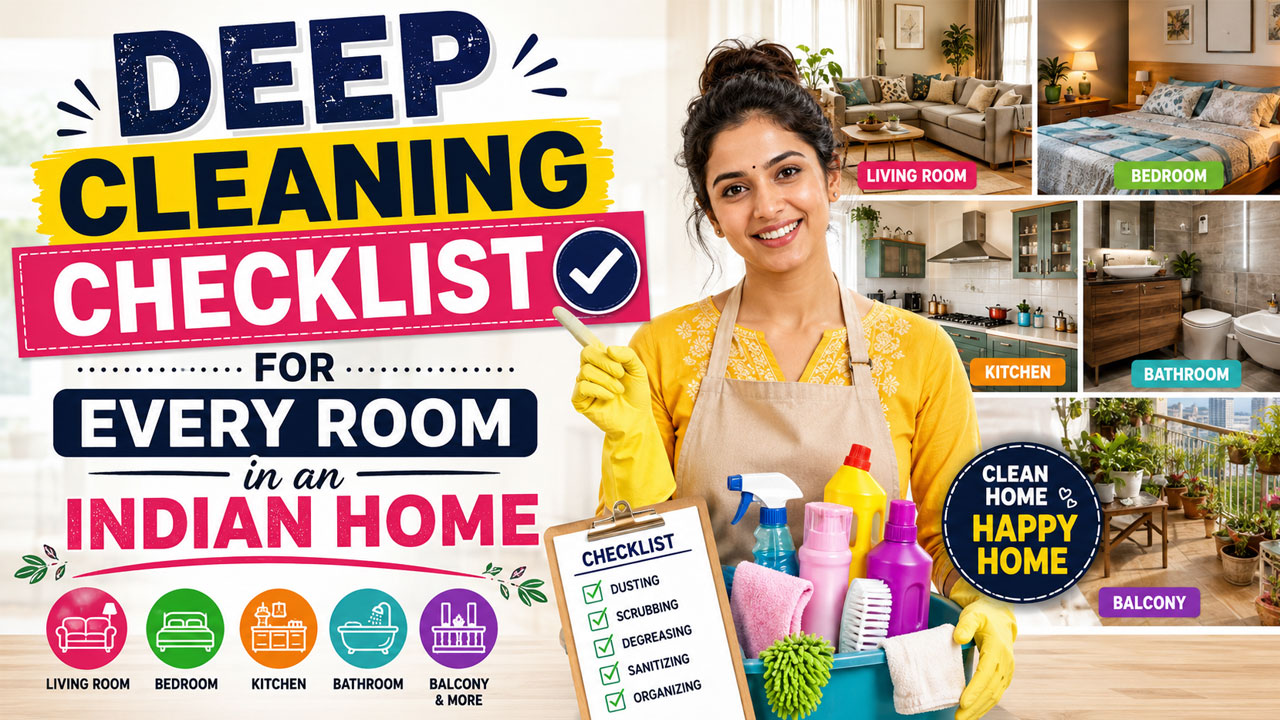
- What Is Deep Cleaning?
- Why Indian Homes Need a Regular Deep Cleaning Routine
- Quick Deep Cleaning Checklist Home: At a Glance
- Essential Cleaning Supplies Before You Start
- The Best Order for Deep Cleaning Your Home
- 1. Living Room Deep Cleaning Checklist
- Ceiling and Upper Areas
- Walls and Doors
- Sofa and Upholstery
- Curtains and Blinds
- Electronics
- Living Room Floor
- 2. Bedroom Deep Cleaning Checklist
- Bed and Mattress
- Wardrobe Deep Cleaning
- Bedroom Furniture
- Bedroom Windows
- Bedroom Air Conditioner
- 3. Kitchen Deep Cleaning Checklist
- Kitchen Ceiling and Walls
- Kitchen Cabinets
- Kitchen Countertops
- Kitchen Sink
- Gas Stove and Cooktop
- Chimney and Exhaust Fan
- Refrigerator Deep Cleaning
- Microwave
- Other Kitchen Appliances
- 4. Bathroom Deep Cleaning Checklist
- Bathroom Ceiling and Walls
- Tiles and Grout
- Shower Area
- Toilet
- Wash Basin
- Bathroom Exhaust Fan
- Bathroom Storage
- 5. Dining Area Deep Cleaning Checklist
- 6. Balcony Deep Cleaning Checklist
- 7. Entrance and Shoe Rack Deep Cleaning
- 8. Utility and Laundry Area
- 9. Windows and Window Tracks
- 10. Fans, Lights, Switches and Doors
- Ceiling Fans
- Light Fixtures
- Switches
- Doors
- 11. Deep Cleaning Forgotten Areas
- 12. Home Deep Cleaning Checklist by Frequency
- 13. Festival Deep Cleaning Checklist for Indian Homes
- 14. Monsoon Deep Cleaning Checklist
- 15. How to Declutter Before Deep Cleaning
- 16. How to Make Deep Cleaning Faster
- Use One Cleaning Kit
- Work Room by Room
- Start High
- Use Microfiber Cloths
- Clean Before Organising
- Do Not Overuse Cleaning Products
- Use Appropriate Tools
- Ask for Help
- 17. When Should You Hire Professional Deep Cleaning Services?
- 18. Important Safety Tips for Deep Cleaning
- 19. Printable Deep Cleaning Checklist Home
- Whole Home
- Living Room
- Bedrooms
- Kitchen
- Bathrooms
- Balcony
- Utility Area
- Important Information for a Deep Cleaning Routine
- Frequently Asked Questions About Deep Cleaning Checklist Home
- 1. What is included in a deep cleaning checklist for home?
- 2. How often should I deep clean my Indian home?
- 3. What should I clean first during a deep clean?
- 4. Should the kitchen be deep cleaned every month?
- 5. How often should I clean ceiling fans?
- 6. How do I deep clean a bedroom?
- 7. What areas are most commonly forgotten during home cleaning?
- 8. Can I deep clean my home myself?
- 9. Is deep cleaning different from regular cleaning?
- 10. What should I clean before Diwali?
- 11. How can I deep clean my home without getting overwhelmed?
- 12. Is baking soda safe for every household surface?
- 13. Can vinegar be used everywhere in the home?
- 14. How do I keep my home clean after deep cleaning?
- 15. What is the most important part of a deep cleaning checklist home routine?
- Conclusion
A clean home feels comfortable, welcoming, and easier to manage, but regular sweeping, mopping, dusting, and wiping are not always enough. Over time, dust settles behind furniture, grease builds up around kitchen surfaces, soap residue collects in bathrooms, and dirt accumulates in window tracks, fans, cupboards, mattresses, curtains, and other less-visible areas.
That is where deep cleaning becomes important.
A proper deep cleaning checklist home routine goes beyond making rooms look tidy. It focuses on the places that are often ignored during everyday cleaning. For Indian homes, deep cleaning can be particularly useful because homes may deal with road dust, cooking fumes, humidity, monsoon moisture, hard-water deposits, pollution, frequent cooking, and seasonal cleaning before festivals.
The good news is that deep cleaning does not have to mean cleaning the entire house in one exhausting day. With a room-by-room system, you can divide the work into manageable sections and make sure nothing important gets forgotten.
This complete guide provides a practical deep cleaning checklist home plan for Indian households. It covers the living room, bedrooms, kitchen, bathrooms, dining area, balcony, entrance, utility area, appliances, storage spaces, and commonly forgotten areas.
Whether you live in a compact apartment, a 2BHK, a 3BHK, an independent house, or a larger family home, you can adapt this checklist according to your space.
What Is Deep Cleaning?
Deep cleaning is more detailed than routine household cleaning.
Regular cleaning usually includes activities such as sweeping floors, mopping, washing dishes, wiping kitchen counters, cleaning bathrooms, removing visible dust, and taking out the garbage.
Deep cleaning focuses on areas that are not necessarily cleaned every day or every week. This may include:
- Cleaning ceiling fans and light fixtures
- Washing or cleaning curtains
- Cleaning window frames and tracks
- Cleaning underneath and behind furniture
- Cleaning inside cupboards and drawers
- Degreasing kitchen cabinets and appliances
- Cleaning refrigerator interiors
- Scrubbing bathroom tiles and grout
- Cleaning mattress surfaces
- Washing sofa covers and cushions
- Cleaning balcony corners and grills
- Removing cobwebs from ceilings and corners
- Cleaning switches, handles, doors, and other high-touch surfaces
A well-organised deep cleaning approach helps you work systematically instead of moving randomly from one task to another.
Why Indian Homes Need a Regular Deep Cleaning Routine
Indian homes can experience several conditions that make detailed cleaning necessary.
Cooking is an important part of everyday life, and frequent frying, tadka, spices, and oil-based cooking can gradually leave a layer of grease around the kitchen. During monsoon, humidity can make some areas damp, while windows and balconies can collect dust throughout the year.
In cities, outdoor pollution and road dust can enter through windows, balconies, doors, and ventilation areas. In many homes, ceiling fans also accumulate considerable dust because they remain above eye level.
Festival seasons are another common reason Indian families deep clean their homes. Before Diwali and other major celebrations, many households clean cupboards, walls, windows, kitchens, balconies, storage areas, and decorative items.
A practical room-by-room checklist helps ensure that these areas are not missed.
Read More: 12 Smart Ways to Organize a Small Kitchen
Quick Deep Cleaning Checklist Home: At a Glance
| Area | Important Deep Cleaning Tasks | Suggested Attention |
|---|---|---|
| Living Room | Sofa, curtains, fan, windows, electronics, furniture, floors | Monthly or seasonal |
| Bedrooms | Mattress, bedding, wardrobe, fan, windows, under-bed area | Monthly to quarterly |
| Kitchen | Chimney, cabinets, refrigerator, microwave, tiles, sink | Monthly |
| Bathroom | Tiles, grout, toilet, shower, exhaust fan, storage | Weekly to monthly |
| Dining Area | Table, chairs, floor, lights, décor | Monthly |
| Balcony | Floor, grills, windows, drains, plants | Monthly or as needed |
| Entrance | Door, handles, mats, shoe rack, switches | Weekly to monthly |
| Utility Area | Washing machine, storage, floor, pipes, drains | Monthly |
| Windows | Glass, tracks, frames, grills, sills | Every few months |
| Storage | Cupboards, drawers, shelves, unused items | Every 3–6 months |
The exact frequency depends on your home, number of residents, cooking habits, weather, dust levels, and lifestyle.
Essential Cleaning Supplies Before You Start
Before beginning a deep clean, gather everything you need. Searching for supplies halfway through the process can make cleaning unnecessarily slow.
A basic cleaning kit can include:
- Microfiber cloths
- Soft cleaning brushes
- Stiff scrub brush
- Small old toothbrush for corners
- Bucket
- Mop
- Vacuum cleaner, if available
- Extendable duster
- Glass-cleaning cloth
- Sponge
- Rubber gloves
- Garbage bags
- Mild all-purpose cleaner
- Suitable kitchen degreaser
- Bathroom cleaner
- Dishwashing liquid
- Baking soda for appropriate cleaning applications
- White vinegar for suitable surfaces
- Clean water
Always read the manufacturer’s instructions before using a cleaning product.
Do not mix cleaning chemicals unless the product instructions specifically allow it. In particular, avoid mixing bleach with acids, vinegar, ammonia, or other household chemicals because dangerous fumes can result.
The Best Order for Deep Cleaning Your Home
One of the easiest ways to make deep cleaning more efficient is to follow the right order.
A useful sequence is:
- Declutter the room.
- Remove items that do not belong there.
- Start cleaning from high surfaces.
- Clean fans, lights, ceilings, and upper areas.
- Clean walls, windows, and furniture.
- Clean appliances and storage spaces.
- Vacuum or sweep thoroughly.
- Mop the floor.
- Return clean and organised items to their places.
The basic principle is simple: work from top to bottom and from dry cleaning to wet cleaning.
This prevents dust from falling onto surfaces that you have already cleaned.
1. Living Room Deep Cleaning Checklist
The living room is often the busiest area of an Indian home. Family members spend time there, guests may sit there, and dust can accumulate on furniture, curtains, electronics, and decorative items.
Ceiling and Upper Areas
Start from the top.
- Remove cobwebs from ceiling corners.
- Dust ceiling fan blades.
- Clean the fan motor housing carefully.
- Dust light fixtures and chandeliers.
- Wipe accessible ceiling vents.
- Check corners around air-conditioner units.
- Remove visible dust from wall-mounted fixtures.
Be careful when cleaning electrical fixtures. Turn off electricity where appropriate and avoid spraying liquid directly onto electrical components.
Walls and Doors
Inspect walls for fingerprints, stains, dust, and marks.
Clean:
- Door surfaces
- Door frames
- Door handles
- Light switches
- Switch plates
- Wall marks
- Corners
- Skirting or baseboards
Test cleaning products on an inconspicuous area first, especially on painted walls.
Sofa and Upholstery
The sofa can collect a surprising amount of dust.
Deep clean the sofa by:
- Removing cushions.
- Vacuuming underneath cushions.
- Vacuuming cracks and corners.
- Cleaning sofa covers according to their care instructions.
- Washing removable cushion covers when suitable.
- Spot-cleaning stains using an appropriate product.
- Cleaning the sides and back of the sofa.
- Cleaning underneath the furniture.
For delicate upholstery, leather, silk, velvet, or expensive fabrics, follow the manufacturer’s cleaning instructions or consider professional cleaning.
Curtains and Blinds
Curtains can collect dust even when they look clean.
Depending on the fabric:
- Vacuum or dust curtains.
- Wash removable curtains according to their care label.
- Dry-clean fabrics that require dry cleaning.
- Dust curtain rods.
- Wipe curtain brackets.
- Clean blinds one section at a time.
Electronics
Clean televisions, speakers, remotes, gaming consoles, routers, and other electronics carefully.
Use a dry or appropriately damp microfiber cloth rather than spraying liquid directly onto the device.
Pay attention to:
- Remote controls
- Television stand
- Router
- Speaker surfaces
- Cable areas
- Charging stations
Living Room Floor
Move lightweight furniture where possible.
Then:
- Vacuum or sweep the entire floor.
- Clean under the sofa.
- Clean behind furniture.
- Clean corners.
- Clean rugs and carpets according to their material.
- Mop hard floors using a suitable floor cleaner.
2. Bedroom Deep Cleaning Checklist
Bedrooms should feel comfortable, organised, and fresh. Because people spend many hours sleeping in bedrooms, bedding, mattresses, curtains, and other fabric surfaces deserve regular attention.
Bed and Mattress
Remove all bedding before starting.
Clean:
- Bedsheets
- Pillow covers
- Mattress protectors
- Blankets
- Duvets
- Pillows according to care instructions
- Headboard
- Bed frame
- Area underneath the bed
Vacuum the mattress surface if the manufacturer’s instructions permit it.
If the mattress has stains or moisture damage, use a cleaning method appropriate for its material. Avoid soaking a mattress unnecessarily because trapped moisture can create additional problems.
Wardrobe Deep Cleaning
A wardrobe can become dusty and overcrowded over time.
Take everything out of one section at a time.
Then:
- Remove unnecessary items.
- Vacuum shelves and corners.
- Wipe shelves with an appropriate cloth.
- Clean wardrobe doors and handles.
- Check for moisture or signs of insects.
- Refold clothes.
- Organise clothes by category.
- Return only clean and dry items.
This is also a good time to separate clothes that are damaged, unused, or no longer needed.
Bedroom Furniture
Dust and wipe:
- Bedside tables
- Dressing table
- Mirrors
- Drawers
- Shelves
- Lamps
- Headboard
- Chair surfaces
- Furniture legs
Do not forget the tops of wardrobes and cabinets.
Bedroom Windows
Clean:
- Window glass
- Frames
- Sills
- Tracks
- Grills
- Curtain rods
Window tracks often collect fine dust and insects, so use a small brush or vacuum crevice attachment before wiping them.
Bedroom Air Conditioner
If you have an AC:
- Turn it off before cleaning.
- Clean accessible filters according to the manufacturer’s instructions.
- Wipe the exterior.
- Keep vents free from visible dust.
- Arrange professional servicing if deeper internal cleaning is required.
3. Kitchen Deep Cleaning Checklist
The kitchen deserves special attention because it combines food, moisture, heat, oil, grease, and frequent use.
For many Indian homes, the kitchen should be one of the highest-priority areas in any deep cleaning checklist home routine.
Kitchen Ceiling and Walls
Look for:
- Grease deposits
- Dust
- Cobwebs
- Cooking residue
- Water marks
Clean washable surfaces using a suitable cleaner.
Kitchen Cabinets
Empty cabinets one section at a time.
Then:
- Remove crumbs.
- Vacuum or wipe shelves.
- Clean cabinet doors.
- Clean handles.
- Wipe drawer interiors.
- Check expired food.
- Organise containers.
- Keep frequently used items accessible.
Allow surfaces to dry completely before replacing food or utensils.
Kitchen Countertops
Clean countertops after removing appliances and containers.
Pay attention to:
- Corners
- Backsplash
- Areas around appliances
- Seams
- Wall edges
- Frequently touched areas
Use a cleaning product compatible with your countertop material. Natural stone, marble, granite, laminate, and engineered surfaces may require different care.
Kitchen Sink
Deep clean the sink and surrounding area.
- Remove food particles.
- Scrub the basin.
- Clean the faucet.
- Clean around the faucet base.
- Clean the drain area.
- Wash the sink strainer.
- Wipe the backsplash.
- Dry the area after cleaning.
Do not mix different drain or cleaning chemicals.
Gas Stove and Cooktop
Remove removable parts where appropriate.
Clean:
- Burners according to the manufacturer’s instructions
- Pan supports
- Knobs
- Cooktop surface
- Areas around burners
- Wall behind the stove
Grease should be removed regularly because accumulated grease becomes harder to clean later.
Chimney and Exhaust Fan
Kitchen exhaust systems can accumulate oil and grease.
Clean accessible filters according to the manufacturer’s instructions.
For heavily greasy chimney filters or internal components, professional servicing may be safer and more effective.
Refrigerator Deep Cleaning
Empty the refrigerator.
Then:
- Discard expired food.
- Remove shelves and drawers if removable.
- Clean interior surfaces.
- Clean door compartments.
- Wipe rubber door seals.
- Clean the exterior.
- Clean the top of the refrigerator.
- Dry all parts before replacing food.
Organise food by category so that older products are easier to use first.
Microwave
Clean:
- Turntable
- Interior walls
- Ceiling of the microwave
- Door
- Handle
- Exterior
Always disconnect or follow the manufacturer’s safety instructions before deep cleaning.
Other Kitchen Appliances
Depending on your home, inspect:
- Mixer grinder
- Air fryer
- Toaster
- Electric kettle
- OTG
- Oven
- Dishwasher
- Water purifier exterior
Each appliance should be cleaned according to its manufacturer’s instructions.
4. Bathroom Deep Cleaning Checklist
Bathrooms require regular cleaning because they are exposed to water, soap, moisture, and mineral deposits.
For a deeper bathroom clean, work systematically.
Bathroom Ceiling and Walls
Remove:
- Cobwebs
- Dust
- Visible moisture marks
- Surface dirt
Check corners for persistent dampness or mould. If mould keeps returning, cleaning alone may not solve the underlying moisture problem.
Tiles and Grout
Scrub:
- Wall tiles
- Floor tiles
- Grout lines
- Corners
- Areas around the shower
- Areas behind the toilet
Use a suitable tile and grout cleaner.
Avoid harsh products on surfaces that may be damaged by acids or abrasive cleaners.
Shower Area
Clean:
- Showerhead exterior
- Faucet
- Shower glass
- Shower floor
- Wall surfaces
- Soap holder
- Shower drain
Hard-water deposits may require a suitable descaling product.
Toilet
Clean:
- Toilet bowl
- Toilet seat
- Lid
- Exterior
- Base
- Flush handle
- Surrounding floor
Use a toilet cleaner designed for the surface and follow the label directions.
Wash Basin
Deep clean:
- Basin
- Faucet
- Drain area
- Counter
- Mirror
- Storage cabinet
- Soap dispenser
Clean water spots around the faucet carefully.
Bathroom Exhaust Fan
Dust can accumulate on exhaust fan covers.
Turn off power before cleaning and follow the manufacturer’s instructions. If the fan needs internal servicing, consider professional help.
Bathroom Storage
Empty cabinets and shelves.
Remove:
- Empty bottles
- Expired products
- Unused containers
- Old cleaning products
Wipe the shelves and return only items that are needed.
5. Dining Area Deep Cleaning Checklist
The dining area may look clean after wiping the table, but deep cleaning should go further.
Clean:
- Dining table top
- Table edges
- Table legs
- Chair seats
- Chair backs
- Chair legs
- Wall near the dining table
- Light fixtures
- Floor
- Rugs
- Storage cabinets
Pay particular attention to areas where food crumbs collect.
If the dining table is made from wood, marble, glass, or another special material, use a cleaner appropriate for that surface.
6. Balcony Deep Cleaning Checklist
Balconies are often exposed to outdoor dust, rain, pollution, leaves, and insects.
Start by removing plants, furniture, and loose items where possible.
Then clean:
- Balcony floor
- Corners
- Railings
- Grills
- Windows
- Window tracks
- Drain area
- Walls
- Ceiling
- Outdoor furniture
- Plant stands
Check the balcony drain carefully and remove leaves or debris that could block water flow.
Never push dirt or waste into a drain where it could cause a blockage.
For high-rise apartments, avoid unsafe leaning or climbing over railings. Use safe tools or professional help for difficult exterior areas.
7. Entrance and Shoe Rack Deep Cleaning
The entrance is one of the first areas people notice when entering a home.
Clean:
- Main door
- Door frame
- Door handle
- Doorbell area
- Light switches
- Shoe rack
- Floor
- Doormat
- Decorative items
- Storage shelves
Empty the shoe rack periodically and remove shoes that are damaged or no longer used.
Wash or clean the doormat according to its material.
8. Utility and Laundry Area
If your home has a separate utility area, do not ignore it.
Clean:
- Washing machine exterior
- Washing machine detergent compartment
- Accessible filter according to manufacturer instructions
- Floor
- Walls
- Storage shelves
- Buckets
- Mops
- Cleaning tools
- Utility sink
- Water connections
Keep cleaning tools dry when possible.
A damp mop left in a closed corner can develop an unpleasant smell, so allow it to dry properly after use.
9. Windows and Window Tracks
Windows are among the most commonly overlooked areas in routine cleaning.
A deep clean should include:
- Glass
- Frames
- Tracks
- Sills
- Grills
- Handles
- Mosquito screens
Start by removing dry dust before using liquid cleaner. This helps prevent muddy buildup.
Clean one window at a time so you can finish the entire area before moving on.
10. Fans, Lights, Switches and Doors
These items exist throughout the home and should be included in your whole-house checklist.
Ceiling Fans
Clean:
- Top of fan blades
- Bottom of blades
- Motor housing
- Canopy
Light Fixtures
Dust accessible fixtures carefully.
Turn off power before cleaning electrical fixtures.
Switches
Wipe switch plates and frequently touched areas with a suitable slightly damp cloth. Do not spray liquid directly into switches.
Doors
Clean:
- Door panels
- Handles
- Locks
- Frames
- Hinges where accessible
- Areas around handles
11. Deep Cleaning Forgotten Areas
The difference between ordinary cleaning and deep cleaning often comes down to the forgotten spaces.
Add these areas to your deep cleaning checklist home:
- Under beds
- Behind sofas
- Behind cabinets
- Under refrigerators
- Behind appliances where safely accessible
- Top of wardrobes
- Top of kitchen cabinets
- Window tracks
- Curtain rods
- Fan tops
- Light fixture tops
- Door frames
- Corners behind furniture
- Storage boxes
- Shoe racks
- Remote controls
- Cable management areas
- AC vents
- Exhaust fan covers
- Dustbins
You do not necessarily have to clean every forgotten area every week. The goal is to make sure they are not permanently forgotten.
12. Home Deep Cleaning Checklist by Frequency
A practical schedule prevents deep cleaning from becoming overwhelming.
| Cleaning Task | Suggested Frequency |
|---|---|
| General dusting | Several times a week as needed |
| Floor sweeping | Daily or as needed |
| Floor mopping | Several times a week or as needed |
| Bathroom detailed cleaning | Weekly |
| Kitchen surface cleaning | Daily |
| Kitchen deep cleaning | Monthly |
| Refrigerator deep cleaning | Monthly or as needed |
| Fan cleaning | Monthly to quarterly |
| Sofa deep cleaning | Every few months |
| Mattress cleaning | Every few months |
| Curtains | According to fabric and dust level |
| Windows | Every few months |
| Wardrobe cleaning | Every 3–6 months |
| Balcony deep cleaning | Monthly or as needed |
| Full-home deep cleaning | Seasonally or as needed |
These are general planning intervals rather than strict rules. Homes with children, pets, high dust exposure, heavy cooking, or higher humidity may require more frequent cleaning.
13. Festival Deep Cleaning Checklist for Indian Homes
Festival cleaning is a tradition in many Indian households.
Before a major festival, consider prioritising:
- Ceiling fans
- Walls
- Windows
- Curtains
- Sofa covers
- Carpets
- Kitchen cabinets
- Refrigerator
- Kitchen chimney
- Bathroom tiles
- Wardrobes
- Storage areas
- Balcony
- Entrance
- Decorative items
- Lamps and light fixtures
- Doors and handles
Instead of trying to complete everything on one day, divide the work across several days.
For example:
| Day | Focus Area |
|---|---|
| Day 1 | Decluttering and storage |
| Day 2 | Bedrooms |
| Day 3 | Living and dining areas |
| Day 4 | Kitchen |
| Day 5 | Bathrooms |
| Day 6 | Windows and balcony |
| Day 7 | Final dusting and floor cleaning |
This approach can make festival preparation much less stressful.
14. Monsoon Deep Cleaning Checklist
Monsoon conditions can introduce additional moisture and humidity into the home.
Pay extra attention to:
- Balcony drains
- Bathroom corners
- Kitchen sink areas
- Window tracks
- Damp walls
- Shoe racks
- Wardrobes
- Under-sink storage
- Utility areas
- AC areas
- Curtains
- Floor corners
Keep wet items from remaining in closed spaces for long periods.
If you notice persistent dampness, water leakage, or recurring mould, address the source rather than repeatedly cleaning the visible area.
15. How to Declutter Before Deep Cleaning
Deep cleaning becomes easier when there is less clutter.
Use three broad categories:
| Category | What to Do |
|---|---|
| Keep | Clean and organise properly |
| Donate | Set aside usable items you no longer need |
| Discard | Dispose of damaged or unusable items responsibly |
Do not clean and reorganise things you have already decided you no longer need.
Start with one drawer, shelf, cupboard, or room instead of trying to declutter the entire house simultaneously.
16. How to Make Deep Cleaning Faster
Deep cleaning can take a lot of time, but good planning can reduce unnecessary effort.
Use One Cleaning Kit
Keep frequently used supplies together so you do not repeatedly walk between rooms.
Work Room by Room
Finish one area before moving to another.
Start High
Clean fans, shelves, cabinets, and upper surfaces before floors.
Use Microfiber Cloths
Microfiber cloths are useful for dusting and wiping many household surfaces.
Clean Before Organising
Do not spend time organising dusty shelves. Empty, clean, dry, and then organise.
Do Not Overuse Cleaning Products
More product does not automatically mean better cleaning. Follow label directions.
Use Appropriate Tools
A small brush can be much more effective than a large cloth for window tracks, corners, and tight spaces.
Ask for Help
Large homes can be divided among family members. One person can handle the kitchen while another works on bedrooms or the living room.
17. When Should You Hire Professional Deep Cleaning Services?
DIY cleaning is suitable for many household tasks, but some jobs may be better handled by professionals.
Consider professional help for:
- High or difficult-to-reach areas
- Heavy sofa cleaning
- Large carpets
- Difficult stains
- Deep mattress cleaning
- Chimney servicing
- AC servicing
- Persistent mould
- Post-renovation dust
- Large homes
- Move-in or move-out cleaning
- Severe grease buildup
- Areas requiring specialised equipment
Professional cleaning can also be useful when you have limited time or when a home has accumulated significant dirt over a long period.
18. Important Safety Tips for Deep Cleaning
Cleaning should never compromise your safety.
Keep these points in mind:
- Read product labels before use.
- Never mix cleaning chemicals unless specifically instructed.
- Keep children away from cleaning products.
- Store chemicals safely after use.
- Wear gloves when appropriate.
- Keep rooms ventilated when using cleaning products.
- Turn off electrical equipment before cleaning.
- Do not spray liquids directly onto electrical appliances.
- Use stable equipment for high areas.
- Do not climb unsafe furniture.
- Keep floors dry where possible to prevent slipping.
- Follow manufacturer instructions for appliances and surfaces.
If a cleaning job requires unsafe heights, electrical work, appliance disassembly, or specialised equipment, it is better to seek professional assistance.
19. Printable Deep Cleaning Checklist Home
Use this master checklist when planning a full-home deep clean.
Whole Home
- Remove cobwebs
- Dust ceiling fans
- Clean light fixtures
- Wipe switches
- Clean doors and handles
- Clean windows
- Clean window tracks
- Clean furniture
- Clean under furniture
- Vacuum or sweep floors
- Mop floors
- Empty unnecessary clutter
Living Room
- Vacuum sofa
- Clean cushions
- Wash sofa covers
- Clean curtains
- Dust electronics
- Clean remote controls
- Clean furniture
- Clean rugs
- Clean corners
- Clean behind furniture
Bedrooms
- Wash bedsheets
- Wash pillow covers
- Clean mattress
- Clean bed frame
- Clean under bed
- Clean wardrobe
- Organise clothes
- Clean dressing table
- Clean mirrors
- Clean curtains
- Clean windows
- Clean fan
Kitchen
- Clean countertops
- Clean backsplash
- Clean cabinets
- Clean drawers
- Clean sink
- Clean faucet
- Clean stove
- Clean burners
- Clean chimney filter
- Clean exhaust fan
- Clean refrigerator
- Clean microwave
- Clean other appliances
- Clean kitchen floor
Bathrooms
- Clean toilet
- Clean basin
- Clean faucets
- Scrub tiles
- Clean grout
- Clean shower
- Clean shower glass
- Clean drains
- Clean exhaust fan
- Clean bathroom storage
- Clean bathroom floor
- Wash bathroom mats
Balcony
- Sweep balcony
- Wash floor
- Clean railings
- Clean grills
- Clean windows
- Clean drain
- Clean plant stands
- Clean outdoor furniture
Utility Area
- Clean washing machine exterior
- Clean detergent compartment
- Clean utility sink
- Clean storage
- Wash cleaning tools
- Clean floor
- Check for dampness
Important Information for a Deep Cleaning Routine
| Situation | Recommended Approach |
|---|---|
| Home gets dusty quickly | Increase dusting and vacuuming frequency |
| Heavy Indian cooking | Deep clean kitchen surfaces more frequently |
| Monsoon season | Pay extra attention to moisture and drains |
| Festival preparation | Start cleaning several days in advance |
| Small apartment | Clean one room at a time |
| Large house | Divide tasks across multiple days |
| Heavy grease | Use a suitable degreaser and follow instructions |
| Persistent mould | Find and fix the moisture source |
| Hard-water deposits | Use a surface-compatible descaling method |
| Delicate furniture | Follow manufacturer’s care instructions |
| Expensive upholstery | Consider professional cleaning |
| High windows | Use safe equipment or professional help |
Frequently Asked Questions About Deep Cleaning Checklist Home
1. What is included in a deep cleaning checklist for home?
A deep cleaning checklist usually includes detailed cleaning of rooms, furniture, floors, windows, fans, appliances, storage spaces, bathrooms, kitchens, balconies, and areas that are often missed during routine cleaning.
2. How often should I deep clean my Indian home?
For many households, a detailed deep clean every few months can be practical, with more frequent attention to kitchens, bathrooms, and high-dust areas. The ideal schedule depends on the home’s size, occupants, cooking habits, weather, and dust levels.
3. What should I clean first during a deep clean?
Start with decluttering, then clean high surfaces such as ceiling fans, upper shelves, lights, and corners. Continue downward through furniture and appliances before finishing with sweeping, vacuuming, and mopping.
4. Should the kitchen be deep cleaned every month?
A monthly kitchen deep clean can be a useful target for many homes, especially where cooking is frequent. However, heavily used kitchens may need certain areas such as countertops, stove surfaces, and sinks cleaned much more often.
5. How often should I clean ceiling fans?
The frequency depends on dust levels. Homes exposed to significant dust may need more frequent fan cleaning, while other homes can include fan cleaning in their monthly or seasonal deep-cleaning routine.
6. How do I deep clean a bedroom?
Start by removing bedding and decluttering. Clean the mattress, bed frame, under-bed area, wardrobe, furniture, windows, curtains, fan, and floors. Finish by washing bedding and organising the room.
7. What areas are most commonly forgotten during home cleaning?
Commonly forgotten areas include fan tops, window tracks, behind furniture, under beds, tops of wardrobes, curtain rods, door frames, switch plates, appliance sides, balcony corners, and storage shelves.
8. Can I deep clean my home myself?
Yes. Many deep-cleaning tasks can be completed at home with basic cleaning tools and suitable products. However, specialised jobs such as AC servicing, difficult chimney cleaning, high-access cleaning, or severe mould problems may require professionals.
9. Is deep cleaning different from regular cleaning?
Yes. Regular cleaning maintains everyday cleanliness, while deep cleaning targets accumulated dirt and less frequently cleaned areas such as inside cupboards, behind furniture, window tracks, appliances, fans, and detailed bathroom and kitchen surfaces.
10. What should I clean before Diwali?
Before Diwali or another major festival, prioritise clutter removal, cupboards, windows, fans, curtains, furniture, kitchen appliances, bathrooms, balconies, floors, doors, and decorative items.
11. How can I deep clean my home without getting overwhelmed?
Divide the work into rooms or categories and spread it across several days. A checklist prevents you from repeatedly deciding what to clean next and helps you see your progress.
12. Is baking soda safe for every household surface?
No. Baking soda can be useful for certain cleaning tasks, but it can be abrasive or unsuitable for some surfaces. Always check the manufacturer’s care instructions and test an inconspicuous area before using it.
13. Can vinegar be used everywhere in the home?
No. Vinegar is acidic and is not appropriate for every surface. Certain natural stones, finishes, metals, and appliances can be damaged by acidic cleaners. Check the surface manufacturer’s recommendations first.
14. How do I keep my home clean after deep cleaning?
Use a simple maintenance routine. Clean spills immediately, sweep regularly, wipe kitchen surfaces after cooking, keep bathrooms dry where possible, declutter regularly, and address dust before it accumulates.
15. What is the most important part of a deep cleaning checklist home routine?
Consistency is more important than trying to make everything perfect in one day. A clear checklist ensures that overlooked areas are eventually cleaned and makes the overall maintenance process easier.
Conclusion
A proper deep cleaning checklist home routine can make household cleaning much more organised and manageable. Instead of focusing only on visible dust and daily mess, deep cleaning gives attention to the hidden areas where dirt, grease, moisture, and dust can accumulate over time.
For an Indian home, the kitchen, bathrooms, windows, balconies, fans, wardrobes, curtains, mattresses, and storage areas deserve particular attention. Seasonal conditions such as monsoon humidity and increased dust can also influence how frequently different areas need cleaning.
The most effective approach is not to clean everything at once. Start by decluttering, gather your supplies, choose one room, work from top to bottom, and finish the floor last. Use suitable products for each surface, follow appliance instructions, and avoid mixing cleaning chemicals.
You can also create your own recurring schedule by dividing tasks into daily, weekly, monthly, and seasonal categories.
Most importantly, remember that a clean home is not about maintaining perfection every day. It is about creating a practical system that keeps your living space comfortable, organised, and easier to maintain.
Keep this deep cleaning checklist home guide handy and revisit it whenever you plan a seasonal clean, festival preparation, move-in cleaning, or a complete home refresh.
How this guide was prepared
This guide is prepared for everyday readers using practical research, usability checks and editorial review. Product-specific claims should be verified against manufacturer instructions before purchase.
- Reviewed: August 21, 2026
- Next review target: February 21, 2027
- Read our Editorial Policy · Request a correction
How did you like this article?
Your feedback helps us make our stories more useful.

Shweta Pandey
My name is Shweta Pandey, I work as a content writer and I love to write articles. With 4 years of blogging experience I am always ready to inspire others and share knowledge to make them a successful blogger.
Related Articles
 Home & Living
Diwali Cleaning Checklist: 7-Day Room-by-Room Plan for a Happy, Beautiful & Stress-Free Home
Diwali is one of my favorite times of the year. The lights, diyas, rangoli, sweets, flowers, family visits, and fresh clothes all…
 Home & Living
7 Essential Diwali Kitchen Cleaning Checklist for a Happy Home
Diwali is one of those times when the whole house feels different. We clean, decorate, bring new things home, prepare sweets, make…
Join the Discussion
Join the conversation and share a useful tip or experience.