- Short answer
- Who this guide is for
- How the rule works — simple decision flow
- What the One In One Out rule applies to — and what it doesn’t
- Printable-style checklist to start a one-in-one-out routine
- Worked mini-example: 30-minute wardrobe sort
- Practical rules and variants to make it hold
- Donating, recycling and disposal — India-friendly tips
- Common Mistakes
- How to track and keep the habit
- Related Smart Ghar Life guides
- Next Step
- Frequently Asked Questions
- Conclusion
- 7 Smart Weekly Fridge Check Routine Tips Before Grocery Shopping That Save Money and Reduce Waste
- Use this plan in your own home
Updated/Reviewed: 14 October 2026
Short answer
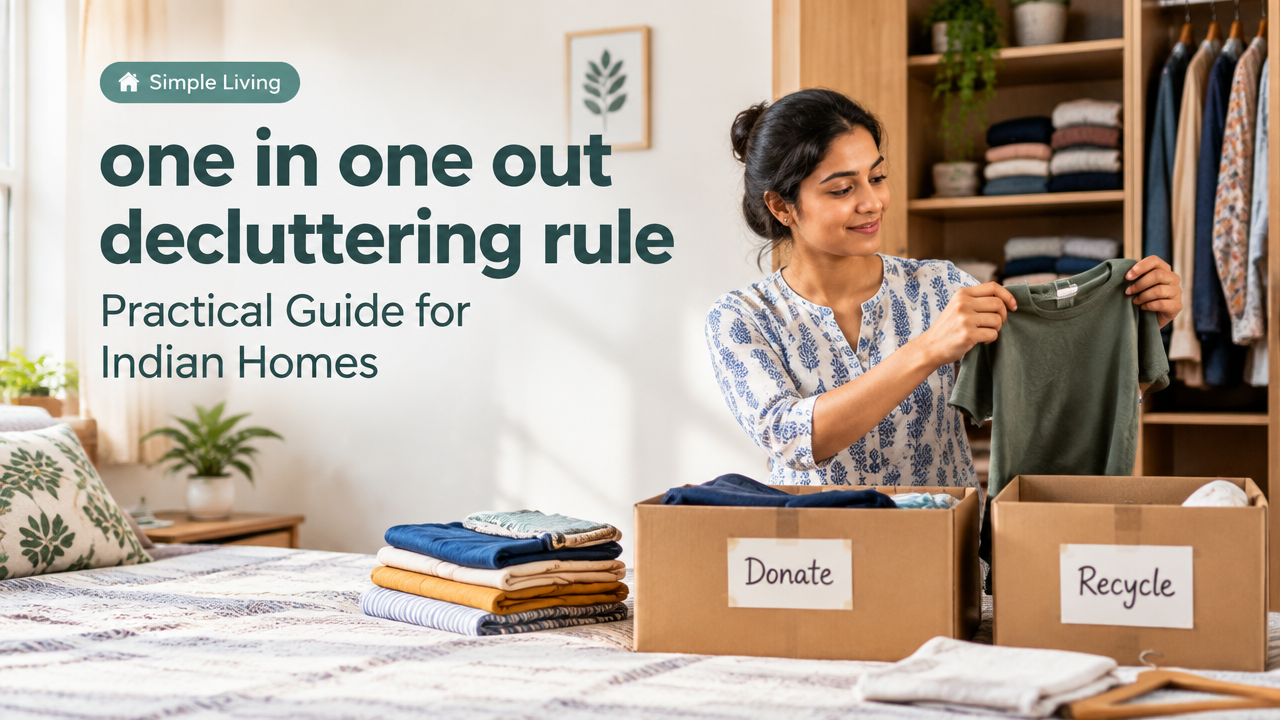
The One In One Out decluttering rule is a simple decision rule: when you bring a new item into the home, remove one similar item. Used consistently, it prevents slow clutter growth, helps you keep storage within limits and makes buying decisions clearer — especially useful in small Indian homes and during festival buying seasons.
- First step: Pick one category (e.g., clothes or kitchen utensils) and set a 15–30 minute timer.
- Time estimate: 15–30 minutes for a quick session; 2–3 hours for a full-room implementation.
- Decision rule: For each new item in a category, remove one existing item from that same category (prefer the least used, worst condition, or duplicate).
- Materials/tools: garbage bag, two cardboard boxes (Donate / Recycle), sticky labels or marker, smartphone for photos, tape measure for storage checks.
Who this guide is for
Families and individuals in Indian households who want a low-effort, repeatable rule to stop clutter from growing. It is especially helpful if you live in a compact apartment, have limited storage, shop during festivals, or want a simple system to manage kids’ toys, clothes, books and kitchenware.
How the rule works — simple decision flow
- New purchase or gift arrives.
- Ask: Which category (clothes, utensils, decor, electronics)?
- Choose one item in that category to remove permanently (donate, recycle, sell, or responsibly discard).
- Remove the chosen item from storage immediately — don’t let it sit in a ‘maybe’ pile.
What the One In One Out rule applies to — and what it doesn’t
It works well for: wardrobes (seasonal clothes), books, kitchenware (plates, serving spoons), decorative items, and toys. It also helps with small home electronics like chargers and headphones.
Use caution or different rules for:
- Perishable food and spices — follow FIFO (first-in, first-out) and FSSAI/package instructions for safety.
- Medicines and health supplies — do not keep expired items; dispose per local rules and avoid arbitrary swapping.
- Children’s clothes — if you keep multiple sizes for hand-me-downs, use a separate labelled storage and a size-based rotation rather than strict one-for-one removal.
- Tools and safety gear — keep what’s necessary for safety and home maintenance; remove redundant duplicates only after confirming compatibility.
Printable-style checklist to start a one-in-one-out routine
- Decide your first category (clothes, kitchenware, books, toys, electronics).
- Set a timer: 15 minutes for a small drawer, 30 minutes for a wardrobe, 1–3 hours for a full room.
- Sort items quickly into Keep / Remove / Unsure piles.
- For each new or recent item in Keep, identify one Remove item in the same category.
- Label Donate and Recycle boxes and move the Remove items there immediately.
- Take photos of items in Donate box (helps announce to family/WhatsApp groups or for local resale apps).
- Arrange a donation drop-off day within 7 days or schedule collection if available locally. Verify acceptance rules with local charity/collection centres.
- Empty Recycle and Non-repairable items as per municipal rules; take electronics to e-waste drop-off points.
- Update storage (shelf dividers, basket labels) and note any storage size mismatch for future buying decisions.
Worked mini-example: 30-minute wardrobe sort
Goal: Apply the one-in-one-out rule after buying one new kurta.
- Set timer to 30 minutes. Tools: 2 boxes (Donate, Recycle), marker and mobile camera.
- Step 1 (5 min): Remove all kurtas from the rail to see what you have. Quickly note colors/sizes that are duplicates.
- Step 2 (10 min): For the new kurta, compare to similar items by frequency worn and condition. Mark the least-worn or stained kurta as Remove.
- Step 3 (5 min): Move the Remove kurta to the Donate box. Take a quick photo and add a sticky note with size/condition.
- Step 4 (10 min): Rehang the remaining kurtas neatly, checking space. If space is still tight, identify 1 more item to remove (e.g., an unworn dress).
Result: New kurta kept; one kurta removed and boxed for donation — net wardrobe size unchanged and storage space respected.
Practical rules and variants to make it hold
- Category pairing: match types — buy a spice container, remove a spice container; buy a plate, remove a plate.
- Quality override: if the new item is a clear upgrade (safer, more durable), remove multiple poorer items if needed.
- Seasonal rotation: for seasonal items (blankets, heaters), use a seasonal box system: when you add a seasonal item, remove one from last season’s box before storing.
- Family exceptions: for children’s growth stages, set a separate box for hand-me-downs rather than one-for-one unless storage is constrained.
- Sale or festival purchases: before buying, measure current storage. If there’s no space, apply one-in-one-out immediately after the purchase.
Donating, recycling and disposal — India-friendly tips
Donating: Verify locally which institutions accept used clothes, books or household goods. Call or check their acceptance guidelines; many places won’t accept stained/soiled items. For books, local libraries, community centres or school drives can be options—confirm before dropping off.
Recycling and e-waste: For electronics and batteries, use municipal e-waste centres or authorised collection events. Avoid throwing electronics in general waste. For textiles that cannot be donated, check local textile-recycling or rag-picking networks, or ask your municipal waste service about guidelines.
Selling or swapping: Use local resale apps or community groups to sell items in good condition. Swapping with relatives or neighbours can be a low-effort way to move items on.
Common Mistakes
- Keeping a long ‘maybe’ pile — it becomes clutter. Decide and move items out within a week.
- Applying rule blindly to food, medicines or safety gear — those need separate handling and safety checks.
- Not matching categories — removing a plate when you brought in a pressure cooker can break the balance of usable items.
- Postponing donation — boxed items that stay in a corner tend to return to the home later.
- Ignoring storage sizes — if new items are larger, removing one old item may not free enough space; measure before buying if tight on space.
How to track and keep the habit
- Keep a small list on your phone or a notebook titled “Incoming items” — when you buy an item, note it and tick the removed item when done.
- Schedule a weekly 10–15 minute check: clear the donate box, review recent purchases, and confirm removed items were dispatched.
- Use family rules — a shared rule helps: for example, every festival purchase needs a one-for-one decision before new items enter the house.
Related Smart Ghar Life guides
- New Year Home Declutter Checklist with Keep-Donate-Recycle System
- Winter Bedding Storage Ideas for Blankets and Quilts
- 17 Smart and Powerful Vertical Storage Ideas for Small Homes That Save Space
- 7 Smart Weekly Fridge Check Routine Tips Before Grocery Shopping
Next Step
Start with one 30-minute session this weekend using the checklist above. Box the Remove items and set a donation date in your calendar within 7 days. Track one purchase and its matched removal over two weeks to see how storage feels.
Frequently Asked Questions
Conclusion
The One In One Out decluttering rule is a lightweight, repeatable habit that keeps home storage stable and reduces shopping regret. Tailor it to each category — especially food, medicines and children’s items — and pair it with clear donation and recycling steps. Try a 30-minute session this weekend and build a weekly check to keep the habit going.
Suggested next read: New Year Home Declutter Checklist with Keep-Donate-Recycle System
Use this plan in your own home
Treat the guide as a practical starting point and adjust it for your rooms, materials, appliances, climate, family size and daily routine.
How this guide was prepared
This guide is prepared for everyday readers using practical research, usability checks and editorial review. Product-specific claims should be verified against manufacturer instructions before purchase.
- Reviewed: October 14, 2026
- Next review target: April 14, 2027
- Read our Editorial Policy · Request a correction
How did you like this article?
Your feedback helps us make our stories more useful.

Ashish Pandey
My name is Ashish Pandey, I work as a content writer and I love to write articles. With 4 years of blogging experience I am always ready to inspire others and share knowledge to make them a successful blogger.
Related Articles
 Simple Living
Evening Home Reset Routine That Makes Mornings Easier
A compact, practical evening home reset routine that takes 20–40 minutes and reduces morning friction. Includes a printable checklist, a worked 20-minute…
 Lifestyle & Wellness
Festive Decluttering Routine for a Calmer Home Before Guests Arrive
A practical festive decluttering routine to create a calmer, guest-ready home. Quick action plan, printable checklist, a 30-minute wardrobe mini-sort and common…
Join the Discussion
Join the conversation and share a useful tip or experience.