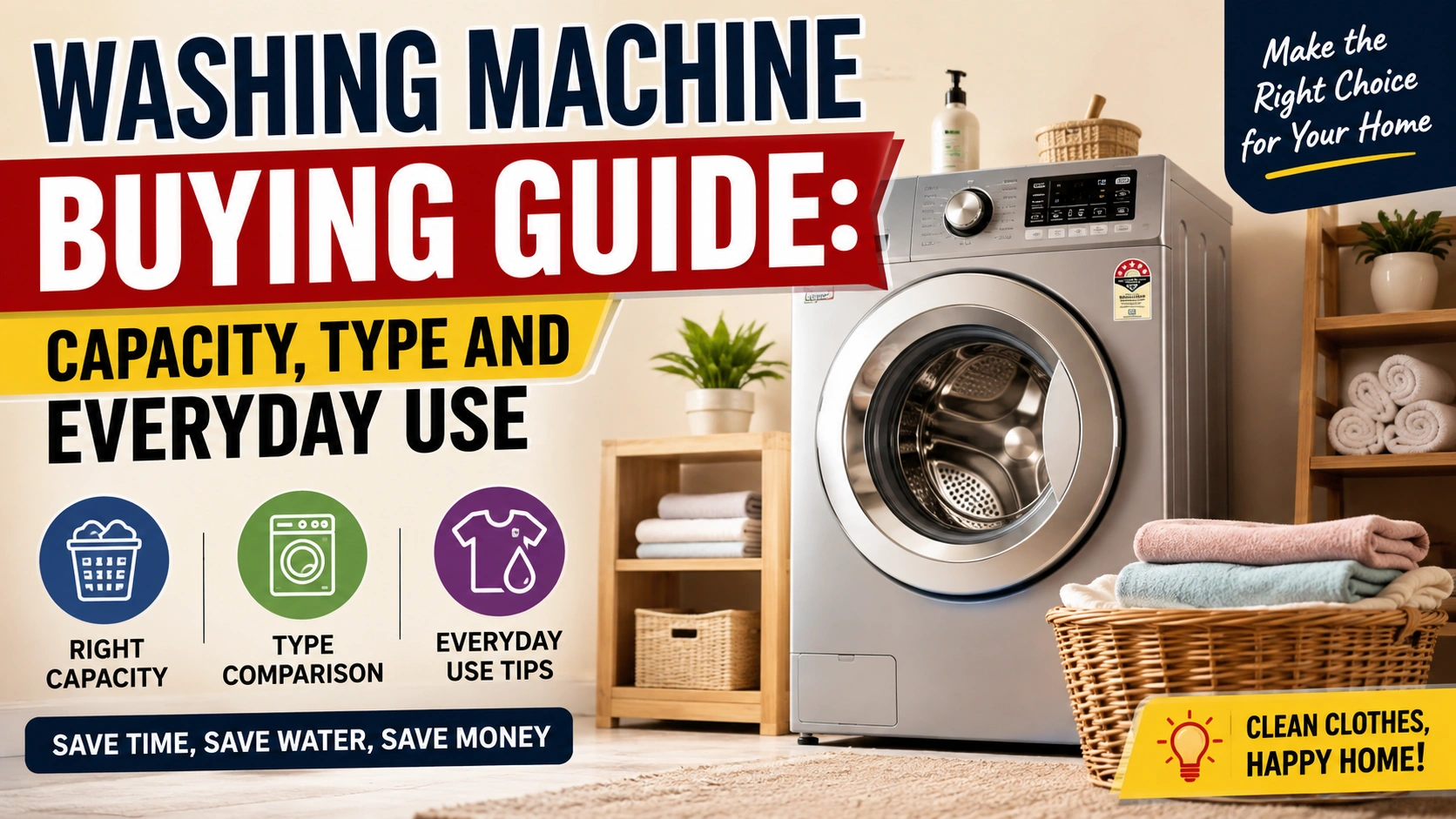
- What Should You Check Before Buying a Washing Machine?
- Washing Machine Buying Guide India: First Understand the Types
- Semi-Automatic Washing Machine
- Fully Automatic Top-Load Washing Machine
- Fully Automatic Front-Load Washing Machine
- Front Load vs Top Load: Which One Should You Buy?
- How Much Washing Machine Capacity Do You Need?
- Do Not Fill the Drum Completely Every Time
- Think About the Clothes You Usually Wash
- Check the Space Before Buying
- Check Your Water Supply
- Is an Inverter Motor Important?
- What About the Energy Rating?
- Useful Washing Programs to Look For
- Do You Need a Heater?
- What Is RPM and Does It Matter?
- Everyday Washing Habits That Make a Difference
- Separate Clothes Properly
- Check Pockets
- Do Not Use Too Much Detergent
- Keep the Machine Clean
- Leave the Door or Lid Open When Appropriate
- Features You Can Skip If You Want to Save Money
- Common Washing Machine Buying Mistakes
- Buying Only by Price
- Buying Too Small
- Buying Too Large
- Ignoring Installation Space
- Focusing Only on Features
- Forgetting After-Sales Service
- Quick Buying Checklist
- My Simple Advice for First-Time Buyers
- Frequently Asked Questions
- 1. What capacity washing machine is best for a family of four?
- 2. Is a front-load washing machine better than a top-load machine?
- 3. Is a 6 kg washing machine enough for two people?
- 4. Should I buy a semi-automatic or fully automatic washing machine?
- 5. Is an inverter motor worth paying extra for?
- 6. How can I keep my washing machine fresh?
- 7. What is the most important thing in a washing machine buying guide India?
- Conclusion
Buying a washing machine is not something most of us do every year. It is usually a decision we make after using the old machine for many years, when it starts making strange sounds, stops spinning properly, or simply becomes too much trouble.
I remember when buying a washing machine meant going to a shop, asking about the price, and choosing between two or three simple options. Today, things are very different. We see 6 kg, 7 kg, 8 kg, 9 kg and even bigger machines. Then there are front-load, top-load, semi-automatic, fully automatic, inverter motors, steam wash, quick wash, smart features and many other names.
It can become confusing very quickly.
That is why I have written this washing machine buying guide India in simple words. You do not need to understand every technical term before buying a machine. You mainly need to understand your family size, laundry habits, available space, water supply and budget.
As I always say, “The best washing machine is not the one with the most features. It is the one that makes your everyday life easier.”
This guide will help you understand capacity, machine type, useful features and everyday washing habits so you can make a sensible choice.
What Should You Check Before Buying a Washing Machine?
Before looking at brands and models, stop for a moment and think about your home.
Ask yourself these questions:
- How many people are in the family?
- How often do you wash clothes?
- Do you wash bedsheets, towels and curtains regularly?
- Is your water supply regular?
- How much space do you have?
- Do you want to move clothes manually?
- Is saving water important to you?
- What is your budget?
- Do you prefer simple controls or extra features?
These questions are more useful than simply asking, “Which washing machine is the best?”
There is no single machine that is perfect for every family.
A couple living in a small apartment may need a different machine from a family of six. Someone who has a regular water supply may prefer a fully automatic machine, while another household may find a semi-automatic machine more practical.
Read More: 15 Powerful Festive Decluttering Tips to Create a Peaceful Home Before the Festival
Washing Machine Buying Guide India: First Understand the Types
The first big decision is the type of washing machine.
In Indian homes, the main choices are semi-automatic, fully automatic top-load and fully automatic front-load machines.
Let us understand each one.
Semi-Automatic Washing Machine
A semi-automatic machine normally has separate washing and spinning sections. After washing, you usually need to move the clothes from the wash tub to the spin tub.
The biggest advantage is the price. These machines are often more affordable than fully automatic models.
They can also be useful where the water supply is not continuous because you have more control over filling and using water.
But there is some extra work involved.
You need to add water, move clothes between tubs and manage parts of the washing process yourself.
For someone who does not mind this work, a semi-automatic machine can be a practical choice.
Fully Automatic Top-Load Washing Machine
This is one of the most popular choices for everyday home washing.
You put the clothes in, add detergent, choose a program and start the machine. The machine takes care of washing, rinsing and spinning.
Top-load machines are also convenient because you load clothes from the top. There is less bending compared with a front-load machine.
Some models also make it easier to add a forgotten item during a cycle.
For families who want convenience without spending too much, a fully automatic top-load machine can be a good middle ground.
Fully Automatic Front-Load Washing Machine
Front-load machines have a door at the front and wash clothes by tumbling them inside the drum.
They are often chosen by people who want good washing performance, gentler handling of clothes and efficient use of water.
They can also have higher spin speeds, which means clothes may come out with less water and can dry faster.
However, front-load machines can cost more, and you need to bend down when loading and removing clothes.
They also need a little care around the door seal and drum. Keeping the door open for some time after washing can help the inside dry properly.
Front Load vs Top Load: Which One Should You Buy?
This is probably the biggest question in any washing machine buying guide India.
Both types can work well. The right one depends on your daily routine.
| Feature | Front Load | Top Load |
|---|---|---|
| Loading | From the front | From the top |
| Bending | More bending needed | Less bending |
| Washing action | Tumbling | Agitator or impeller depending on model |
| Water use | Often lower | Often higher |
| Wash time | Can be longer | Often shorter |
| Mid-cycle loading | Usually limited | Often easier |
| Fabric care | Generally gentle | Depends on wash system |
| Price | Often higher | Often more affordable |
| Best for | Efficiency and fabric care | Convenience and simple everyday use |
If you want a machine that focuses on efficient washing and do not mind a higher starting price, a front-load machine can be worth considering.
If you want something simple, convenient and usually more budget-friendly, a top-load machine may suit you better.
Neither choice is automatically right for everyone.
How Much Washing Machine Capacity Do You Need?
Capacity is another important part of this washing machine buying guide India.
You will usually see washing machines described as 6 kg, 7 kg, 8 kg, 9 kg and so on.
This number refers to the machine’s laundry capacity, generally based on the weight of dry clothes.
A common mistake is buying a machine that is too small because it looks cheaper.
For example, if you have a family of four and regularly wash bedsheets and towels, a very small machine may make you run extra cycles.
On the other hand, buying a huge machine for one or two people may not be necessary.
Here is a simple starting point:
| Household | Suggested Capacity | Suitable For |
|---|---|---|
| 1–2 people | 6–6.5 kg | Daily clothes and small loads |
| 2–3 people | 6.5–7 kg | Regular clothes and bedsheets |
| 3–4 people | 7–8 kg | Family laundry and weekly linen |
| 4–5 people | 8 kg | Clothes, towels and bedsheets |
| 5–6 people | 8–9 kg | Larger regular loads |
| Large family | 9 kg+ | Heavy and frequent laundry |
These are general starting points, not strict rules.
Your laundry habits matter too.
If you wash clothes every day, you may need less capacity than a family that collects clothes for several days and washes everything together.
Do Not Fill the Drum Completely Every Time
One thing I learned from years of doing laundry is that more clothes does not always mean better use of the machine.
It is tempting to fill the drum until there is no room left. But clothes need enough space to move around.
An overloaded machine may not wash clothes properly, and the clothes can become tightly packed together.
So instead of trying to use every last bit of space, leave some room for the clothes to move.
Think about it this way:
The washing machine needs space to wash the clothes, not just space to hold them.
This is especially important with towels, blankets, jeans and bedsheets because these items can become bulky.
Think About the Clothes You Usually Wash
Do not choose a machine only by family size.
Look at your laundry basket.
What is inside it most of the time?
If you mainly wash light daily clothes, a medium-capacity machine may be enough.
If your household has lots of school clothes, office clothes, towels, bedsheets and heavy cotton items, you may prefer a little extra capacity.
If you regularly wash blankets or curtains, check the manufacturer’s instructions for the machine’s capacity and whether those items are suitable for washing.
Check the Space Before Buying
This is a simple step that many people forget.
A washing machine may look small in a showroom but feel surprisingly large once it reaches your home.
Before buying, measure:
- Width
- Depth
- Height
- Door or lid opening space
- Water inlet location
- Drain location
- Electrical outlet location
For a front-load machine, remember that the door opens toward the front.
You need enough space to open it comfortably.
For a top-load machine, make sure there is enough space above the machine to open the lid fully.
Never buy first and measure later.
A few minutes with a measuring tape can save a lot of trouble.
Check Your Water Supply
Your home’s water supply is very important.
Fully automatic machines generally need a suitable water connection. If the water pressure or supply in your home is not reliable, check the manufacturer’s installation requirements before buying.
If your home has limited water availability, a machine with efficient water use may be worth considering.
Also think about the quality of your water.
Hard water can create mineral deposits over time. If you live in an area with hard water, look for models with suitable hard-water washing or maintenance features, but do not assume that a feature alone will solve every water-quality problem.
Regular cleaning and correct detergent use still matter.
Is an Inverter Motor Important?
You will see the word “inverter” on many washing machines.
In simple words, an inverter motor can adjust its speed according to the washing requirement rather than always running at one fixed speed.
For many households, this can mean quieter operation and potentially better energy efficiency, depending on the machine and how it is used.
But do not buy a machine only because the word “inverter” is written on the box.
Look at the complete machine.
A reliable machine with the right capacity and useful programs is better than a machine full of features you never use.
What About the Energy Rating?
Electricity use matters because a washing machine can stay in your home for many years.
When comparing models, check the current energy-rating information provided for the machine.
A higher rating can be helpful for reducing electricity use, but always compare the actual specifications and usage information of the models you are considering.
Remember that your electricity bill depends on more than the rating.
The number of washes, wash temperature, cycle selected and other settings also affect electricity use.
Useful Washing Programs to Look For
You do not need twenty different washing programs.
In my opinion, a few useful programs are more valuable than a long list of confusing names.
Look for programs such as:
Quick Wash: Useful when clothes are lightly soiled and you want a shorter cycle.
Cotton: Helpful for everyday cotton clothing and similar items.
Delicate: Useful for clothes that need gentler washing.
Heavy Wash: Helpful for suitable heavily soiled clothing.
Rinse and Spin: Useful when you only need an extra rinse or spin.
Wool or special-care programs: Useful if you regularly wash suitable wool or delicate garments.
Always check the care label on your clothes before selecting a program.
Do You Need a Heater?
Some fully automatic machines come with built-in heating.
Warm or hot washing can be useful for certain types of laundry and cleaning needs, but you should not assume that every load needs hot water.
For normal everyday clothes, the appropriate program and temperature can be enough.
If you rarely use heated cycles, do not pay a large extra amount simply for a feature that will sit unused.
What Is RPM and Does It Matter?
RPM means revolutions per minute.
It refers to how quickly the drum spins during the spin cycle.
A higher spin speed can remove more water from clothes, which can be useful if you need clothes to dry quickly.
But higher RPM is not automatically better for every piece of clothing.
Delicate fabrics may need a gentler setting.
So instead of asking only, “What is the highest RPM?” ask:
“Does this machine let me choose the right spin speed for different clothes?”
That is much more useful for everyday washing.
Everyday Washing Habits That Make a Difference
Buying a good washing machine is only half the job.
How you use it matters too.
Separate Clothes Properly
You do not need to make ten different piles of clothes.
At minimum, separate clothes according to colour, fabric and washing needs.
Keep very dark colours away from light clothes when necessary.
Also keep delicate clothes separate from heavy items that may rub against them.
Check Pockets
This sounds like a small thing, but it saves trouble.
Before putting clothes into the machine, check pockets for:
- Coins
- Tissues
- Pens
- Small toys
- Receipts
- Hair clips
A forgotten tissue can turn a normal wash into a cleaning job.
Do Not Use Too Much Detergent
Many people think extra detergent means cleaner clothes.
That is not always true.
Too much detergent can leave residue on clothes and inside the machine.
Use the amount recommended for your detergent, clothing load and machine instructions.
Keep the Machine Clean
The washing machine also needs cleaning.
Every so often, clean the detergent drawer, door area, filter where applicable and drum according to the manufacturer’s instructions.
For front-load machines, pay attention to the rubber door seal because moisture and leftover dirt can collect there.
After washing, allowing the inside to dry can also help keep the machine fresh.
Leave the Door or Lid Open When Appropriate
After a wash, do not rush to close the machine immediately if the manufacturer allows it.
Allowing moisture to escape can help the inside dry.
For front-load machines especially, leaving the door slightly open after use is a simple habit that can help reduce unwanted smell.
Features You Can Skip If You Want to Save Money
Modern washing machines can come with Wi-Fi, mobile apps, smart sensors, voice controls and many other features.
Some people enjoy these features.
But ask yourself whether you really need them.
If you only want to wash clothes, a reliable machine with good capacity, useful programs and simple controls may be enough.
I always believe “A simple machine that you use happily is better than an expensive machine that confuses you.”
Do not let fancy words push you beyond your budget.
Common Washing Machine Buying Mistakes
Here are some mistakes worth avoiding.
Buying Only by Price
The cheapest machine is not always the cheapest choice over several years.
Look at capacity, warranty, service, energy use, features and build quality too.
Buying Too Small
If you regularly wash large loads, buying a small machine just to save money can become frustrating.
Buying Too Large
On the other hand, do not buy a very large machine just because the number looks impressive.
Match the capacity to your actual laundry.
Ignoring Installation Space
Always measure the space before ordering.
Focusing Only on Features
More buttons do not automatically mean better washing.
Forgetting After-Sales Service
A washing machine is a long-term home appliance. Before buying, check whether the brand has service support available in your area.
Quick Buying Checklist
Before placing your order, keep this checklist with you:
| What to Check | Why It Matters |
|---|---|
| Capacity | Should match your family and laundry |
| Machine type | Decides how much work you do |
| Front or top load | Affects loading comfort and washing style |
| Space | Prevents installation problems |
| Water supply | Important for automatic machines |
| Energy rating | Helps compare energy efficiency |
| Spin speed | Affects how much water clothes retain |
| Wash programs | Choose useful programs for your clothes |
| Motor | Can affect noise and efficiency |
| Warranty | Gives protection after purchase |
| Service | Important for long-term ownership |
| Budget | Keeps the purchase comfortable |
My Simple Advice for First-Time Buyers
If you are buying your first washing machine and feel confused by all the choices, make the decision step by step.
First, decide your budget.
Second, decide between semi-automatic and fully automatic.
Third, decide between top-load and front-load if you are choosing a fully automatic machine.
Fourth, choose the capacity based on your family and actual laundry.
Fifth, check the space and water connection.
Finally, compare a few machines based on useful features, energy information, warranty and service.
Do not start by looking at every possible feature.
Start with your home.
Your home will tell you what machine you actually need.
Frequently Asked Questions
1. What capacity washing machine is best for a family of four?
A 7–8 kg machine is a useful starting point for a family of four. If your household regularly washes heavy items such as towels, bedsheets and larger loads, choosing the higher capacity may give you more flexibility.
2. Is a front-load washing machine better than a top-load machine?
Neither is automatically better for every family. Front-load machines are often chosen for efficient washing and fabric care, while top-load machines are convenient to load and can be simpler for everyday use. Your budget, space and laundry habits should decide the choice.
3. Is a 6 kg washing machine enough for two people?
For two people with normal laundry habits, a 6–6.5 kg machine can be a practical size. If you wash large amounts of bedsheets, towels or other bulky items frequently, consider a little more capacity.
4. Should I buy a semi-automatic or fully automatic washing machine?
A semi-automatic machine can be useful if you want a lower purchase cost or more control over water use. A fully automatic machine is better if you want the washing process to require less manual work.
5. Is an inverter motor worth paying extra for?
An inverter motor can offer benefits such as quieter operation and efficient motor control. However, compare the complete machine rather than choosing only because it has an inverter motor.
6. How can I keep my washing machine fresh?
Do not overload it, use the recommended amount of detergent, clean the detergent area and other washable parts as instructed, and allow the inside to dry after washing when appropriate. Follow your machine’s maintenance instructions.
7. What is the most important thing in a washing machine buying guide India?
For most homes, the biggest decisions are capacity, machine type, available space, water supply, useful features, energy use, warranty and service support. Getting these basics right is more important than buying every extra feature.
Conclusion
Buying a washing machine does not have to be stressful.
The market may have hundreds of models, but your actual needs are much simpler.
Think about how many people live in your home, how much laundry you normally wash, what kind of clothes you wash, how much space you have and how much you want to spend.
For a simple and budget-friendly option, a semi-automatic machine may be suitable.
For easy everyday washing, a fully automatic top-load machine can be a comfortable choice.
For people who want efficient washing, fabric care and are comfortable with a higher purchase price, a front-load machine may be worth considering.
The most important thing is not to buy the biggest or most expensive machine.
Buy the machine that fits your home and your routine.
After all, a washing machine is there to make life easier. Once you choose the right capacity and type, learn a few simple washing habits and take care of the machine, it can quietly handle one of the most tiring household jobs for years.
And honestly, there is nothing better than putting a basket of dirty clothes into the machine, pressing one button and getting back a basket of clean clothes.
That little convenience can make a surprisingly big difference to everyday life.
Want a professional website designed for your business or blog?
Visit eDigitalized for website design and development services.
Need help or support?
Visit our Contact Us page and get in touch with us.
Want to become a blogger and start your own blog?
Visit WP Bazaar for blogging resources, tools, and helpful guides.
How this guide was prepared
This guide is prepared for everyday readers using practical research, usability checks and editorial review. Product-specific claims should be verified against manufacturer instructions before purchase.
- Reviewed: September 5, 2026
- Next review target: March 5, 2027
- Read our Editorial Policy · Request a correction
How did you like this article?
Your feedback helps us make our stories more useful.

Shweta Pandey
My name is Shweta Pandey, I work as a content writer and I love to write articles. With 4 years of blogging experience I am always ready to inspire others and share knowledge to make them a successful blogger.
Related Articles
 Home & Living
7 Essential Diwali Kitchen Cleaning Checklist for a Happy Home
Diwali is one of those times when the whole house feels different. We clean, decorate, bring new things home, prepare sweets, make…
 Home & Living
Diwali Cleaning Checklist: 7-Day Room-by-Room Plan for a Happy, Beautiful & Stress-Free Home
Diwali is one of my favorite times of the year. The lights, diyas, rangoli, sweets, flowers, family visits, and fresh clothes all…
Join the Discussion
Join the conversation and share a useful tip or experience.