- Why a Monsoon Home Products Checklist Is Useful
- Quick Monsoon Home Products Checklist
- 1. Start With the Right Entrance Mats
- Keep One Mat Outside
- Keep Another Absorbent Mat Inside
- Anti-Slip Backing Matters
- 2. Keep a Shoe Tray Near the Door
- 3. An Umbrella Stand Saves a Lot of Mess
- 4. A Foldable Drying Rack Is a Monsoon Essential
- Choose the Right Size
- Leave Space Between Clothes
- 5. Use Hangers for Shirts and Light Clothes
- 6. Add a Small Fan Near the Drying Area
- 7. Moisture Absorbers for Wardrobes and Cabinets
- 8. Consider a Dehumidifier for Very Humid Rooms
- 9. Bathroom Mats Should Be Quick-Drying
- 10. Keep Microfiber Cloths Ready
- 11. Choose a Laundry Basket With Airflow
- 12. Take Care of Wardrobes During Monsoon
- 13. Protect Books, Papers and Important Documents
- 14. Kitchen Moisture Also Needs Attention
- 15. Do Not Ignore Ventilation
- A Simple Room-by-Room Monsoon Setup
- Entrance
- Laundry Area
- Bedroom
- Bathroom
- Kitchen
- What I Would Buy First on a Limited Budget
- Monsoon Products You May Not Need
- Simple Daily Monsoon Routine
- Frequently Asked Questions
- 1. What should be included in a monsoon home products checklist?
- 2. Which type of mat is best for monsoon?
- 3. How can I dry clothes indoors during monsoon?
- 4. Are moisture absorbers useful during monsoon?
- 5. Do I need a dehumidifier during monsoon?
- 6. How can I stop wet shoes from making the house dirty?
- 7. How can I prevent clothes from smelling during rainy weather?
- Conclusion
The monsoon season always brings a little happiness to my home. I love the smell of rain, cooler evenings, hot tea, and watching the plants look fresh again. But after managing a home for many years, I also know that rain brings its own set of problems.
Wet shoes enter the house, clothes take forever to dry, bathrooms stay damp, floors become slippery, cupboards start smelling odd, and sometimes even bedsheets feel slightly moist.
This is exactly why I follow a simple monsoon home products checklist before the rainy season becomes heavy.
I do not believe that we need to buy dozens of fancy things for monsoon. A few useful products placed in the right areas can make the house cleaner, safer, and much easier to manage.
“A comfortable monsoon home is not about buying more things. It is about keeping the right things ready before the rain creates a problem.”
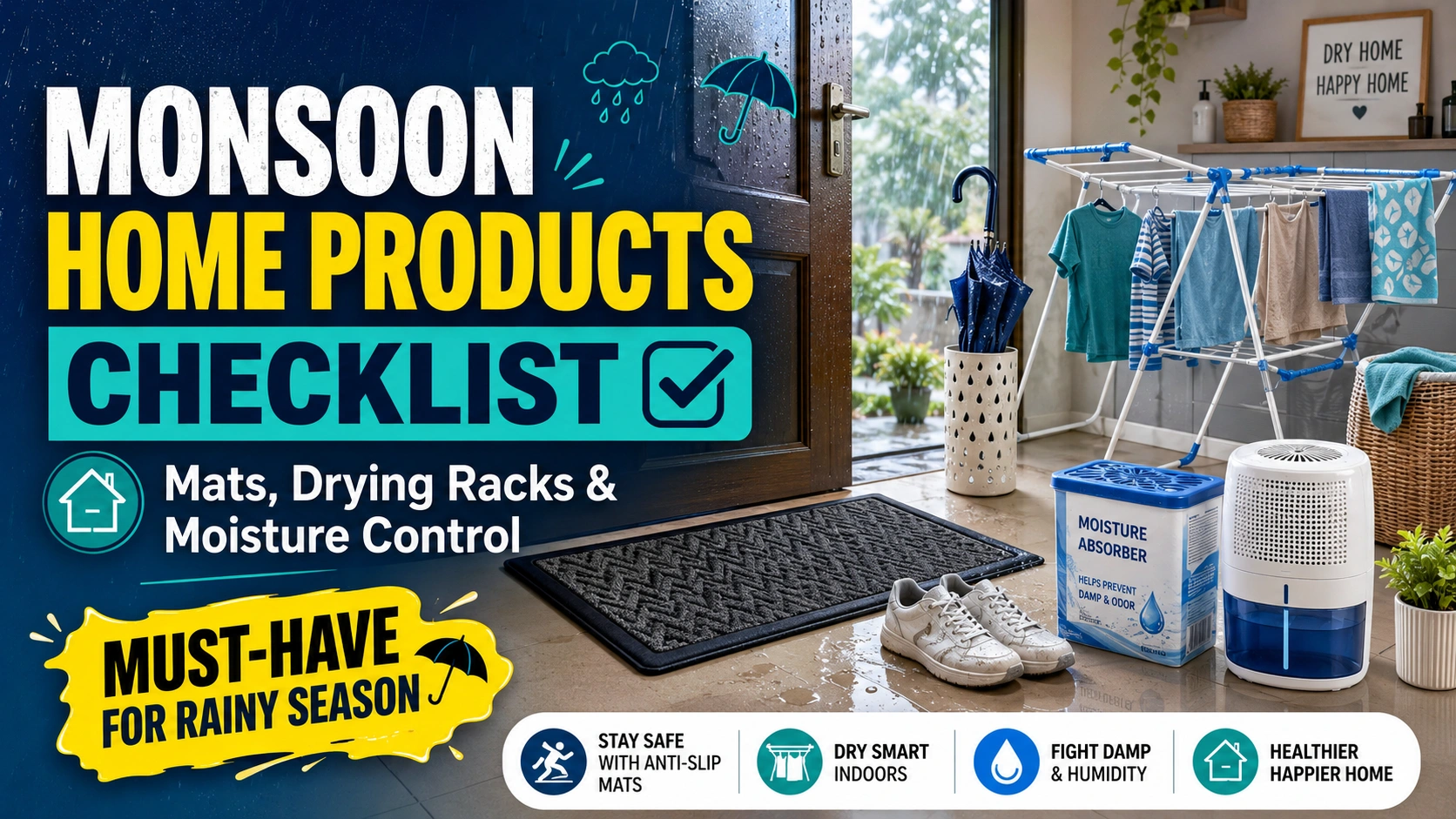
In this guide, I am sharing the practical products I feel are worth keeping at home, especially mats, drying racks, moisture-control products, shoe storage, bathroom items, and small everyday helpers.
Why a Monsoon Home Products Checklist Is Useful
During summer, we can leave windows open, dry clothes quickly, and clean wet floors without much trouble. Monsoon is different.
Humidity stays high for many hours. Wet items do not dry quickly. Shoes bring mud inside. Towels remain damp. Clothes sometimes develop a musty smell. Small bathrooms may feel stuffy, and closed cupboards can become uncomfortable.
Having a monsoon home products checklist helps because you are solving these small problems before they become bigger ones.
For me, the main goals are simple:
Keep floors dry and safe
Give wet clothes enough space to dry
Control moisture inside cupboards and rooms
Keep wet shoes and umbrellas away from clean areas
Reduce bad smell
Improve airflow whenever possible
You do not have to change your whole house. Even a few smart additions can make a noticeable difference.
Quick Monsoon Home Products Checklist
| Product | Where to Use It | Why It Helps | Priority |
|---|---|---|---|
| Anti-slip entrance mat | Main door | Reduces water and muddy footprints | High |
| Absorbent indoor mat | Inside entrance | Absorbs moisture from footwear | High |
| Foldable drying rack | Balcony, utility room, bedroom | Helps dry clothes indoors | High |
| Clothes hangers | Drying area | Creates space between clothes | High |
| Moisture absorber | Wardrobes and cabinets | Helps manage excess moisture | High |
| Dehumidifier | Humid rooms | Removes moisture from indoor air | Optional |
| Shoe tray | Entrance | Keeps wet shoes in one place | High |
| Umbrella stand | Near entrance | Prevents dripping water around home | Medium |
| Bathroom floor mat | Bathroom exit | Reduces wet and slippery flooring | High |
| Exhaust fan | Bathroom or kitchen | Improves ventilation | High |
| Storage boxes | Cupboards | Protects seasonal items | Medium |
| Microfiber cloths | Kitchen and entrance | Quickly wipes water | High |
| Laundry basket with airflow | Laundry area | Prevents damp clothes from sitting together | Medium |
| Small fan | Drying area | Improves airflow around clothes | Optional |
For general weather information during the rainy season, you can also check the India Meteorological Department. For general information about controlling indoor moisture and mold, the U.S. Environmental Protection Agency mold guide is also useful.
1. Start With the Right Entrance Mats
If I had to choose only one product from my monsoon home products checklist, a good entrance mat would be among the first things I buy.
Most rainwater enters the house through footwear.
Children come home with wet school shoes. Someone goes outside to collect a parcel. Guests arrive with muddy sandals. Within minutes, the entrance floor can become wet.
A normal decorative mat may not be enough during heavy rain.
Keep One Mat Outside
The outside mat should be slightly rough so that it can remove mud and water from the bottom of shoes.
Look for a mat that is:
Easy to wash
Quick to dry
Strong enough for regular use
Not too smooth
Suitable for outdoor or semi-outdoor areas
Avoid very thick mats that remain wet for a long time.
Keep Another Absorbent Mat Inside
I prefer keeping a second mat just inside the door.
This mat catches the moisture that remains after someone has already wiped their shoes outside.
This simple two-mat system can reduce a surprising amount of cleaning.
“One mat removes the dirt. The second mat catches the moisture.”
Anti-Slip Backing Matters
During monsoon, the floor can already be slippery.
So please do not select a mat only because it looks attractive. Check whether the back has a good grip.
A mat sliding under someone’s feet can become more dangerous than the wet floor itself.
2. Keep a Shoe Tray Near the Door
Wet shoes should not travel through the whole house.
I learned this after cleaning muddy footprints far too many times.
A plastic or rubber shoe tray is one of the simplest monsoon products you can keep near the entrance.
Family members can place wet shoes directly inside it.
The tray collects dripping water and mud instead of letting it spread across the floor.
Choose one that is large enough for at least two or three pairs of footwear.
Clean it regularly because standing dirty water can start smelling unpleasant.
If you have a small home, a shallow tray that slides below a shoe rack is very useful.
3. An Umbrella Stand Saves a Lot of Mess
We often think about umbrellas when going outside but forget about what happens when we bring a wet umbrella back inside.
If the umbrella is placed against a wall, water slowly collects on the floor.
An umbrella stand solves this problem.
Keep it near the main entrance, preferably beside the shoe tray.
A good umbrella stand should be:
Stable
Easy to clean
Large enough for family umbrellas
Able to collect dripping water
If you do not want to buy a special umbrella stand, even a tall waterproof container can work.
The important point is to give wet umbrellas a fixed place.
4. A Foldable Drying Rack Is a Monsoon Essential
Drying clothes is probably one of the biggest household problems during continuous rain.
Sometimes clothes remain on the balcony for hours, and then another round of rain starts.
A foldable drying rack makes life much easier.
You can place it in:
A balcony
A utility room
Near a large window
A spare room
A covered terrace
A well-ventilated passage
I personally like foldable racks because they can be stored away when not needed.
Choose the Right Size
Do not automatically buy the biggest rack available.
Think about where you will place it.
A large rack may hold more clothes, but if it blocks the whole room, you may stop using it.
For a small family, a medium foldable rack is often enough.
For larger families, a multi-level rack can provide more drying space without taking up too much floor area.
Leave Space Between Clothes
Do not pack clothes tightly together.
Air needs to move between them.
Whenever possible, leave a small gap between shirts, towels, trousers, and other items.
This can help them dry faster and reduce that unpleasant damp smell.
5. Use Hangers for Shirts and Light Clothes
Hangers are another small product that becomes very useful during monsoon.
Instead of placing every shirt directly on the drying rack, I hang some clothes on separate hangers.
It gives them more breathing space.
It also makes ironing easier later because shirts may dry with fewer deep folds.
Make sure the hanger is strong enough for wet clothes because wet fabric can be heavier than we expect.
6. Add a Small Fan Near the Drying Area
Sometimes there is no sun for two or three days.
In that situation, moving air becomes very important.
A small fan placed near the drying rack can improve airflow around clothes.
Do not push the fan too close to wet items. Keep it at a safe distance and use it only in a dry location.
If your room has a ceiling fan, that may already provide enough air movement.
I often find that airflow makes more difference than simply leaving wet clothes hanging in a closed room.
7. Moisture Absorbers for Wardrobes and Cabinets
This is another important part of my monsoon home products checklist.
Closed cupboards can trap moisture during rainy weather.
You may notice:
A musty smell
Clothes feeling slightly damp
Moisture around corners
Shoes smelling unpleasant
Bags or stored fabric feeling stale
Moisture absorber boxes or hanging moisture absorbers can be helpful in small enclosed areas.
They are commonly used in:
Wardrobes
Shoe cabinets
Storage cupboards
Small utility spaces
Closed shelves
Always follow the instructions written on the product.
Keep these products away from children and pets, and replace them when required.
8. Consider a Dehumidifier for Very Humid Rooms
A moisture absorber is useful for small spaces, but sometimes the whole room feels humid.
In such situations, a dehumidifier may be worth considering.
A dehumidifier removes moisture from indoor air and collects water inside a tank or drains it through a pipe, depending on the model.
It can be especially useful in:
Bedrooms with poor ventilation
Basement-style rooms
Rooms that receive very little sunlight
Homes in very humid areas
Rooms where clothes are often dried indoors
You do not need a dehumidifier in every home.
If natural ventilation, fans, and moisture absorbers are enough, there is no need to spend extra money.
9. Bathroom Mats Should Be Quick-Drying
Bathrooms already stay wet, and monsoon can make the situation worse.
A bathroom mat should not remain soaked throughout the day.
Choose one that absorbs water but can also dry reasonably quickly.
I like keeping two bathroom mats during monsoon so that one can be washed and dried while the other is being used.
Wash the mat regularly.
A mat may look clean from the top but can remain damp underneath.
Also make sure it does not slide easily.
10. Keep Microfiber Cloths Ready
I keep a few microfiber cloths only for rainy days.
They are useful for quickly cleaning:
Water near the entrance
Wet window edges
Drips from umbrellas
Kitchen counters
Bathroom surfaces
Small wet patches on furniture
They absorb water well and can be washed repeatedly.
Instead of searching for an old towel every time someone enters the house wet, having dedicated cleaning cloths saves time.
11. Choose a Laundry Basket With Airflow
One common mistake during monsoon is putting damp clothes into a closed laundry basket.
If those clothes stay there for many hours, they can develop a strong smell.
A laundry basket with ventilation holes allows some air movement.
Even better, avoid placing very wet clothes directly into the laundry basket.
Let them dry slightly first whenever possible.
This is especially important for:
Towels
Gym clothes
Children’s uniforms
Wet socks
Kitchen cloths
12. Take Care of Wardrobes During Monsoon
Products help, but small habits also matter.
Once or twice a week, I like to leave wardrobe doors open for a short time when the weather is dry enough and the room has good airflow.
Do not keep freshly ironed clothes inside if they still feel warm or slightly moist.
Avoid stuffing cupboards completely.
A little space between clothes allows better air circulation.
You can also keep frequently used items closer to the front so that the cupboard opens regularly.
13. Protect Books, Papers and Important Documents
Humidity can also affect paper.
Important documents, certificates, school papers, old photographs, and books should not be kept directly against damp walls.
Use folders, storage boxes, or sealed containers for important items.
If a cupboard is close to an outside wall that becomes damp during rain, keep a small space between stored items and the back wall.
For valuable documents, I prefer using a proper plastic folder before placing them in a cabinet.
14. Kitchen Moisture Also Needs Attention
The kitchen can become surprisingly humid during monsoon.
Cooking already produces steam. Add rainy weather and limited ventilation, and the room can feel uncomfortable.
Use the kitchen exhaust fan or chimney while cooking.
Wipe wet counters.
Do not leave damp kitchen towels folded together.
Dry chopping boards properly before storing them.
Check areas below the sink because small leaks are easier to miss during rainy weather.
15. Do Not Ignore Ventilation
No product can completely replace fresh air.
Whenever rain stops and the outside air is suitable, open windows for some time.
Use exhaust fans in bathrooms.
Use kitchen ventilation while cooking.
Keep internal doors open when possible so air can move between rooms.
If you are drying clothes indoors, airflow becomes even more important.
“Moisture becomes a bigger problem when wet things stay wet and closed spaces stay closed.”
A Simple Room-by-Room Monsoon Setup
Entrance
Keep:
Outdoor mat
Absorbent indoor mat
Shoe tray
Umbrella stand
Microfiber cleaning cloth
This keeps most of the rainwater near the door instead of spreading it across the house.
Laundry Area
Keep:
Foldable drying rack
Extra hangers
Laundry basket with ventilation
Fan if needed
Avoid drying too many clothes in one small room at the same time.
Bedroom
Keep:
Moisture absorber inside wardrobe
Enough airflow
Storage boxes for important items
Check walls behind furniture occasionally.
Bathroom
Keep:
Quick-drying anti-slip mat
Exhaust fan
Cleaning wiper
Separate hooks for wet towels
Do not leave wet towels folded or piled together.
Kitchen
Keep:
Absorbent cloths
Exhaust or chimney
Dry storage containers
Cleaning wiper
Regularly inspect areas below the sink.
What I Would Buy First on a Limited Budget
You do not need to complete the entire monsoon home products checklist in one shopping trip.
If my budget was limited, I would buy things in this order:
1. Anti-slip entrance mat
This improves both cleanliness and safety.
2. Indoor absorbent mat
It stops remaining water from entering the house.
3. Foldable drying rack
Useful throughout the rainy season.
4. Shoe tray
Cheap, simple, and extremely practical.
5. Moisture absorbers
Helpful for cupboards and shoe cabinets.
6. Bathroom mat
Another safety item that deserves attention.
7. Umbrella stand
Helpful but can also be replaced with a suitable waterproof container.
8. Dehumidifier
Consider this only if you genuinely have a serious humidity problem.
Monsoon Products You May Not Need
Rainy-season shopping can become unnecessary very quickly.
Do not buy a product just because it says “monsoon essential” on the label.
For example, you may not need a large electric dehumidifier if your home already has strong ventilation and very little moisture.
You may not need an expensive drying machine if a simple rack and fan work well.
You may not need several special storage products if your existing waterproof boxes are already doing the job.
The best monsoon home products checklist is the one that matches your actual home.
Simple Daily Monsoon Routine
Products work better when they are supported by a small routine.
In the morning, I like to check whether clothes left for drying are still damp.
During the day, wet bathroom and entrance floors should be wiped when needed.
In the evening, wet footwear should be moved into a ventilated area.
Before sleeping, avoid leaving wet towels on beds, chairs, or sofas.
These are very basic habits, but they prevent many annoying monsoon problems.
Frequently Asked Questions
1. What should be included in a monsoon home products checklist?
A useful monsoon home products checklist should include anti-slip mats, absorbent entrance mats, a foldable drying rack, hangers, a shoe tray, an umbrella stand, moisture absorbers, quick-drying bathroom mats, cleaning cloths, and good ventilation products such as exhaust fans.
2. Which type of mat is best for monsoon?
A mat with a good grip and water-absorbing ability is best. For the entrance, I prefer using one rough mat outside and one absorbent mat inside. Make sure the mat does not slide easily.
3. How can I dry clothes indoors during monsoon?
Use a foldable drying rack and leave enough space between clothes. Keep the rack near a ventilated area and use a fan when needed. Avoid placing too many wet clothes close together.
4. Are moisture absorbers useful during monsoon?
Yes, moisture absorbers can be useful in wardrobes, shoe cabinets, cupboards, and other small closed spaces. They are especially helpful when these areas start feeling damp or develop a musty smell. Always follow the product instructions.
5. Do I need a dehumidifier during monsoon?
Not everyone needs one. A dehumidifier may be useful if your rooms remain very humid, ventilation is poor, or moisture is becoming difficult to control. For many homes, fans, open windows, exhaust systems, and small moisture absorbers may be enough.
6. How can I stop wet shoes from making the house dirty?
Keep a rough mat outside, an absorbent mat inside, and a waterproof shoe tray near the entrance. Ask everyone to remove wet footwear before walking further into the home.
7. How can I prevent clothes from smelling during rainy weather?
Do not leave wet clothes packed together. Give them enough space on the drying rack, improve airflow with a fan, avoid storing clothes before they are completely dry, and wash towels or heavily damp clothes without leaving them in a closed basket for long periods.
Conclusion
Monsoon is a beautiful season, but a little preparation makes it much more comfortable.
For me, the best approach is not to fill the house with expensive products. It is to solve the most common rainy-season problems one by one.
A proper entrance mat controls muddy water.
A shoe tray keeps wet footwear in one place.
A drying rack gives clothes room to dry indoors.
A moisture absorber helps closed cupboards stay more comfortable.
A quick-drying bathroom mat improves safety.
And good ventilation supports everything else.
If you are preparing your home for the rainy season, start with the basic items from this monsoon home products checklist and add more only when you feel they are really needed.
“A few thoughtful changes before the rain can save a lot of cleaning, drying, and frustration later.”
A dry, fresh, and organized home makes rainy days much more enjoyable.
Want a professional website designed for your business or blog?
Visit eDigitalized for website design and development services.
Need help or support?
Visit our Contact Us page and get in touch with us.
Want to become a blogger and start your own blog?
Visit WP Bazaar for blogging resources, tools, and helpful guides.

How this guide was prepared
This guide is prepared for everyday readers using practical research, usability checks and editorial review. Product-specific claims should be verified against manufacturer instructions before purchase.
- Reviewed: August 29, 2026
- Next review target: March 1, 2027
- Read our Editorial Policy · Request a correction
How did you like this article?
Your feedback helps us make our stories more useful.

Shweta Pandey
My name is Shweta Pandey, I work as a content writer and I love to write articles. With 4 years of blogging experience I am always ready to inspire others and share knowledge to make them a successful blogger.
Related Articles
 Lifestyle & Wellness
Family Screen Charging Station Organization: Safer, Calmer Common Spaces
Set up a neat, safe family charging station for phones, tablets and e-readers in a common space. Step-by-step layout, safety rules, a…
 Organization
Family Drop Zone Organization for Keys, Bags, School Items and Chargers
Create a simple, central family drop zone for keys, bags, school items and chargers — with a quick set-up plan, printable checklist…
Join the Discussion
Join the conversation and share a useful tip or experience.